
.jpg)
Building a mileage reimbursement budget for 2027 requires more than taking this year’s spend and adding a percentage.
Your total reimbursement cost depends on how many employees drive for work, how many business miles they cover, where they drive, and how your mileage reimbursement program calculates payments.
Changes in fuel, insurance, maintenance, and vehicle ownership costs can affect the numbers too.
There is also an important unknown for teams budgeting ahead: the 2027 IRS standard mileage rate has not been announced yet.
For context, the IRS set the business standard mileage rate at 72.5 cents per mile for the first half of 2026, then increased it to 76 cents per mile effective July 1, citing recent increases in fuel prices.
For CFOs, Finance teams, and Operations leaders working on 2027 budgets now, that makes scenario planning especially useful.
Instead of trying to predict one perfect number, you can build a mileage reimbursement budget around the variables you already know, test how changes would affect spending, and update the forecast once the IRS publishes its 2027 rate.
What Should a 2027 Mileage Reimbursement Budget Include?
At its simplest, a mileage reimbursement budget estimates what your organization will spend reimbursing employees who use personal vehicles for business.
The main inputs are:
- Number of employees or drivers eligible for mileage reimbursement
- Expected business miles per driver or role
- Reimbursement methods
- Average expected reimbursement rates
- Expected hiring, turnover, or territory changes
- Technology and program administration costs
The first two variables are particularly important.
A 10% increase in your field team does not necessarily mean mileage reimbursement will increase exactly 10%.
New territories, changing customer coverage, travel policies, or shifts in employee responsibilities can all change how much people drive.
Start with your actual 2026 data and work from there.
Start With Your 2026 Mileage Reimbursement Data
Before forecasting 2027, establish a clean baseline.
Finance and Operations teams should look at total business mileage, total reimbursement spend, active drivers, average miles per employee, average reimbursement per employee, and monthly mileage patterns.
Monthly data can reveal something an annual total cannot: when and why costs change.
A sales team might drive substantially more during certain parts of the year. A field service organization could add employees while shrinking individual territories.
Another company could keep headcount flat while expanding the geographic area its employees cover.
Those changes can all produce different mileage budgets.
It is also useful to segment employees by annual business mileage. Someone driving 2,000 business miles a year has a different reimbursement profile from a field employee driving 15,000 miles.
That distinction becomes important when deciding how each group should be reimbursed.
How Do You Forecast a 2027 Mileage Reimbursement Budget?
For a Cents-Per-Mile (CPM) program, the basic calculation is straightforward:
Projected business miles × reimbursement rate = projected mileage reimbursement spend
CPM reimburses employees for using their personal vehicles for business based on a defined per-mile rate. Many organizations base their rate on the IRS optional standard mileage rate, which is designed to reflect average fixed and variable costs of operating an automobile for business.
For example, imagine your organization expects employees to drive a combined 2 million business miles in 2027.
Since the 2027 IRS rate is not yet available, Finance can test several scenarios:
These are planning examples, not predictions of the 2027 IRS rate.
The value is in seeing how sensitive the budget is to changes in the rate. In this example, every 1-cent-per-mile change represents $20,000 in annual reimbursement spend.
For a company reimbursing 10 million business miles, that same 1-cent difference represents $100,000.
This is why seemingly small assumptions can become meaningful budget variables for large field teams.
(highlight)
For more detail on the calculation itself, Cardata’s guide to calculating mileage reimbursements walks through mileage, rates, and reimbursement methods step by step.
(highlight)
Model Changes in Mileage, Not Just the Mileage Rate
The reimbursement rate gets plenty of attention during budget season. Mileage volume deserves just as much.
Consider the same company forecasting 2 million business miles. If mileage finishes 5% higher than expected, that creates another 100,000 reimbursable miles.
At 76 cents per mile, those additional miles would represent $76,000 in reimbursement spend.
Finance teams can therefore model two variables independently:
- Rate sensitivity: What happens if the per-mile reimbursement rate changes?
- Mileage sensitivity: What happens if employees drive more or fewer business miles than expected?
You can then combine the two into a simple budget matrix.
A base case might use expected headcount, expected mileage, and your current reimbursement assumptions.
A higher-cost scenario could incorporate additional hiring, more business miles, and a higher mileage rate.
This provides a useful range for planning without pretending that every 2027 variable is already known.
Consider How Your Mileage Reimbursement Method Affects the Budget
Mileage reimbursement does not have to mean paying every driver the same amount for every mile.
Three common approaches are Cents-Per-Mile (CPM), Fixed and Variable Rate (FAVR) reimbursement, and Tax-Free Car Allowance (TFCA).
All three are designed to reimburse employees for business-required use of their personal vehicles, but the way reimbursement is calculated, substantiated, and budgeted differs.
Cents-Per-Mile (CPM)
CPM pays an employee a defined amount for each qualified business mile, which makes budgeting relatively straightforward.
If Finance knows the expected mileage and reimbursement rate, it can estimate total spend quickly.
For companies using a Cents-Per-Mile (CPM) reimbursement program based on the IRS standard mileage rate, changes to that rate can affect budgeting.
In 2026, for example, the IRS announced a midyear increase, raising the rate from 72.5 cents to 76 cents per mile effective July 1.
However, employers can decide whether to adjust their reimbursement rate midyear to reflect the change.
Not all CPM programs use the IRS standard mileage rate.
Companies can also set custom, location-specific rates based on the actual cost of driving for different roles and geographic areas.
In these programs, budgeting depends on the rates established for each driver group rather than changes to the IRS standard mileage rate.
CPM can be a practical fit for employees with occasional or lower business mileage because reimbursement rises directly with driving activity.
For Finance teams, that also makes rate and mileage assumptions especially important when forecasting annual costs.
The limitation for budgeting is that a single national rate treats every mile the same. Individual vehicle costs do not always work that way.
Insurance and depreciation, for example, do not increase one-for-one every time an employee drives another business mile.
Fuel and maintenance are more closely connected to mileage. Costs can also vary by location, vehicle, and individual circumstances.
Fixed and Variable Rate (FAVR)
FAVR takes a different approach.
It separates the costs of driving into fixed and variable categories. Fixed costs can include expenses such as insurance, registration, and depreciation. Variable costs can include fuel, maintenance, oil, and tires.
FAVR then uses those cost components, a standard vehicle profile, geographic data, and employee mileage to calculate reimbursement.
This means budgeting for FAVR is more detailed than multiplying total mileage by one national rate.
That additional detail can be useful for organizations with high-mileage employees or drivers spread across different parts of the country.
Costs can be modeled around projected business mileage, location-specific driving costs, and historical month-over-month reimbursement rate changes.
Companies can also review average rate increases from the previous year and account for annual adjustments to vehicle profiles to forecast how reimbursement costs may change throughout the budget year.
(highlight)
You can read more about the differences between these programs in Cardata’s FAVR vs. Cents-Per-Mile guide.
(highlight)
Tax-Free Car Allowance (TFCA)
Tax-Free Car Allowance (TFCA) is another mileage reimbursement option for employees who use personal vehicles for work.
A TFCA can include a fixed reimbursement amount, a variable per-mile reimbursement, or a combination of both.
The program connects reimbursement to documented business driving and follows IRS accountable plan requirements so qualifying reimbursements can receive tax-free treatment.
For Finance teams, mileage is an important part of both budgeting and substantiation.
Employees need to document their business driving, and that mileage helps establish the amount of reimbursement that can be treated as substantiated under the applicable IRS rules.
The IRS standard mileage rate is particularly relevant when a TFCA program uses the standard mileage method.
An employee’s substantiated business mileage multiplied by the applicable IRS rate provides the federal-rate amount that can be treated as substantiated under that method.
If an allowance exceeds the applicable federal rate, the excess is generally treated as taxable wages unless another permissible substantiation method applies.
That means a TFCA budget should account for expected reimbursement amounts alongside expected business mileage.
Finance teams should also consider how changes to the IRS standard mileage rate could affect TFCA reimbursement costs in 2027.
TFCA can offer greater budget predictability, particularly when reimbursements are structured as fixed monthly payments tied to documented business mileage.
For programs that combine fixed and variable payments, companies can forecast costs using projected business mileage, historical month-over-month rate changes, and average rate increases from the previous year.
Factoring in annual adjustments to vehicle profiles can also help finance teams anticipate how reimbursement costs may change throughout the budget year.
Your 2027 Budget May Need To Account For More Than One Reimbursement Method
A single reimbursement method does not necessarily need to cover every driver. Consider a business with 300 employees who drive personal vehicles for work.
Some field employees may drive 15,000 or more business miles each year, while another group might drive only a few thousand.
Those groups create different cost profiles.
A company could use FAVR for higher-mileage drivers, CPM for employees who drive less frequently, and TFCA for employees whose driving profiles are better suited to a structured reimbursement with a fixed component.
This type of mixed mileage reimbursement program can give Finance more control over how reimbursement is matched to different driving patterns.
The budget should therefore account for the expected number of employees in each program.
Instead of:
300 drivers × one reimbursement assumption
The forecast could separate employees into meaningful mileage groups and model each one appropriately.
That creates a more useful view of expected spending and makes it easier to understand what is driving changes in the budget.
Factor Changing Vehicle Costs Into 2027 Planning
The IRS's decision to adjust the 2026 business mileage rate midyear is a useful reminder that vehicle costs can evolve quickly.
The business rate increased from 72.5 cents to 76 cents per mile on July 1, 2026. The IRS attributed the adjustment to recent increases in fuel prices.
Fuel is only one component of driving costs.
Insurance, maintenance, tires, registration, depreciation, and vehicle prices can also influence what it costs an employee to use a personal vehicle for business.
These costs behave differently, which matters when building a forecast.
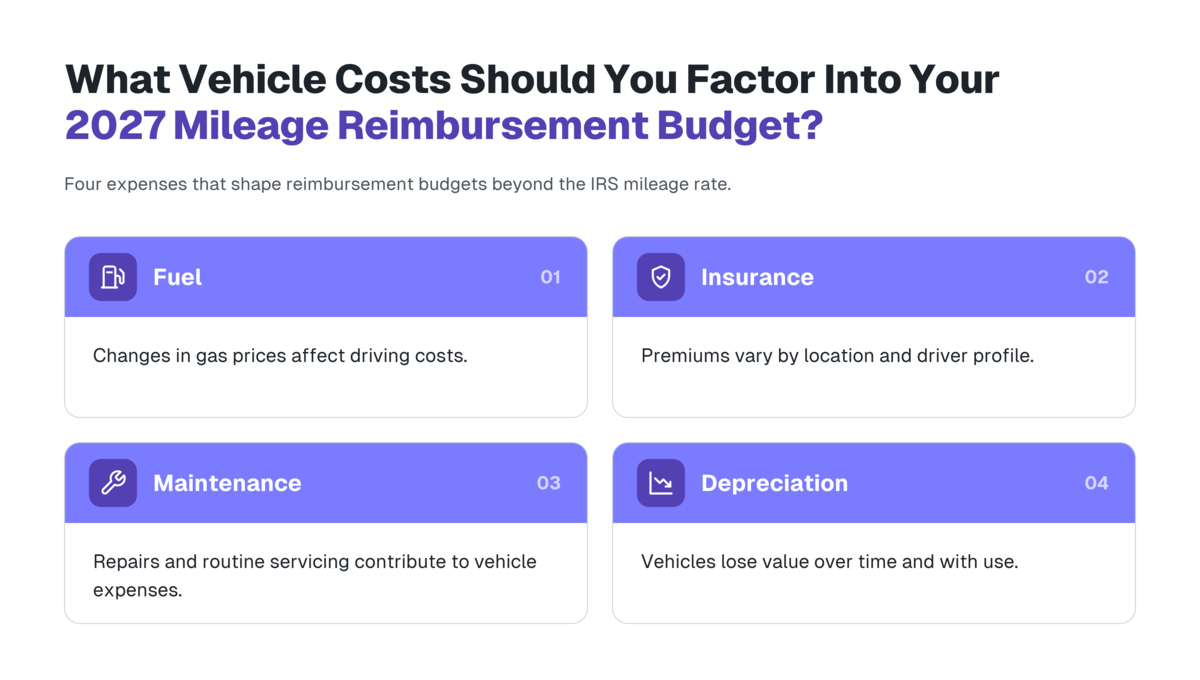
A CPM program generally rolls vehicle costs into one per-mile reimbursement rate.
FAVR separates fixed ownership expenses from variable operating expenses, allowing those cost components to be modeled separately.
TFCA can include fixed and mileage-based reimbursement while using documented business mileage to substantiate the applicable tax-free amount.
For Finance teams, the practical takeaway is simple: avoid assuming every vehicle cost will increase at the same rate in 2027.
A better budget identifies the variables most likely to affect your workforce and monitors them throughout the year.
Make Mileage Tracking Part of the Budget Conversation
Accurate budgeting depends on accurate mileage data.
Under IRS accountable plan rules, reimbursed expenses must have a business connection, employees must adequately account for qualifying expenses within a reasonable period, and excess reimbursements generally must be handled according to accountable plan requirements.
IRS Publication 463, Travel, Gift, and Car Expenses, provides guidance on mileage records, substantiation, car allowances, and accountable plans.
That makes mileage tracking more than an administrative task.
Reliable mileage data tells Finance how much employees are actually driving, how mileage differs across teams or territories, and whether the assumptions behind the annual budget are holding up.
It also gives Operations a clearer view into changes that could affect future reimbursement spending.
If mileage is recorded manually or stored across disconnected systems, forecasting can become harder. Finance may know how much was paid without having a clear picture of the activity behind that number.
Automated mileage tracking apps can make that process more consistent by capturing business trips as employees drive, reducing reliance on manual mileage logs.
When that mileage data flows into the reimbursement program, Finance and Operations have a more reliable view of driving activity and reimbursement costs throughout the year.
A structured, automated mileage capture process gives the budget a better foundation and makes it easier to compare actual driving against the assumptions used in the forecast.
Monitor Cost Per Mile Throughout 2027
Once the budget is approved, the planning process should continue. One useful metric is your organization's effective cost per business mile:
Total mileage reimbursement spend ÷ total reimbursed business miles = effective cost per mile
For example, if a company spends $1.4 million reimbursing 2 million business miles, its effective reimbursement cost is 70 cents per mile.
Tracking that number over time can help Finance understand whether changes in total spending are coming from mileage, reimbursement costs, workforce changes, or a combination of factors.
Cost per mile can be particularly useful when comparing periods with different headcounts.
Total spending might rise as the company grows while the economics of the reimbursement program remain relatively stable.
It can also make small improvements easier to quantify.
A 1-cent change in cost per mile equals $100 for a driver traveling 10,000 business miles annually. Across hundreds of employees, small per-mile differences can add up quickly.
A Practical 2027 Mileage Reimbursement Budget Checklist
Before finalizing your 2027 budget, Finance and Operations should be able to answer seven key questions:
- How many employees will drive personal vehicles for business in 2027?
- How many business miles do we expect them to drive?
- Which employees are best suited to CPM, FAVR, or TFCA?
- What reimbursement assumptions are we using until the 2027 IRS mileage rate is published?
- What happens to the budget if mileage or rates finish above forecast?
- Do we have reliable mileage data and documentation to support reimbursements?
- How often will we compare actual mileage and reimbursement spending with the forecast?
You do not need perfect answers to every 2027 variable during the initial budgeting process.
You need a model that makes the assumptions visible.
That way, when the IRS publishes a new mileage rate, headcount changes, or employees start driving more than expected, Finance can update the relevant input instead of rebuilding the budget from scratch.
Build a Mileage Reimbursement Budget You Can Explain
A useful 2027 mileage reimbursement budget connects spending to the way your employees actually drive.
Start with 2026 mileage and reimbursement data. Forecast changes in driver count and business mileage.
Model multiple rate scenarios while the 2027 IRS mileage rate remains unknown. Then look at whether CPM, FAVR, TFCA, or a mixed approach makes sense for different employee populations.
Most importantly, keep measuring once 2027 begins.
Mileage reimbursement is easier to manage when Finance and Operations can see the connection between employees, miles, rates, and total spend.
Cardata helps companies build and manage mileage reimbursement programs that are fair, compliant, and financially responsible.
If you're planning your 2027 mileage reimbursement budget, talk to Cardata about what the right program could look like for your drivers and your budget.
Talk to Cardata

.jpg)
.jpg)
