.jpg)
When should employees receive their Fixed and Variable Rate (FAVR) reimbursements?
For employers, the answer affects more than the payment calendar.
Timing can influence mileage reconciliation, employee changes, recordkeeping, and the amount of administrative work involved in running the program.
The IRS gives employers some flexibility. FAVR payments do not have to wait until every mile has already been driven.
Advances can be used when applicable accountable-plan requirements are followed, including substantiating business expenses and returning certain excess amounts within a reasonable period.
At the same time, many employers may find it practical to calculate payments after a reporting period closes, particularly when the reimbursement depends on actual business mileage.
Here is how the rules work and what employers should consider when setting a FAVR payment schedule.
How Do FAVR Reimbursements Work?
FAVR reimburses employees for the real, business-required costs of owning and operating a personal vehicle for work, using fixed and variable rates based on a standard vehicle and the employee's location.
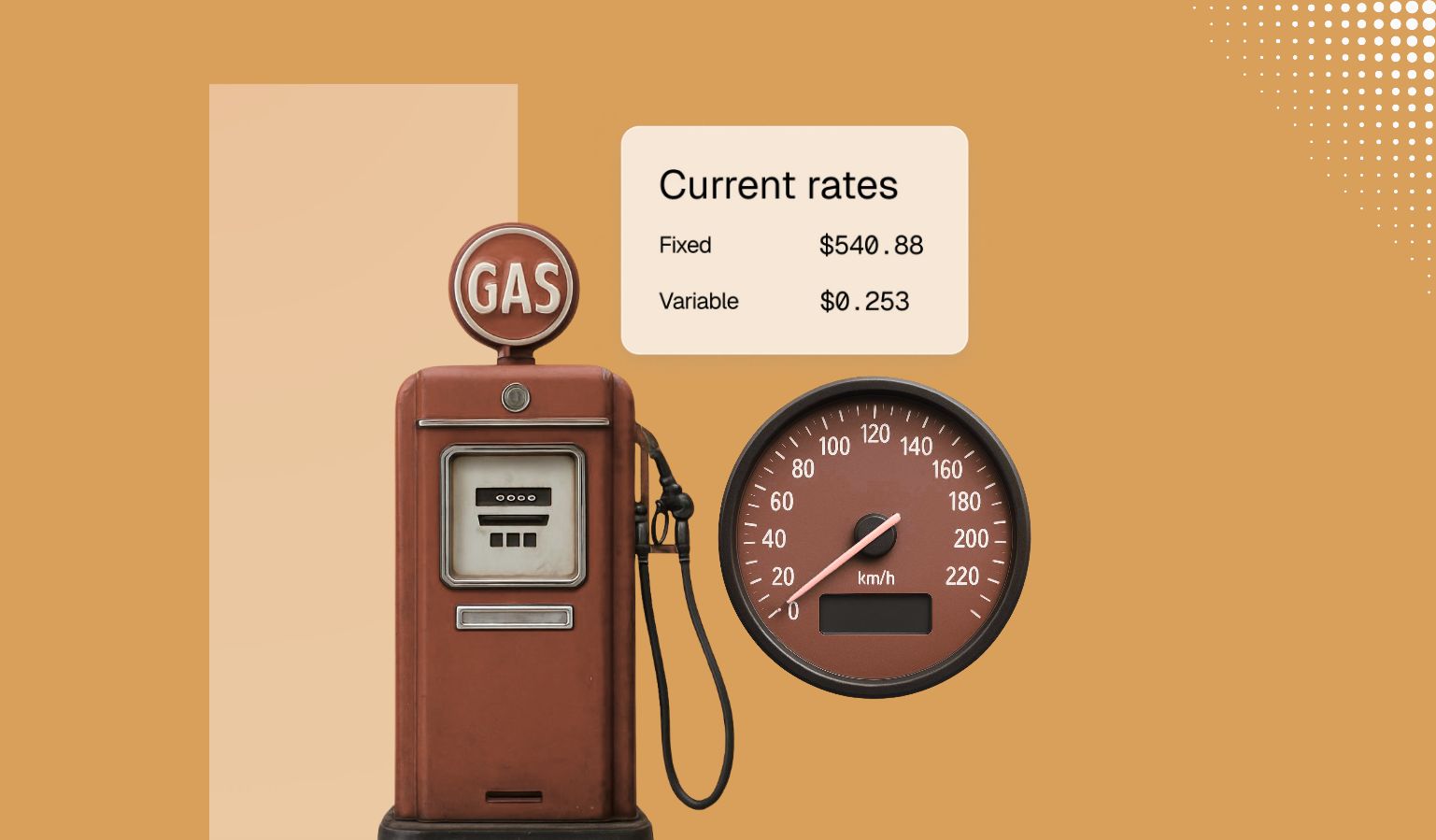
It divides those costs into two components: fixed and variable.
The fixed portion covers projected ownership costs such as depreciation or lease payments, insurance, registration and license fees, and applicable personal property taxes.
The variable portion covers projected operating costs such as fuel, oil, tires, maintenance, and repairs.
The variable portion is tied to the employee's substantiated business mileage, while the fixed portion is calculated based on projected fixed costs and the program's business-use assumptions.
This distinction between fixed and variable costs is important because the two pieces are calculated differently, even when they ultimately appear together as part of an employee's vehicle reimbursement.
How Often Do FAVR Reimbursements Have To Be Paid?
Under IRS FAVR rules, periodic fixed and variable payments must each be made at least quarterly.
Revenue Procedure 2019-46 states that the periodic fixed payment must be paid at least quarterly. It applies the same minimum frequency to periodic variable payments.
But, employers can opt to pay out FAVR reimbursements more frequently if they like.
A monthly reimbursement cycle, for example, satisfies the IRS requirement because payments are being made more often than quarterly.
That makes monthly reimbursement a program-design choice rather than a specific federal requirement.
The right schedule can depend on the employer's payment processes, workforce expectations, mileage reporting cycle, and applicable state requirements.
Can FAVR Reimbursements Be Paid In Advance?
Yes. FAVR and accountable-plan rules do not categorically prohibit advance payments.
IRS accountable-plan guidance allows employers to provide advances for qualifying employee business expenses.
Employees still need to adequately account for the expenses, and applicable excess amounts must be returned within a reasonable period.
The IRS provides safe-harbor timing guidelines for what generally counts as reasonable.
An advance received within 30 days of the expense, substantiation within 60 days after the expense is paid or incurred, and return of excess reimbursement within 120 days are generally treated as occurring within a reasonable period.
The individual facts and circumstances can also matter.
FAVR has additional rules for excess amounts.
For example, an employee must generally return the portion of a variable payment related to business miles that were not substantiated.
A fixed payment associated with a period when the employee was no longer covered by the FAVR allowance can also have to be returned.
That is why an advance payment process needs a reliable way to reconcile what was paid with what the employee ultimately substantiated.
What Does Paying FAVR Reimbursements In Arrears Mean?
Paying in arrears means issuing a payment after the period associated with that reimbursement has ended.
For example, an employee might record business mileage throughout January.
After January closes, the employer reviews the applicable mileage and program information, calculates the reimbursement, and issues payment.
(highlight)
The process might look like this:
Business driving → mileage substantiation → reimbursement calculation → payment
(highlight)
This approach can be useful because the employer has more information available before the reimbursement is finalized.
The employee's business mileage has already occurred. Changes in employment status can be accounted for.
Mileage records can be reviewed as part of the normal reimbursement workflow.
Why Might Employers Choose To Pay After The Reporting Period?
One practical reason is that business mileage changes.
Employees may cover new territories, visit more customers, take leave, change responsibilities, or simply drive fewer miles in one month than another.
For the variable portion of FAVR, those changes matter because payment is tied to substantiated business mileage.
Processing the variable reimbursement after the reporting period gives the employer the actual business-mileage information needed for that calculation.
It can also make reconciliation easier.
Mileage records, reimbursement calculations, and the final reimbursement can be connected within one workflow rather than comparing a forecast with actual driving later.
This is an operational advantage, not an IRS rule. Employers can structure payments differently as long as the program continues to meet the applicable requirements.
How Does Payment Timing Affect FAVR Tax Treatment?
FAVR reimbursement timing itself does not determine whether a FAVR reimbursement receives accountable-plan treatment.
The IRS focuses on the requirements behind the arrangement.
Under an accountable plan, expenses must have a business connection, the employee must adequately account for them within a reasonable period, and applicable excess reimbursements must be returned within a reasonable period.
Amounts that satisfy the rules generally are not treated as wages for federal income and employment tax purposes.
FAVR then adds its own requirements for compliance.
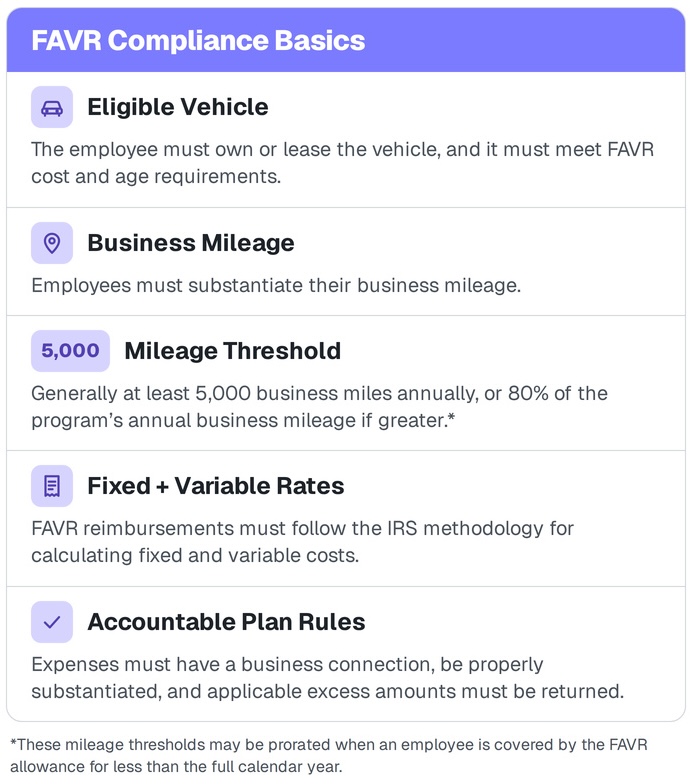
For example, an employee generally must substantiate at least 5,000 business miles during the calendar year or, if greater, 80% of the annual business mileage established for the FAVR allowance.
Those limits may be prorated when an employee participates for less than the full calendar year.
The key point is that FAVR reimbursement timing should support the broader compliance process. It does not replace it.
Can Paying After The Period Make Employee Offboarding Easier?
It can make reconciliation more straightforward.
When an employee leaves, the employer still needs to determine what reimbursement is associated with the employee's final period of business driving.
If reimbursements are based on completed reporting periods, administrators can work from the employee's final substantiated mileage and program information before processing the remaining reimbursement.
Advance reimbursements may require an additional reconciliation step.
If part of an advance relates to unsubstantiated business mileage or a period when the employee was no longer covered, FAVR rules address the return of those amounts.
Employers should also consider state-specific wage and expense-reimbursement requirements when determining final reimbursement timing.
Does Reimbursing In Arrears Improve Recordkeeping?
It can create a cleaner workflow, particularly for employers with large numbers of drivers.
A FAVR program involves more than sending a reimbursement.
Employers need visibility into business mileage, reimbursement rates, employee eligibility, vehicle requirements, and compliance information.
Processing mileage and reimbursement information before issuing the related reimbursement can make those records easier to connect.
Technology can also reduce some of the manual coordination involved.
Mileage capture, reimbursement calculation, approvals, and payments can be part of one process rather than separate spreadsheets or systems.
Should Every Employer Pay FAVR Reimbursements In Arrears?
There is no single FAVR reimbursement schedule that fits every organization.
A monthly, after-the-period cycle can be practical when employers want to incorporate reported business mileage before finalizing reimbursement.
Another employer may have a different reimbursement process that still complies with FAVR and accountable-plan requirements.
A useful way to evaluate the schedule is to look at the complete workflow.
- Can employees document business mileage consistently?
- Can the organization calculate fixed and variable reimbursements correctly?
- Can administrators identify employee or vehicle compliance changes?
- Can excess reimbursements be reconciled when necessary?
- Can Finance clearly trace reimbursements back to the records supporting them?
If the answer to those questions is clear, the reimbursement schedule is working as part of a well-managed program.
Make FAVR Reimbursements Easier To Manage
FAVR reimbursement timing is one part of running the program well.
Employers also need accurate mileage capture, properly calculated reimbursement rates, employee and vehicle compliance monitoring, clear reporting, and a dependable way to deliver reimbursements.
Cardata brings those pieces together through fully managed mileage reimbursement programs.
Mileage capture, FAVR calculations, compliance support, reporting, and direct-to-driver reimbursements work together so Finance and HR teams have a clearer view of the entire reimbursement process.
Whether you're building a new FAVR program or reviewing how an existing program handles payments, Cardata can help design and manage a program that fits your workforce and business needs.
Take a look at Cardata's FAVR program or talk to Cardata about simplifying mileage reimbursements for your drivers.
Talk to Cardata