

If you’ve ever run a car allowance program, you already know the tension.
You need to support the employees who are driving for work. You want something predictable for budgeting, and easy to administer. But of course, you want it to be fair. And you definitely don’t want to create tax headaches for payroll or your employees.
That’s where a Tax-Free Car Allowance (TFCA) comes in.
A TFCA is an IRS-compliant way to reimburse employees who use their personal vehicles for business. It follows the accountable plan rules laid out in IRS Publication 463. Because of that, you’ll sometimes hear it referred to as a “463 Program” or an “Accountable Allowance.”
At its core, a TFCA allows you to provide a fixed allowance, a cents-per-mile rate, or a combination of both, while keeping those payments tax-free, as long as they stay within a clearly defined IRS limit.
It’s simple in concept, but the details do matter.
Why Traditional Car Allowances Fall Short
Let’s start with the problem most companies are trying to solve: You have employees using their personal vehicles for work. You need a way to reimburse them that feels fair, is easy to manage, and doesn’t create compliance risk.
For many organizations, the default solution is a traditional car allowance, which is a flat monthly payment that is typically added to payroll. No mileage logs. No calculations. Just one fixed payment, set at the start of the year.
When you look up the average car allowance, most sources land in a similar range. In 2025, the average monthly car allowance rose to just over $700 per month (Source: Internal Cardata aggregated data 2025).
On the surface, that figure seems fair. But a fixed car allowance applies the same payment to every employee who drives for work, regardless of how much they drive, where they’re located, or what their actual vehicle costs look like.
In short: a flat car allowance doesn’t reflect actual business driving costs. And unless that allowance is structured under an IRS-compliant accountable plan, it’s treated as taxable income. That means it shows up on the employee’s W-2 as wages.
The employee pays federal, state, and FICA taxes on it, and you, the employer, pay payroll taxes on it too.
In most cases, roughly a third of the allowance disappears into taxes before it ever really helps cover vehicle costs. So while the allowance looks generous on paper, the actual take-home value is lower for the employee, and the true cost is higher for the employer.
A TFCA is designed to fix this gap through a simple reimbursement structure.
What Makes a TFCA “Tax-Free”?
A TFCA works because it follows the IRS rules for accountable plans. It is not a workaround or a loophole. It is simply a structured way to reimburse employees for real business driving, without turning that reimbursement into taxable wages.
Under IRS Publication 463, reimbursements can be excluded from taxable income if they meet specific conditions. To qualify under an accountable plan, three conditions must be met:
- The payment must be for legitimate business expenses, which in this case, would be for work-related driving requirementsThe employee must substantiate the driving expense (by documenting business mileage).
- Any excess above the IRS limit must be treated as taxable income.
That final condition is what makes the whole thing hold together. A TFCA runs within a clear boundary, often called the “Tax Test” or the “Safe Harbour Method”. Think of this as a cap that’s based on the IRS standard mileage rate and the actual miles an employee drives for work.
As long as payments stay at or below that cap, they’re tax-free. If they go over, only the excess amount is treated as income.
That distinction matters. It means you’re not turning the entire reimbursement into taxable pay just because you went a little higher. Only the overage is taxed, ensuring that as long as employees are driving for work, they’re offsetting real business expenses and minimizing unnecessary tax exposure.
Pay people for the business miles they actually drive, stay within IRS limits, and you protect the tax-free portion while keeping things simple on both sides.
The Tax Test Explained
The Tax Test is what makes a TFCA actually work. It’s not some complex formula buried in the tax code.
In reality, it’s a simple comparison that keeps reimbursements fair and within IRS limits, which is part of what makes the program practical to run.
Here’s how it works.
First, employees track their business mileage. That means recording the date, where they went, why they went, and how many miles they drove.
Years ago, that meant paper logs stuffed in a glove box or spreadsheets filled out at the end of the month. Today, most companies use mileage tracking apps. Today’s apps have mileage tracking features that automate compliance, eliminate manual logging, and create clean, defensible records without the hassle.
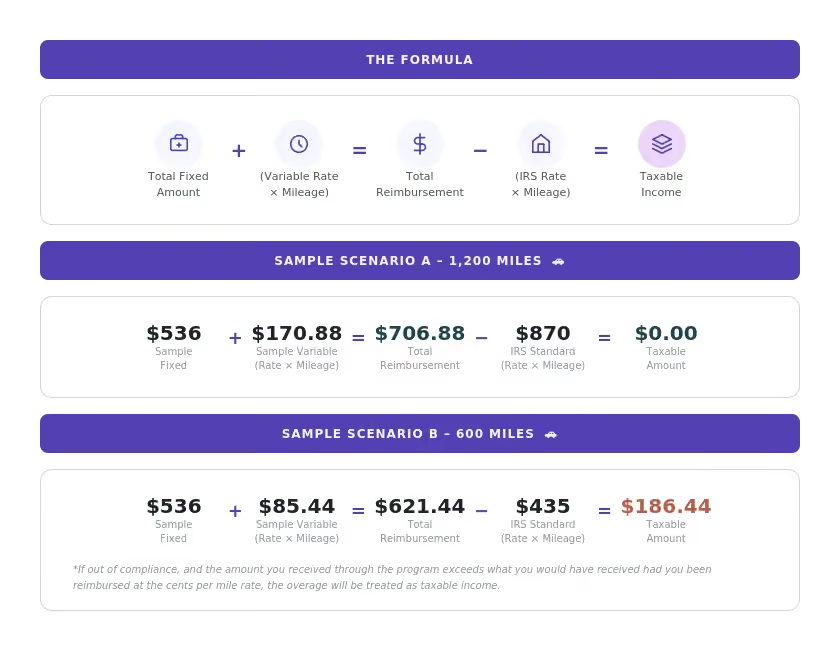
Next, you calculate the tax-free limit. This is done by multiplying the employee’s documented business miles by the IRS standard mileage rate for that year.
That IRS rate is meant to reflect the average cost of driving across the country. It bundles together fuel, maintenance, depreciation, insurance, and other operating costs into one national benchmark.
For programs like TFCA and Cents-Per-Mile (CPM), it acts as the ceiling for what can be reimbursed tax-free.
It also serves as a safeguard within Fixed and Variable Rate (FAVR) programs. If a driver falls out of FAVR compliance, the IRS standard mileage rate becomes the benchmark for a tax test, and any reimbursement above that threshold may be treated as taxable income.
Then you compare what the employee was actually paid under the TFCA to that IRS-based limit.
If the total reimbursement is at or below the IRS amount, everything stays tax-free. If it goes over, the difference, often called the delta, is treated as taxable income.
That’s really all there is to it. There are no minimum mileage thresholds to hit, no vehicle price rules to manage, and no required number of employees who drive to qualify. Just one clear test that keeps the program grounded in actual business miles and aligned with IRS guidelines.
6 Key Benefits of a TFCA Program
A TFCA keeps things simple like a traditional car allowance, but removes most of the tax waste and compliance risk that usually comes with it.
Here’s why that matters for both employees, and employers.
1. More Money Stays in Employees’ Pockets
With a traditional flat car allowance, a big chunk of every dollar can disappear to federal, state, and payroll taxes. That means employees never actually receive the full value of what you intended to pay them.
A TFCA changes that. As long as payments stay within the IRS limit and mileage is documented properly, the reimbursement is tax-free. Employees keep more of what they earn, and employers avoid unnecessary payroll tax on those dollars. It’s the same budget, but it goes further.
2. Lower Payroll Tax for Employers
When an allowance is treated as wages, your company pays payroll tax on top of the amount issued. That adds up quickly across a team of employees who are driving for work.
Because a properly structured TFCA falls under an accountable plan, those reimbursements are not treated as income. That means no extra employer-side payroll tax on the tax-free portion. Over time, that can translate into meaningful savings, especially for growing teams.
3. Simple to Understand and Manage
One reason flat allowances became popular in the first place is that they’re straight-forward. A TFCA keeps that simplicity, but adds structure behind the scenes.
Employees who drive for work track their business miles. The company runs the Tax Test. As long as payments fall within the IRS limit, everything stays clean. There are no complex vehicle cost calculations, no required driver minimums, and no detailed vehicle class rules like you see in more rigid programs.
For many companies, it’s a practical optimization without becoming overly complicated.
4. Fairer Than a Flat Allowance
With a traditional allowance, someone driving 300 miles a month gets paid the same as someone driving 3,000. That can create quiet frustration over time.
A TFCA ties reimbursement to actual business miles. Higher-mileage drivers are supported appropriately, while lower-mileage drivers aren’t overpaid. It feels more balanced because it reflects real driving activity instead of a one-size-fits-all estimation.
5. Clear Compliance Guardrails
The Tax Test creates a clear boundary. There’s a defined ceiling based on the IRS standard mileage rate and documented business miles. If payments stay within that boundary, they’re tax-free. If they exceed it, the difference is treated as income.
That clarity reduces gray areas. Finance leaders get a defensible framework. HR teams have a policy they can explain with confidence. And employees understand how their reimbursement is calculated.
6. Flexible for Growing Teams
A TFCA works well for companies with smaller driver populations, mixed driving patterns, or roles that don’t meet the requirements of other tax-free mileage options, like Fixed and Variable Rate (FAVR) reimbursement. There’s no minimum driver count and no minimum annual mileage threshold to qualify.
That flexibility makes it a good fit for organizations that want tax efficiency, but aren’t ready for a more complex reimbursement structure.
How TFCA Compares to Other Reimbursement Programs
To really understand TFCA, it helps to compare it to the two most common alternatives.
Cents-Per-Mile (CPM) is the simplest alternative model. You reimburse employees a set amount per business mile.
As long as that rate does not exceed the IRS standard mileage rate, it is automatically tax-free. This works well for occasional employees who log fewer than 5,000 business miles per year.
Fixed and Variable Rate (FAVR) is more detailed. It uses region-specific cost data to calculate fixed and variable expenses. FAVR can reimburse above the IRS standard rate tax-free, but only if strict IRS requirements are met.
For example, you need at least five employees who drive for work. Each must drive 5,000 business miles annually. Vehicle cost limits and insurance compliance rules apply.
TFCA strikes a nice balance.
It gives you more predictability than pure CPM, and it has far fewer structural requirements than FAVR. It relies on one clear compliance mechanism: the Tax Test.
For organizations with moderate-mileage drivers who want stability without heavy administration, this balance is appealing.
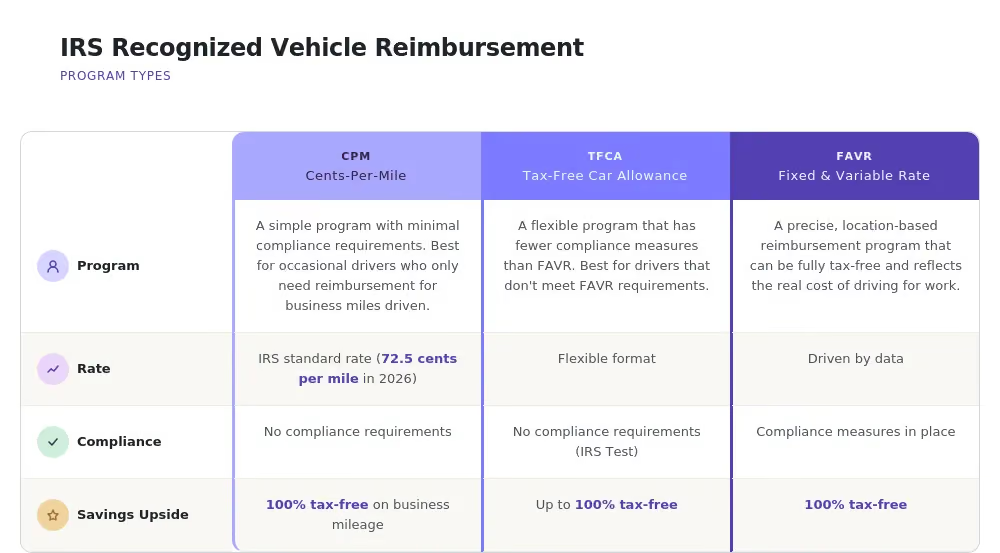
Comparison table of IRS-recognized vehicle reimbursement programs: CPM, TFCA, and FAVR. CPM is simple with minimal compliance, TFCA offers flexibility with fewer compliance measures, and FAVR provides precise, location-based reimbursements. The chart compares program type, rate structure, compliance requirements, and tax-free savings potential.
When Is a Tax-Free Car Allowance the Right Fit?
A TFCA tends to work best when your employees who drive for work fall somewhere in the middle, like executives and managers who drive consistently, but not at extreme mileage levels.
You want a predictable monthly budget number. You don’t meet FAVR’s minimum driver or mileage thresholds, or you don’t want the added structure.
You’re comfortable reimbursing up to the IRS standard rate, but not beyond it. And you want to eliminate the tax waste that comes with flat, taxable allowances.
In these cases, TFCA offers a practical solution. It keeps things compliant, protects drivers from unnecessary taxation on legitimate business expenses, and it gives finance teams a clear rule to manage against.
The Operational Reality: Keeping It Clean & Compliant
A TFCA is simple by design, but simple does not mean casual. The structure only works when the documentation behind it is solid.
This is where many companies run into trouble. Manual systems create friction and spreadsheets introduce small errors that compound over time.
Employees who drive for work might forget to log trips until the end of the month. Payroll teams are left reconciling adjustments and trying to untangle what should and should not be taxed.
That is why technology now plays a larger role in reimbursement programs than it did even a few years ago.
Modern mileage reimbursement platforms now combine mobile mileage tracking, cloud-based program management, automated reimbursement calculations, and built-in compliance checks into one connected system.
Instead of relying on your employees to remember trips at the end of the month, GPS-based apps capture mileage in real time. Instead of payroll teams manually applying the Tax Test, reimbursement engines automatically compare payments to the IRS standard mileage rate and flag any overages.
Insurance verification and policy compliance can also be monitored within the same system, reducing blind spots.
How to Get Started
For companies with field sales reps, service techs, or territory managers using their own vehicles, TFCA hits a practical middle ground.
It gives finance a predictable structure, gives employees who drive a fair reimbursement tied to real miles, and keeps HR and payroll out of unnecessary tax trouble. Compared to a flat, taxable car allowance, more of the money actually goes where it’s supposed to go.
The real difference comes down to how it’s managed. Clean mileage tracking, consistent documentation, and a clear process for running the Tax Test are what keep everything running smoothly.
That’s where a partner like Cardata can help. Instead of piecing it together with spreadsheets and manual checks, Cardata builds and manages tax-free reimbursement programs from end to end. Mileage tracking, automated Tax Test calculations, compliance monitoring, and direct payments are all handled in one connected system.
If you’re thinking about moving away from a taxable car allowance, or just want to see if TFCA makes sense for your team, it’s worth having a conversation. Cardata can walk you through what the switch would look like and whether it would actually save you money while making things easier to manage.
See If TFCA Makes Sense for Your Team


.avif)
.jpg)
