

Mileage reimbursement seems simple enough. Employees drive for work, track their mileage, and get reimbursed.
But there's more to managing a vehicle reimbursement program than making payments.
The decisions companies make about reimbursement affect taxes, budgets, compliance, and how fairly employees are paid for using their personal vehicles at work.
And some of the most expensive mistakes aren't immediately obvious.
Maybe your company has been paying the same car allowance for years. Maybe your mileage tracking process still involves spreadsheets. Or perhaps reimbursement rates haven't been reviewed since the program was introduced.
These approaches may have made sense when they were first implemented. But as your business changes, it's worth checking whether they're still the right fit.
As we head toward 2027, now is a good time to take a closer look at your reimbursement strategy.
Here are five common mileage reimbursement mistakes employers should watch for, along with practical considerations around how to avoid them.
What Are the Most Common Mileage Reimbursement Mistakes?
Some of the most common mileage reimbursement mistakes include maintaining outdated programs, paying employees without accounting for different driving requirements, overlooking tax implications, relying on inaccurate mileage records, and failing to review reimbursement rates.
These issues can affect reimbursement costs, employee satisfaction, and compliance with IRS requirements.
For employers managing mobile teams, understanding where these mistakes happen is the first step toward building a reimbursement program that's fair, cost-efficient, and easier to manage.
Mistake #1: Keeping the Same Reimbursement Program Because It's Familiar
There's a reason traditional car allowances and company vehicles remain common. They're familiar, relatively easy to understand, and can work well for certain businesses.
A monthly car allowance gives employees a predictable payment. Company vehicles can make sense when employees need specialized equipment or branded vehicles.
But businesses change.
A company that started with 20 field employees might now have 200 working across several states. Sales territories expand, job responsibilities evolve, and employees' driving requirements change.
A program designed around your workforce five years ago may no longer reflect how employees drive today.
The same applies to mileage reimbursement programs.
For example, a Cents-Per-Mile (CPM) program uses a standardized per-mile rate to reimburse employees for the real, business-required cost of using a personal vehicle for work.
It's often a practical option for employees who drive occasionally.
A Fixed and Variable Rate (FAVR) program reimburses the real, business-required cost of owning and operating a personal vehicle for work through separate fixed and variable payments. It can be particularly useful for frequent drivers whose vehicle costs vary by location.
Both can provide tax-free reimbursements when applicable IRS requirements are met.
The right approach depends on your workforce, business needs, and reimbursement goals.
(highlight)
What to consider for 2027: When was the last time your organization evaluated whether its reimbursement method still matches employee driving requirements?
A regular program review can help identify opportunities to improve fairness, cost control, and administration.
(highlight)
Mistake #2: Assuming Equal Reimbursements Mean Fair Reimbursements
Imagine two employees who receive the same $700 monthly car allowance.
One drives 500 business miles per month in a small territory. The other drives 1,500 miles visiting customers across a much larger region.
Both receive identical payments, even though their driving requirements are very different.
And mileage is only part of the equation.
Fuel prices, insurance premiums, maintenance expenses, and vehicle ownership costs can vary depending on where employees live and work.
As a result, a reimbursement amount that works well for one driver may not adequately cover another employee's business driving expenses.
Over time, these differences can affect company spending and employee perceptions of fairness.
For employers, the goal is to use a consistent reimbursement methodology that reflects the real, business-required costs employees take on when driving for work.
Some organizations benefit from using different reimbursement methods for different driver groups. Others may find value in programs that account for location-specific vehicle costs and business mileage.
The important thing is understanding how reimbursement amounts compare with employees' actual driving requirements.
(highlight)
What to consider for 2027: Are employees with significantly different driving patterns receiving reimbursements that reflect those differences?
Reviewing mileage, geography, and reimbursement data can help identify potential gaps in your current approach.
(highlight)
Mistake #3: Overlooking the Tax Implications of Mileage Reimbursement
The amount your company reimburses employees is only one part of the total reimbursement cost. How those payments are taxed matters, too.
Traditional car allowances that don't meet IRS accountable plan requirements are generally treated as taxable wages.
Employees may owe federal income and payroll taxes on those payments, while employers are also responsible for applicable payroll taxes.
For example, a company paying an employee a $600 monthly taxable car allowance provides $7,200 annually before taxes.
If the full amount is subject to the standard 7.65% employer Social Security and Medicare tax rate, the employer would pay approximately $551 in additional annual payroll taxes. Actual tax obligations depend on applicable wage limits and other circumstances.
Across a larger workforce, these costs can add up.
Fortunately, the IRS provides a framework for reimbursing qualifying business expenses without treating those payments as taxable wages.
Under IRS Publication 463, Travel, Gift, and Car Expenses, an accountable plan generally must meet three requirements:
- Expenses must have a qualifying business connection.
- Employees must adequately substantiate expenses within a reasonable period.
- Employees must return reimbursements exceeding substantiated expenses within a reasonable period.
When these requirements are satisfied, qualifying reimbursements generally aren't included in employees' taxable wages.
Certain reimbursement methods, including FAVR, have additional rules that employers must follow.
The distinction matters because tax-efficient reimbursement programs can help employers direct more of their spending toward legitimate business driving expenses.
(highlight)
What to consider for 2027: Do you know the total cost of your reimbursement program, including applicable payroll taxes?
Understanding how your current payments are structured and taxed can help identify opportunities to improve efficiency while maintaining compliance.
(highlight)
Mistake #4: Assuming Mileage Tracking Automatically Means Accurate Mileage
Accurate mileage tracking is essential for reimbursing employees fairly and maintaining reliable business expense records.
But capturing a trip doesn't automatically mean that trip qualifies for tax-free reimbursement.
Consider an employee who drives from home to their regular office, visits several customers throughout the day, and makes a personal stop before returning home.
Some of those miles may qualify as business travel.
Others are personal or commuting miles that generally shouldn't be included in tax-free business mileage reimbursement.
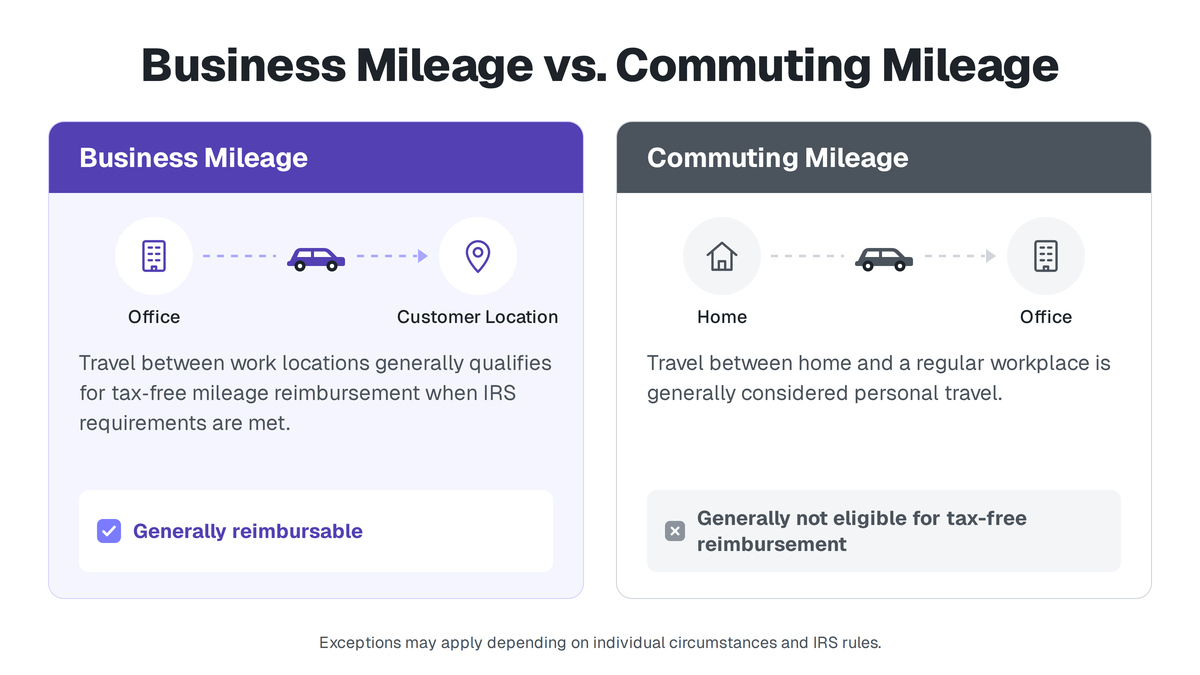
According to IRS Publication 463, ordinary commuting between home and a regular workplace is generally considered personal travel.
Travel between business locations can qualify as business transportation, subject to applicable rules and exceptions.
For companies with employees driving frequently, separating these trips accurately can become time-consuming.
Manual mileage logs may require employees to reconstruct trips at the end of the week or month, increasing the possibility of missing information or incorrect classifications.
Automated mileage tracking apps can help reduce this administrative work. Some systems also support configurable commute deductions that apply company policies to recorded mileage.
For example, employers may use preset commute distances or location-based rules to help account for ordinary commuting.
However, automation still requires appropriate oversight. Employees remain responsible for correctly identifying personal trips, and employers need policies that reflect applicable IRS rules.
Accurate tracking also depends on maintaining appropriate documentation, including trip dates, destinations, business purposes, and distances.
(highlight)
What to consider for 2027: How confident are you that your mileage records accurately distinguish qualifying business travel from personal driving?
Reviewing how trips are captured, classified, and approved can help employers identify opportunities to improve accuracy and reduce manual work.
(highlight)
Mistake #5: Setting Reimbursement Rates and Forgetting About Them
The cost of driving changes over time.
Fuel prices fluctuate. Insurance premiums change. Vehicle depreciation, maintenance, and repair costs can all affect what employees spend to drive for work.
That's why reimbursement rates deserve regular attention.
According to Cardata's 2026 Mileage Reimbursement Benchmark Report, average monthly reimbursements increased 12.87% year over year, while average business mileage rose 6.74%.
These findings from Cardata's proprietary benchmark analysis illustrate how reimbursement spending and driving activity can change as business needs and market conditions evolve.

The IRS also adjusted its optional business standard mileage rate during 2026.
Following an increase in fuel prices, the IRS raised the business rate from 72.5 cents per mile to 76 cents per mile, effective July 1, 2026, as documented in IRS Announcement 2026-11.
For employers using the IRS standard mileage rate, this required attention to when business travel occurred and which rate applied.
For organizations using other reimbursement methods, it was another reminder that vehicle costs can change during the year.
As companies prepare for 2027, they should monitor the IRS standard mileage rate announcements and review the assumptions behind their reimbursement programs.
Depending on the method, that may include updated fuel prices, insurance costs, vehicle ownership expenses, business mileage, and geographic cost differences.
(highlight)
What to consider for 2027: When were your reimbursement rates last reviewed, and what data was used to set them?
Regular benchmarking and program reviews can help ensure reimbursements remain aligned with current costs and employee driving requirements.
(highlight)
How Can Employers Avoid Mileage Reimbursement Mistakes in 2027?
Avoiding common reimbursement mistakes starts with understanding how your current program is performing.
A useful first step is to review your reimbursement policies, employee driving patterns, and administrative processes.
Ask yourself:
- Does our reimbursement method reflect how employees actually drive today?
- Are payments aligned with differences in business mileage and geography?
- Do we understand the tax treatment and total cost of our program?
- Are business mileage records accurate and properly documented?
- Do we regularly review reimbursement rates and program performance?
These questions can help Finance, HR, and Operations teams identify where the current program is working well and where improvements may be needed.
It's also worth considering the employee experience and the administrative effort required to keep the program running.
A successful reimbursement program should provide fair and accurate payments, support compliance, and give administrators clear visibility into costs and performance.
For many organizations, that means treating mileage reimbursement as an ongoing business process that evolves alongside the workforce.
Get the Full Guide: 10 Mileage Reimbursement Mistakes and How to Avoid Them
These five mistakes are a starting point. Other reimbursement decisions can also affect your organization's costs, compliance, and employee experience.
Our ebook, What You Don't Know Is Costing You: Mileage Reimbursement Mistakes and How to Avoid Them, explores ten common mistakes employers make and how to address them.
Inside, you'll find real-world examples of reimbursement challenges, practical guidance for evaluating different approaches, and a self-assessment checklist to help identify opportunities for improvement.
You'll also get questions to ask your current reimbursement provider and considerations for keeping your program effective as your business changes.
If you're preparing your reimbursement strategy for 2027, the guide can help you take a more informed look at what's working and what may need attention.



.jpg)
