

Thinking about switching mileage reimbursement providers? It's easier than you might think.
You don't need to figure everything out on your own. With the right provider, you can get help with everything from setting up your new program to getting your employees started.
And the best part? Your team can keep focusing on their day-to-day work while your new provider helps handle the switch.
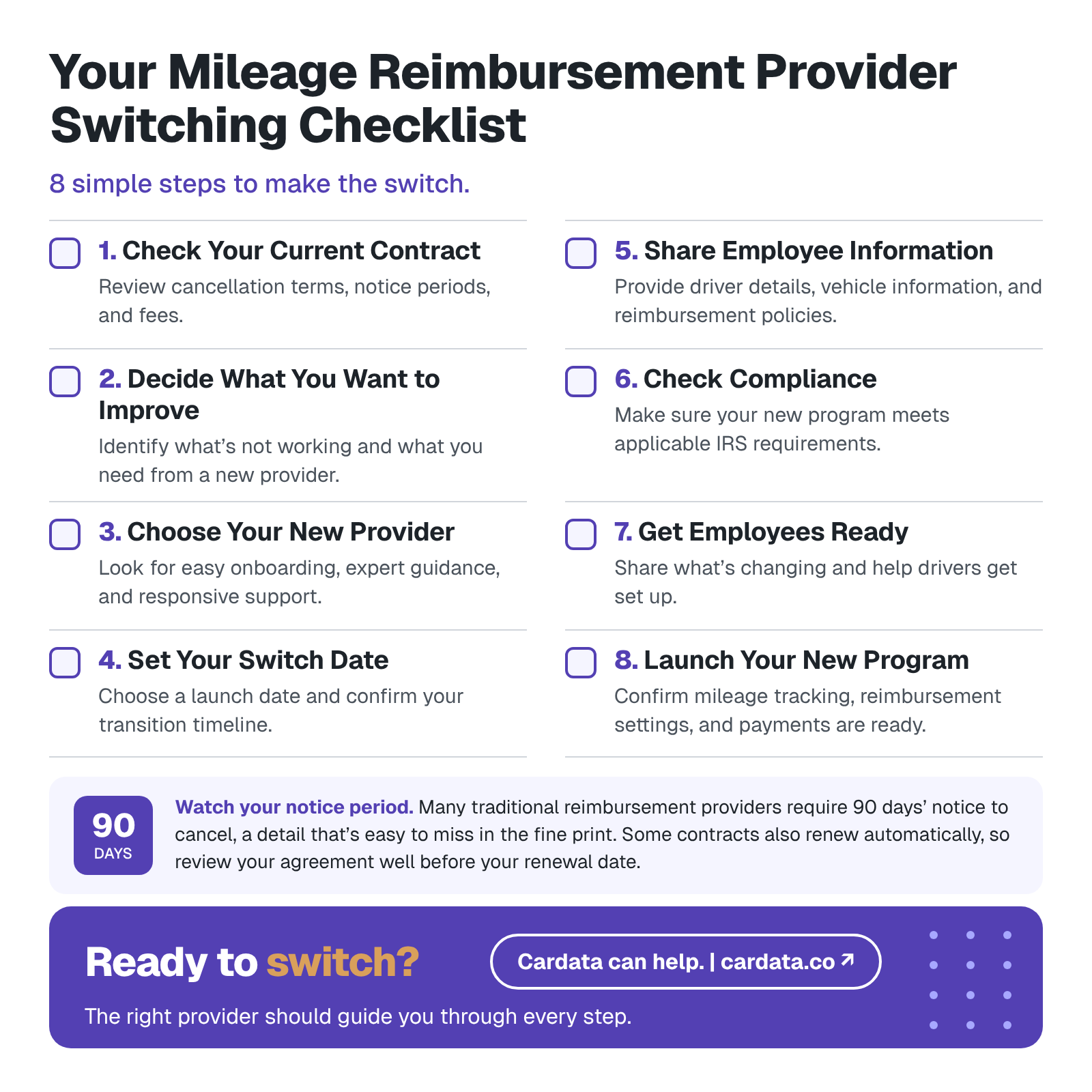
Here's how to switch mileage reimbursement providers in eight simple steps.
Why Switch Mileage Reimbursement Providers?
Your mileage reimbursement program should make managing reimbursements easier for your business.
It should be simple for employees to track their mileage, easy for your team to manage reimbursements, and straightforward to get help when you need it.
If your current provider isn't making those things easy, it might be time for a change.
Some common reasons companies switch include:
- Better support: Get answers when you need them, without the back-and-forth and long wait times.
- Less admin work: Spend less time managing reports, payments, and employee questions.
- Easier mileage tracking: Give drivers a simple way to track their business trips.
- Clearer, customized reporting: See where your reimbursement dollars are going and whether your program is meeting your business goals.
- Greater savings and accuracy: Reduce unnecessary reimbursement costs with more accurate mileage tracking and program assignments.
- Continuous program optimization: Work with a partner who regularly reviews and adjusts your program as your business needs change, rather than setting it up once and leaving it untouched.
- A better fit: Get a program that works for your employees and your business, with the flexibility to evolve as your organization grows.
Switching providers gives you a chance to make things simpler for everyone. And with the right support, making that change can be surprisingly easy.
A good provider will walk you through the process, explain what they need, and help you get everything ready.
Here's what to expect when switching mileage reimbursement providers in 8 easy steps.
Step 1: Check Your Current Contract
First, take a quick look at your current mileage reimbursement provider's contract.
You'll want to check:
- When your contract ends
- How much notice you need to give
- Whether there are any cancellation fees
That's it. These details will help you figure out when you can switch.
You may be able to give notice before you've made the decision to switch to a new provider. This will help you in ensuring you never miss an automatic renewal.
Your legal or procurement team can help you confirm the details.
(highlight)
Quick tip: Many traditional reimbursement providers require 90 days' notice to cancel, a detail that's easy to miss in the fine print. Some contracts also renew automatically, so review your agreement well before your renewal date. Knowing your cancellation deadline gives you time to explore other options without getting locked into another term.
(highlight)
Step 2: Decide What You Want to Improve
Now, think about what you'd like your next provider to do better.
There's no need for a long review, just start with what's frustrating your team today.
Maybe you're spending too much time pulling reports. Maybe employees find mileage tracking confusing or inaccurate.
Maybe you're worried that mileage overpayments are driving up your company’s costs. Or maybe you just want a support team that's easier to reach.
You can also think about whether your current reimbursement program still makes sense for your business.
Common options include Fixed and Variable Rate (FAVR), Cents-Per-Mile (CPM), and Tax-Free Car Allowances (TFCA).
These programs use different methods to reimburse employees for the real, business-required costs of owning and operating personal vehicles for work.
Not sure which reimbursement program is right for your business? That's something your new provider should help you figure out.
The goal is simple: Understand what's working, what isn't, and what you'd like to improve. Your new provider can help with the rest.
Want to see how your current program measures up? Take our free vehicle reimbursement program assessment to get your score and identify areas for improvement before making the switch.
Step 3: Find a Provider That Makes Switching Easy
This is one of the most important steps.
You'll want to look for a mileage reimbursement provider that helps you do more than track miles and process payments.
The right provider should help you build a better vehicle reimbursement program.
That means making sure employees are on the right reimbursement plans, costs are under control, and your program supports your business goals.
A good provider should also take the heavy lifting off your plate.
That includes planning the transition, setting up your new program, onboarding employees, and making sure everything runs smoothly.
You shouldn't have to figure out every detail yourself. When comparing providers, ask a few simple questions:
- Transition support: Will you help us plan the switch and manage the timeline?
- Program optimization: Will you evaluate our current program and help us choose the right reimbursement methods for our employees?
- Cost management: Will you help us identify overpayments, improve reimbursement accuracy, and control vehicle spending?
- Driver safety and compliance: Will you help us manage IRS compliance, insurance requirements, and employee driving risk?
- Reporting and visibility: Will we have access to clear reporting on reimbursement costs and program performance?
- Employee onboarding: Will you help our drivers understand their program and get started with the new system?
- Ongoing support: Will we have a dedicated team that responds quickly when we need help?
The best providers offer more than software. They help you manage and improve your entire vehicle reimbursement program, from controlling costs and managing risk to supporting your employees.
And that support shouldn't stop once your new program launches.
Look for a provider that will continue monitoring your program, answering employee questions, and helping you make adjustments as your business needs change.
Whether you're dealing with a reimbursement question, a compliance concern, or an employee who needs help, you should be able to get answers quickly without waiting days for a response.
Step 4: Pick a Date to Switch
Once you've chosen your new provider, you'll need to decide when to go-live with the change.
This is usually pretty straightforward. For example, if your current contract ends on June 30, you’ll likely want your new provider’s services to go-live on July 1.This ensures continuity for your employees.
Your new provider can help you work backward from that date and figure out what needs to happen before launch.
They will also help you plan the workback schedule for employee training and setup, program detail finalization, any policy updates, and executing your first reimbursement cycle.
You'll just need someone from your team, usually HR, Finance, or Operations, to stay in touch with your new provider.
Plan to go live with your new provider as soon as your current contract ends, so employees can start tracking mileage on the new platform right away and no business miles get missed.
With the right provider, planning the switch date should be pretty straightforward. They'll help you set a timeline and walk you through each step.
Step 5: Share Your Employee Information
Next, your new provider will need some basic information to set up your program.
This usually includes things like:
- Employee names and contact information
- Work locations
- Vehicle details
- Current reimbursement policies
Depending on your program, you may also be asked to share previous mileage or payment records for tax reporting and compliance purposes.
Don't worry about figuring out exactly what's needed, because your new provider should give you a clear list and help you prepare everything.
It’s also a good idea to make sure any outstanding reimbursements are taken care of and that past records are saved internally.
Once you've shared the information, your provider can help take care of the user setup, employee training, and ensuring all your employees are ready to start using the new system.
Step 6: Make Sure Your Program Stays Compliant
Mileage reimbursement compliance can sound complicated, but it doesn't have to make switching difficult.
Your new provider should help you understand what needs to stay in place so your reimbursement program continues to follow the applicable IRS rules.
For most programs, the basics include:
- Keeping accurate records of business mileage
- Making sure reimbursements are tied to business driving
- Following the rules for your reimbursement method
Under IRS Publication 463, Travel, Gift, and Car Expenses, tax-free reimbursements under an accountable plan generally require a business connection, proper expense records, and the return of excess payments within a reasonable period.
Some programs, like FAVR, have additional requirements.
The good news is that you don't need to become a tax expert to switch providers. That's what your provider is there for.
They should know the rules, help you keep employee records in order, and make sure your program stays compliant throughout the transition.
With the right provider handling the details, that's one less thing for you to worry about.
Step 7: Get Your Employees Excited About the Switch
Switching providers should be a positive change for your employees, too!
Whether it's easier mileage tracking, a better app, or faster access to support, make sure your drivers understand how the new program will make their lives easier.
When you're ready to announce the switch, keep things simple.
Your drivers mainly need to know three things:
- When the new program starts
- How to track their mileage
- Where to go if they need help
If reimbursement amounts, payment dates, or required documents are changing, let employees know that too.
Your new provider should help with driver communications, onboarding, training, and answering any questions as they come up.
A good provider should take care of employee onboarding for you.
That means helping drivers understand their new reimbursement program, meet compliance requirements, set up their mileage tracking app, and get answers to any questions along the way.
With a dedicated support team handling everything from setup to ongoing questions, your employees can feel confident and excited about the change, without adding more work for your HR team.
Step 8: Start Using Your New Program
That's it. You're almost there!
Before launch, your new provider should help you run through a few final checks to make sure everything is ready to go.
That includes confirming:
- Employees are set up: Everyone has access to the new system and knows how to use it.
- Mileage tracking is working: Drivers can record and submit their business trips.
- Reimbursement settings are correct: Rates, employee details, program compliance and reimbursement eligibility rules are set up properly.
- Payments are ready to go: Reimbursement schedules and payment information are confirmed.
- Support is available: Employees know who to contact if they have questions.
You'll also want to make sure there's a clear cutoff date for the old system, so employees know exactly when to start tracking mileage with the new provider.
Any outstanding mileage submissions or reimbursements should be accounted for, too.
Once everything is ready, it's time to go live!
Your employees can start tracking their business mileage, and your new provider should be there to help with any questions that come up during the first few weeks.
And just like that, you've made the switch. With the right provider guiding the process, getting started with your new program should be simple.
What Happens After You Switch?
Once your new program is running, there shouldn't be much for your team to worry about.
During the first few reimbursement cycles, it's a good idea to check that mileage is being tracked correctly, payments are going out as expected, and your team has access to the reports it needs.
Your provider should be there to answer questions and help make adjustments if needed.
Over time, they should also help you keep your program running smoothly, while ensuring it’s aligned with your business goals and how your employees actually drive.
That means helping you stay on top of compliance, understand your reimbursement costs, and make improvements when needed.
The goal of switching is to make your mileage reimbursement program easier to manage and ensure it works for your business, with employees on the right programs, fair and accurate reimbursements, and better alignment with your company's goals.
With the right provider, that's exactly what you should expect.
Ready to Make the Switch? Cardata Can Help
Switching mileage reimbursement providers doesn't have to be complicated, especially when you have the right team helping you.
At Cardata, we help businesses make the move to a new mileage reimbursement program, from planning the transition and setting up employees to managing compliance and ongoing support.
Our team handles the details so yours can focus on running the business. And once you're up and running, we're here to help keep things simple.
Thinking about switching providers? Get in touch with Cardata to learn what the process could look like for your business.
Talk to Cardata