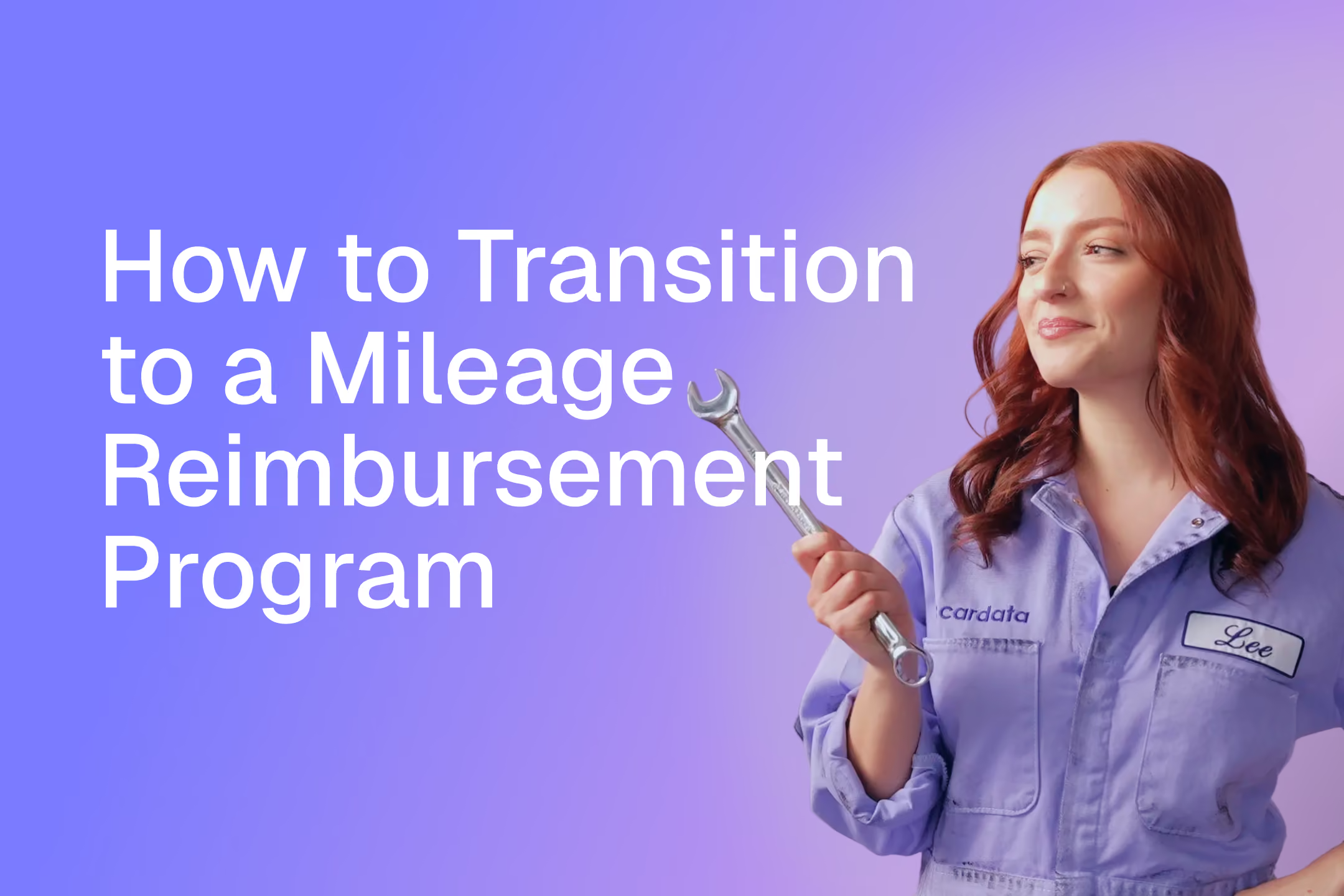
Hi! I’m Lee, and I’m your mileage mechanic from Cardata.
I’m here to help you understand your mileage reimbursement options, fix what’s not working, and keep your program running smoothly.
Companies can reimburse business driving in a few different ways.
Cents-Per-Mile pays based on miles driven.
Tax-Free Car Allowance offers a more flexible, tax-efficient approach to car allowances.
Both work—but they miss a key question: do they reflect what driving actually costs?
Because not all costs behave the same. Some are fixed, like insurance. Others vary with every mile, like fuel and maintenance.
When you try to combine all of that into a single reimbursement rate, you lose a lot of accuracy.
That’s where FAVR comes in.
What is a FAVR Program?
FAVR stands for Fixed and Variable Rate. It’s a tax-free mileage reimbursement program that’s built to do one thing really well: Give you precision.
At a basic level, FAVR separates the cost of driving for business into two parts. Fixed costs, and variable costs.
Let’s take a look under the hood.
Fixed costs come with owning a vehicle.
Insurance. Depreciation. Registration.
These costs don’t change that much based on how much a person drives.
Then there’s variable costs.
Fuel. Maintenance. Wear and tear.
These costs increase as an employee drives.
With FAVR, these two types of costs are handled differently.
Fixed costs are reimbursed as a consistent monthly amount, and variable costs are reimbursed on a per-mile basis.
When you combine fixed and variable costs together, you get a reimbursement that actually reflects how the cost of driving works in the real world.
FAVR programs are built around the vehicle employees actually need to do their job—whether that’s an SUV for your sales team, or a pickup for your field service reps.
FAVR also considers where your people drive, factoring in the location-based costs of owning and operating the required vehicle.
By accounting for the job, vehicle, and geography, FAVR helps avoid overpaying or underpaying drivers, making it a fair and accurate way to reimburse business driving.
Oh! And there’s one more benefit you should know.
FAVR is also IRS-approved, and it’s the only program that can reimburse above the IRS mileage rate without creating tax. That means that when it’s set up and maintained properly, it can be completely tax-free—as long as you stay compliant.
FAVR is typically a great fit for high-mileage drivers, anyone driving over 5,000 business miles a year. Think sales teams, field service roles, and territory managers.
It’s a great option if you want tighter cost control and more accuracy at scale.
One thing to note? FAVR is more structured than other options.
There are more moving parts, more compliance rules, and more data involved. But that’s kind of the point.
That structure is what creates the precision…and what makes 100% tax-free reimbursement possible, even above the IRS standard mileage rate.
The Key Takeaway
With the right setup and support, a FAVR program can run just as smoothly as a simpler program… just without the guesswork.
When you zoom out, here’s how FAVR fits into your mileage reimbursement options.
Cents Per Mile gives you simplicity.
A Tax-Free Car Allowance gives you flexibility.
And FAVR gives you precision.
Remember: These mileage reimbursement programs aren’t one-size-fits-all.
If you want to see how they compare side by side, come with me to the next video, where I’ll break down all three and help you figure out which one makes the most sense for your business.
See you there.
Talk to Cardata