
.jpg)
A Fixed and Variable Rate (FAVR) reimbursement program reimburses employees for the real, business-required cost of owning and operating a personal vehicle for work.
To calculate those costs consistently, every FAVR program needs a benchmark.
That benchmark is the FAVR standard vehicle, referred to by the IRS as the standard automobile.
The standard vehicle is the automobile an employer selects as the basis for a specific FAVR allowance.
Its cost and operating characteristics help determine the fixed and variable costs used to calculate reimbursement. It also creates an important compliance benchmark for the personal vehicles employees use for work.
One of the most important requirements tied to that benchmark is the FAVR 90% rule.
Under IRS Revenue Procedure 2019-46, an employee's vehicle must have had a cost when new of at least 90% of the standard automobile cost used for that employee's FAVR allowance in the first calendar year they receive the allowance for that vehicle.
Here's how the standard vehicle works, how the 90% rule applies, and what employers should consider when building a FAVR vehicle profile.
What Is a FAVR Standard Vehicle?
The IRS defines a standard automobile as the automobile an employer selects as the basis for a specific FAVR allowance.
The employee does not have to drive that exact make or model. Instead, the standard vehicle creates a consistent benchmark for reimbursement.
Rather than calculating reimbursement based on the particular vehicle each driver chooses to own, FAVR uses the standard vehicle and localized cost data to determine the costs associated with business-required driving.
For example, an employer might determine that a reasonably equipped midsize SUV reflects the vehicle needs of a particular group of field employees.
That vehicle can become the basis for calculating the fixed and variable components of their FAVR reimbursement.
Fixed payments cover projected costs such as depreciation or lease payments, insurance, registration and license fees, and personal property taxes.
Variable payments cover projected costs such as gasoline, oil, tires, and routine maintenance and repairs.
That distinction is central to FAVR. An employee who chooses a more expensive personal vehicle does not automatically receive a higher reimbursement because of that choice. The reimbursement is based on the applicable standard vehicle rather than the driver's actual vehicle.
How Does the FAVR 90% Rule Work?
The 90% rule connects the employee's personal vehicle to the standard vehicle used by the FAVR program.
According to Revenue Procedure 2019-46, an employee's automobile must have had a cost when new of at least 90% of the standard automobile cost used to determine the employee's FAVR allowance for the first calendar year they receive that allowance for the vehicle.
Importantly, the IRS looks at the vehicle's cost as a new vehicle, whether or not the employee actually purchased it new.
Here's a simple example.
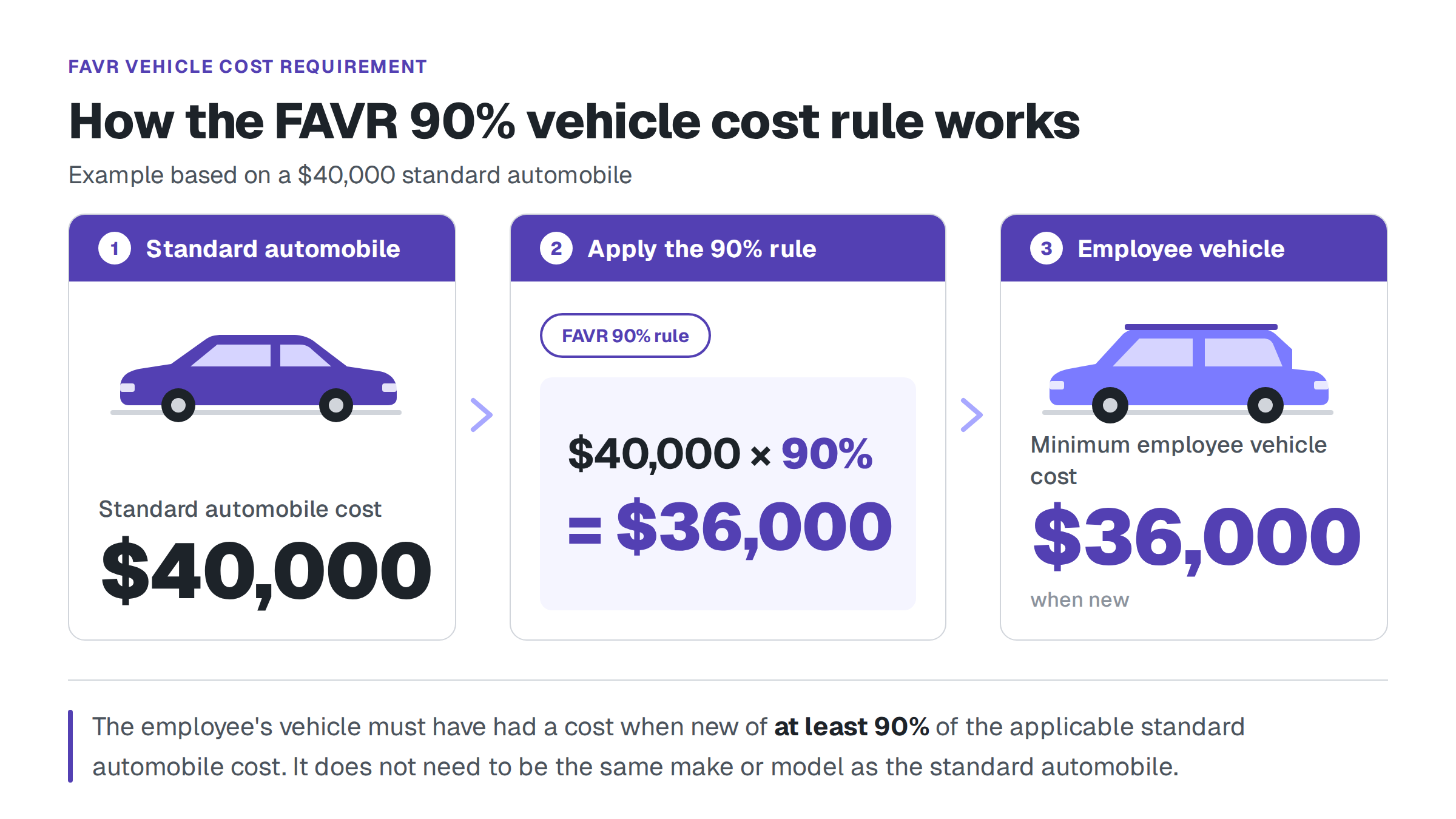
Suppose the standard automobile cost used by an employer is $40,000.
The minimum employee vehicle cost under the 90% rule would be:
$40,000 × 90% = $36,000
The employee's vehicle would therefore need to have had a cost of at least $36,000 when new to satisfy this particular FAVR requirement.
This creates a consistent relationship between the vehicle used to calculate reimbursement and the personal vehicle used by the employee for work.
Does My Car Have to Be the Same as the FAVR Standard Vehicle?
No. Employees do not have to buy or drive the same make and model as the program's standard vehicle.
Think of the standard vehicle as a reference point for the program.
A driver can use a different qualifying personal vehicle as long as the vehicle satisfies the applicable FAVR requirements and any reasonable vehicle policies established by the employer.
Under IRS rules, the vehicle must be owned or leased by the employee, satisfy the 90% cost requirement, and meet the applicable model-year requirement.
This gives employees flexibility in what they drive while giving employers a consistent basis for calculating reimbursement.
Employers can also establish vehicle policies based on legitimate job requirements.
A field employee who regularly carries tools or equipment, for example, may have different vehicle needs from a sales employee who primarily drives between customer meetings.
How Should an Employer Choose a FAVR Standard Vehicle?
A useful starting point is the work employees actually perform.
Consider the type of vehicle reasonably required for the role. Factors such as cargo needs, passenger capacity, driving conditions, expected mileage, vehicle class, and company safety policies may all inform the decision.
From there, the employer can select an appropriate standard automobile and establish the assumptions needed to calculate its ownership and operating costs.
There are IRS limits to consider.
Revenue Procedure 2019-46 states that the standard automobile cost for a calendar year cannot exceed 95% of the sum of the retail dealer invoice cost of the standard automobile in the applicable base locality plus state and local sales or use taxes.
The standard automobile cost is also subject to an annual IRS maximum.
For 2026, the maximum standard automobile cost for a FAVR plan is $61,700 for automobiles, including trucks and vans, according to IRS Notice 2026-10.
That figure is a ceiling. It does not mean employers should automatically select a $61,700 standard vehicle.
The standard vehicle should reflect what employees reasonably need to do their jobs and provide an appropriate basis for reimbursement.
What Is a FAVR Vehicle Profile?
When designing a FAVR program, employers may also use a vehicle profile to bring together the assumptions behind the reimbursement calculation.
A vehicle profile brings together the assumptions used to represent the typical cost of owning and operating a vehicle for a particular role.
It may be based on a specific make and model or a broader vehicle category.
The standard automobile is an important part of that profile, but it is not the only input used to calculate a FAVR allowance.
FAVR calculations also account for factors such as the expected retention period, annual business mileage, business-use percentage, insurance assumptions, and location-specific costs.
Location matters because vehicle expenses vary across the country.
Revenue Procedure 2019-46 defines the base locality as the geographic area where an employee generally incurs the costs of driving while performing services for an employer.
For fixed costs, the base locality is generally where the employee resides. For variable costs, it is generally where the employee drives for work.
This structure allows a common vehicle benchmark to be paired with local cost information.
This helps the reimbursement reflect the business-required cost of owning and operating a personal vehicle for work in the employee's location.
How Does Vehicle Age Affect FAVR Eligibility?
Cost is only one part of FAVR vehicle compliance.
The employee's vehicle also needs to meet the model-year requirement associated with the FAVR allowance's retention period.
The IRS defines the retention period as the number of calendar years an employer expects an employee to drive the standard automobile for work before replacing it.
The retention period cannot be shorter than two calendar years.
For an employee's vehicle to qualify, the difference between its model year and the current calendar year cannot be greater than the number of years in the applicable retention period.
For example, the retention period influences both the depreciation assumptions behind the standard vehicle and the age requirement applied to employee vehicles.
It also makes vehicle compliance something employers need to monitor over time.
A driver's vehicle can meet the applicable requirements when they enter the program and later require review as the vehicle ages.
What Other FAVR Requirements Apply?
The standard vehicle and 90% rule are important, but they are only part of the FAVR framework.
Revenue Procedure 2019-46 includes several additional requirements.
For example, FAVR allowances must generally cover at least five employees.
An employee must also substantiate at least 5,000 business miles per calendar year or, if greater, 80% of the annual business mileage used by the applicable FAVR allowance.
Those mileage requirements may be prorated when an employee participates for less than the entire calendar year.
Insurance is another part of the framework. An employee's insurance coverage limits must be at least equal to the limits used to calculate the insurance component of the applicable FAVR fixed payment.
Employees also have reporting obligations.
Within 30 days after a FAVR allowance initially covers an employee's vehicle, IRS rules require the employee to provide information including the vehicle's make, model, year, insurance coverage limits, odometer reading, and purchase price or applicable lease value.
Taken together, these requirements show why FAVR involves more than setting a reimbursement rate.
Employers need a structured way to establish rates, capture mileage, collect vehicle information, and monitor compliance.
Build a FAVR Program Around the Right Vehicle Profile
The standard vehicle gives a FAVR program a consistent foundation.
It establishes a benchmark for calculating vehicle costs, while employees retain flexibility to choose qualifying personal vehicles that work for them.
The 90% rule, retention period, insurance requirements, mileage substantiation, and other FAVR requirements help keep that structure aligned with IRS rules.
For employers, the practical work is choosing a vehicle profile that makes sense for each role and keeping the data and compliance requirements behind it current.
Cardata helps companies design and manage FAVR programs around those details.
Our team helps establish appropriate vehicle profiles, calculate reimbursements using current cost data, capture business mileage, and monitor driver and vehicle compliance over time.
Learn more about Cardata's FAVR program and how a fully managed approach can make reimbursement easier to administer and more defensible.
Talk to Cardata

.jpg)
.jpg)
.jpg)
