.avif)
When employees use their personal vehicles for work, reimbursement can get complicated quickly.
Fuel costs change. Insurance costs vary by location. Some employees drive thousands more business miles than others.
A Fixed and Variable Rate (FAVR) reimbursement program gives employers a structured way to account for those differences.
FAVR reimburses employees for the real, business-required cost of owning and operating a personal vehicle for work.
Instead of using one national mileage rate or a flat payment, FAVR separates vehicle expenses into fixed and variable costs and uses location-specific data to calculate reimbursement.
When a FAVR program meets IRS requirements, qualifying reimbursements can be provided without being treated as wages.
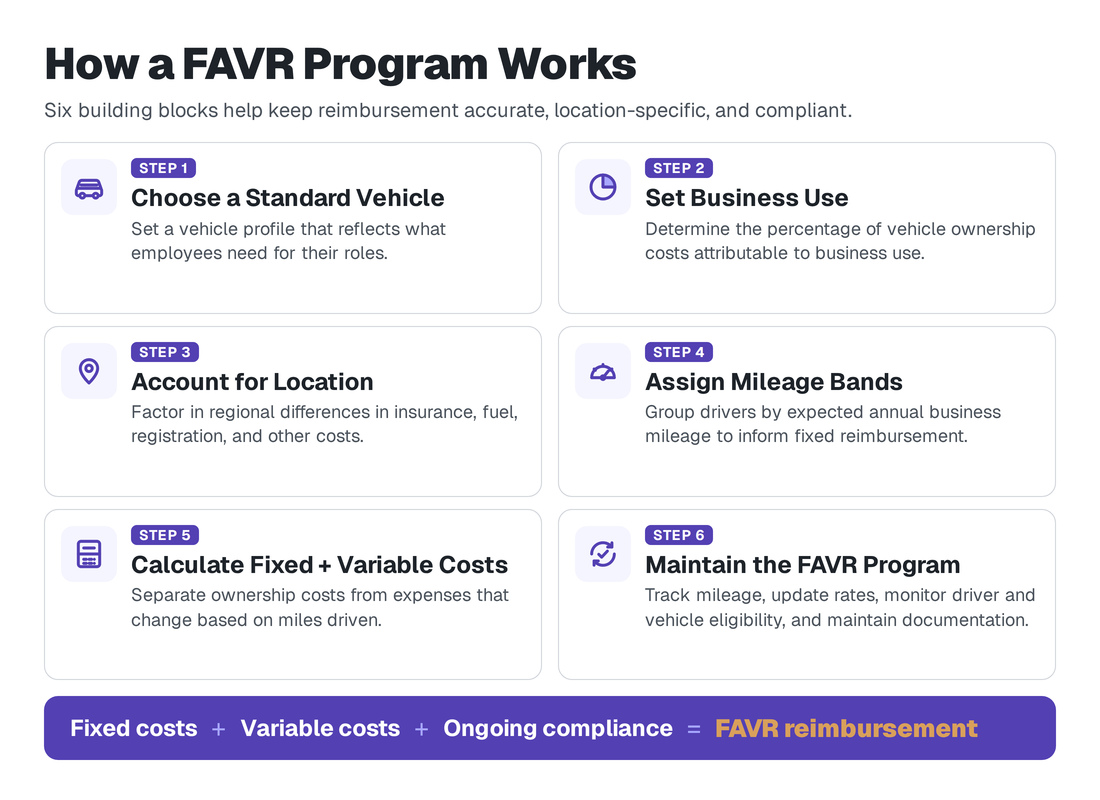
Here’s how to build a FAVR program step by step.
What Is a FAVR Reimbursement Program?
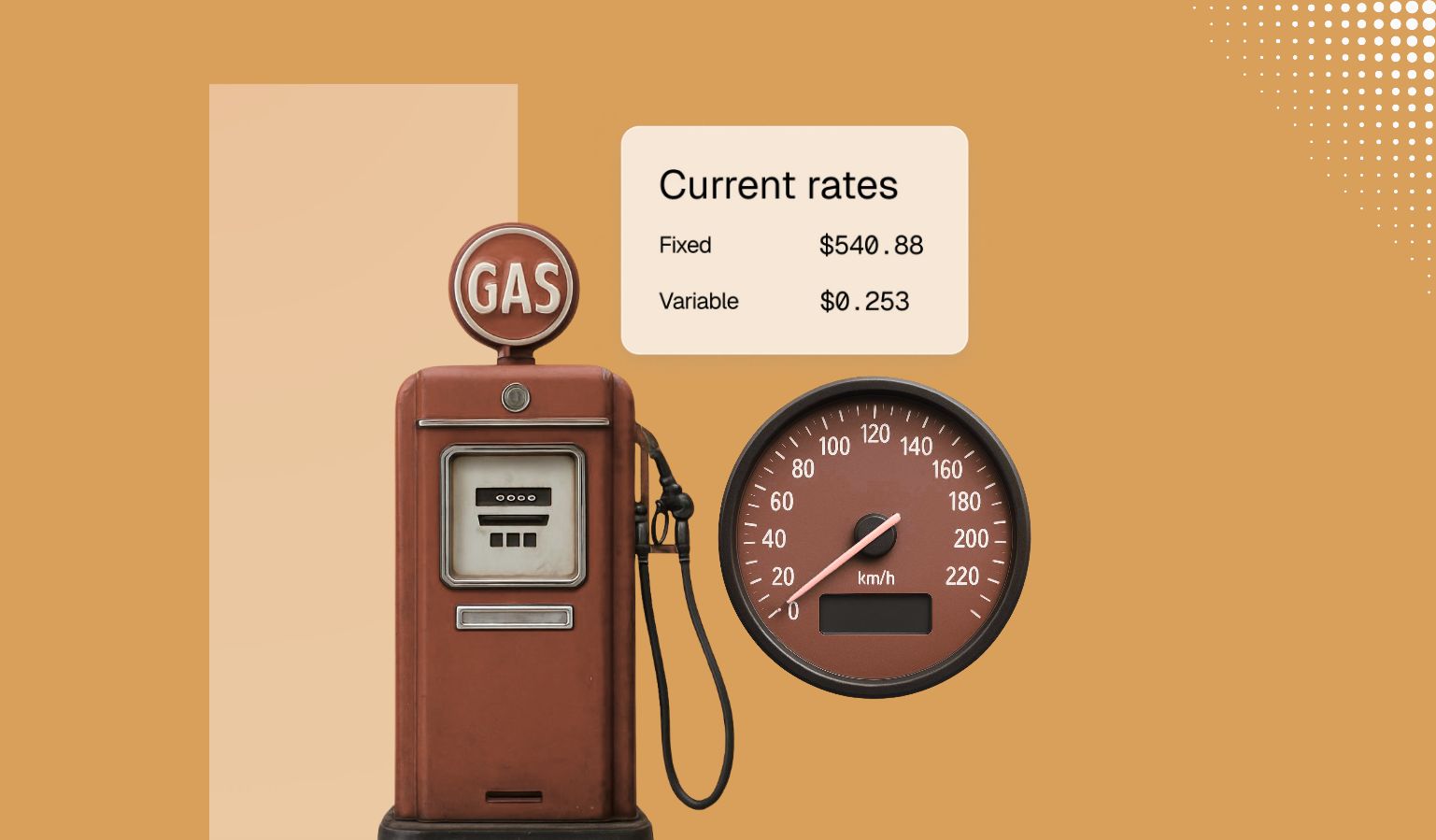
A FAVR program combines two types of vehicle reimbursement: fixed and variable.
Fixed reimbursement covers projected ownership costs, such as depreciation or lease payments, insurance, license and registration fees, and certain vehicle taxes.
Variable reimbursement covers projected operating costs, including fuel, oil, tires, routine maintenance, and repairs. It is tied to an employee’s substantiated business mileage.
The IRS requires FAVR rates to use data from the employee’s applicable geographic area and to reflect reasonable, statistically defensible consumer costs.
That gives employers a way to account for a simple reality: the cost of driving for work can look very different for an employee in California than for a driver in Ohio.
Step 1: Choose Your FAVR Standard Vehicle
Every FAVR program starts with a standard vehicle.
The standard vehicle is the benchmark used for calculating reimbursement. It should reasonably represent the type of vehicle an employee needs to perform the job.
Employees still own or lease their personal vehicles and have flexibility in what they choose to drive.
For example, a company may determine that a midsize SUV reasonably represents what a field service employee needs to carry equipment and travel between customer locations.
The costs associated with the program’s standard vehicle are then used in the FAVR calculation.
The IRS also places limits on the standard vehicle cost.
For 2026, the maximum standard automobile cost that can be used to calculate a FAVR allowance is $61,700, according to IRS Notice 2026-10.
Choosing the standard vehicle carefully matters because depreciation, insurance, fuel efficiency, maintenance, and other costs feed into the reimbursement calculation.
Step 2: Establish Annual Mileage And Business Use
Next, the employer needs reasonable projections for annual mileage and annual business mileage.
These figures help determine the program’s Business Use Percentage (BUP).
Under IRS guidance, BUP is calculated by dividing projected annual business mileage by projected total annual mileage, and it cannot exceed 75%.
The IRS also provides safe-harbor BUP percentages based on projected annual business mileage:
- 6,250 to fewer than 10,000 business miles: up to 45%
- 10,000 to fewer than 15,000: up to 55%
- 15,000 to fewer than 20,000: up to 65%
- 20,000 or more: up to 75%
Employers can establish a different reasonable percentage using appropriate mileage records, subject to the IRS limit.
These requirements are detailed in IRS Revenue Procedure 2019-46.
This calculation matters because BUP helps determine the portion of projected fixed vehicle costs used to calculate the fixed reimbursement.
Step 3: Account For Where Employees Drive
Location is one of the most useful features of FAVR.
The IRS defines a FAVR “base locality” as the geographic area where an employee generally incurs the cost of driving for work.
For fixed costs, this is generally where the employee lives. For variable costs, it is generally where the employee drives for business.
Vehicle costs vary across the country. Insurance premiums, fuel prices, taxes, registration fees, and other expenses can change from one location to another.
A location-sensitive program lets reimbursement calculations reflect those differences instead of applying the same assumption to every driver.
Step 4: Build The Fixed And Variable Rates
Once the standard vehicle, mileage assumptions, BUP, retention period, and location data are established, the FAVR rates can be built.
The fixed portion accounts for projected costs associated with owning or leasing and keeping the standard vehicle available for business use.
Under IRS guidance, those costs can include depreciation or lease payments, insurance, license and registration fees, and personal property taxes.
The variable portion accounts for costs associated more directly with driving. These include gasoline and related taxes, oil, tires, routine maintenance, and repairs.
A simplified way to understand the reimbursement is:
Total FAVR reimbursement = fixed reimbursement + variable reimbursement based on substantiated business mileage
Want to see how those two pieces come together?
Use the FAVR calculator below to explore an estimated reimbursement based on fixed costs, variable costs, and business mileage. You can also learn more about how the FAVR calculator works.
Keep in mind that a calculator provides an estimate for informational purposes.
An estimate does not establish an IRS-compliant FAVR program or determine whether an employer, employee, or vehicle meets applicable FAVR requirements.
The two-part structure of FAVR is what separates it from a flat car allowance or a Cents-Per-Mile (CPM) reimbursement.
The actual rate-setting methodology is more detailed, which is why accurate vehicle, mileage, geographic, and cost data matter.
Step 5: Confirm Driver And Vehicle Eligibility
FAVR also comes with specific IRS eligibility requirements. For example, a FAVR program must cover at least five employees.
A participating employee generally must substantiate at least 5,000 business miles per calendar year, or 80% of the program’s projected annual business mileage if that amount is higher.
These thresholds can be prorated when an employee is covered for only part of the year.
Vehicles have requirements too. The employee must own or lease the vehicle.
Its cost when new must generally be at least 90% of the standard vehicle cost used for the employee’s FAVR reimbursement, and its model year must fall within the program’s established retention period.
The employee must also maintain insurance coverage limits at least equal to those used in the FAVR calculation.
(highlight)
For employers evaluating the details, our FAVR program requirements guide provides a deeper look at eligibility and compliance.
(highlight)
Step 6: Track Business Mileage And Compliance
Accurate mileage records are central to FAVR.
Employees need to substantiate their business mileage so the variable portion of reimbursement can be calculated and the program can satisfy applicable tax requirements.
More broadly, IRS Publication 463, Travel, Gift, and Car Expenses, explains that accountable plans require expenses to have a business connection.
They must also be adequately accounted for within a reasonable period, and have excess reimbursement returned within a reasonable period when applicable.
For employers, reliable mileage tracking creates a clearer record of where reimbursement dollars are going.
Software can make this process easier by capturing business mileage and maintaining organized records without requiring employees or administrators to manage everything through spreadsheets.
(highlight)
Comparing your technology options? Review our in-depth guide to business mileage tracking apps.
(highlight)
Step 7: Keep The Program Current
Launching a FAVR program is only part of the job.
Vehicle costs change. Fuel prices move. Employees replace vehicles. Insurance policies expire. Drivers join and leave the organization. Mileage patterns shift.
The IRS also requires employees to provide specified vehicle information when they initially enter a FAVR program and again annually, including vehicle make, model and year, proof of insurance coverage limits, and odometer information.
Employers or their agents must maintain records supporting the statistical data and projections used to calculate FAVR payments.
The standard vehicle limit can change annually too. That is one reason FAVR works best as an actively managed reimbursement program rather than a rate that gets set once and forgotten.
Why a FAVR Partner Matters
At this point, you might be thinking: maintaining a FAVR program sounds like a lot to manage. And you’re not wrong.
A FAVR program requires current cost data, accurate mileage tracking, annual odometer declarations, eligibility monitoring, and vehicles that meet IRS age and value requirements.
Policies need to be written clearly and applied consistently so reimbursements stay tax-free.
Handled manually, that can feel like a full-time job.
If those pieces aren’t actively maintained, risk builds over time. Rates can become outdated, and drivers can fall below eligibility thresholds. Documentation gaps can create audit exposure.
Even a well-designed program can drift if no one is keeping it aligned.
The good news is you don’t have to manage this on your own. This is where the right partner makes a difference.
A mileage reimbursement partner like Cardata handles the administrative side of the program, from calculating location-based fixed and variable rates, to tracking mileage, collecting odometer declarations, verifying insurance, and maintaining audit-ready documentation.
Instead of relying on spreadsheets and manual oversight, your HR and finance teams can stay focused on their core responsibilities.
The compliance framework runs in the background, rates stay current, and the program scales as your team grows.
FAVR is built on structure. A strong partner helps you keep that structure intact without adding workload to your internal team.
Getting Started With FAVR
Setting up a FAVR program is not about adding complexity. It is about replacing guesswork with structure.
When built correctly, a FAVR program aligns reimbursements with real driving costs, keeps payments tax-free under IRS rules, adjusts for geographic and mileage differences, reduces administrative burden, and improves fairness across drivers.
If you are transitioning from fleet vehicles or replacing a flat car allowance, the setup process is more manageable than it may seem. Once implemented, the program operates on clear rules, documented inputs, and consistent updates.
That structure is what makes it sustainable over time.
If you’re considering FAVR and want help figuring out what the right program could look like for your team, reach out to Cardata.
Our team can help you evaluate your current approach, understand your options, and build a reimbursement program around your employees and business needs.
Talk to a FAVR Expert