
No, employers generally aren't required to reimburse employees directly at the IRS standard mileage rate. Businesses can set their own cents-per-mile reimbursement rates, provided they follow applicable employment laws and tax requirements.
For employers, that flexibility creates an opportunity to build a reimbursement program that better reflects what employees actually spend when driving their personal vehicles for work.
The IRS rate is a useful starting point. But depending on your workforce, a custom mileage reimbursement rate may make more sense.
Here's what employers need to know about IRS mileage reimbursement requirements, the differences between standard and custom CPM rates, and how to choose a fair, cost-effective approach based on real driving costs.
Do Employers Have to Pay the IRS mileage rate?
The IRS standard mileage rate is an optional benchmark used to calculate the cost of operating a personal vehicle for business purposes.
For 2026, the IRS standard business mileage rate is:
- 72.5 cents per mile for January 1 through June 30, 2026.
- 76 cents per mile for July 1 through December 31, 2026.
The IRS increased the rate midyear in response to higher fuel prices, as outlined in Announcement 2026-11.
Employers can use these rates to reimburse employees for eligible business mileage, but they can also choose a different rate.
For example, a company might reimburse employees at 65 cents per mile instead of 76 cents. This can still qualify for tax-free treatment when the reimbursement meets IRS accountable plan requirements.
However, employers should understand that IRS tax rules and employment reimbursement laws serve different purposes.
While federal law doesn't establish a universal mileage reimbursement rate, some states require employers to cover necessary business expenses.
California, for example, requires reimbursement of necessary employee expenses under Labor Code Section 2802.
Federal wage laws can also create reimbursement obligations when employee-paid business expenses would reduce wages below minimum wage or interfere with required overtime pay.
The takeaway for employers is that there's flexibility in setting a mileage rate, but that rate still needs to meet applicable legal requirements.
What is a Custom Cents-Per-Mile (CPM) Reimbursement Rate?
A Cents-Per-Mile (CPM) reimbursement program pays employees a set amount for each eligible business mile driven in their personal vehicles.
These reimbursements are intended to cover the business-required cost of owning and operating a vehicle, including fuel, maintenance, insurance, depreciation, and other related expenses.
Many employers use the IRS standard mileage rate because it's familiar and easy to administer.
Others establish custom rates based on their employees' driving patterns, vehicle requirements, and local operating costs.
For example, consider an employee who drives 1,000 business miles in a month.
- At the IRS rate of 76 cents per mile, the employee would receive $760.
- At a custom rate of 65 cents per mile, the reimbursement would be $650.
That's a difference of $110 for the month.
Whether that custom rate is appropriate depends on the employee's actual expected expenses and applicable employment laws.
The goal of a custom CPM program is to establish a rate that reflects business driving costs while giving employers a consistent, manageable way to reimburse their teams.
What Are the Three Types of CPM Reimbursement Rates?
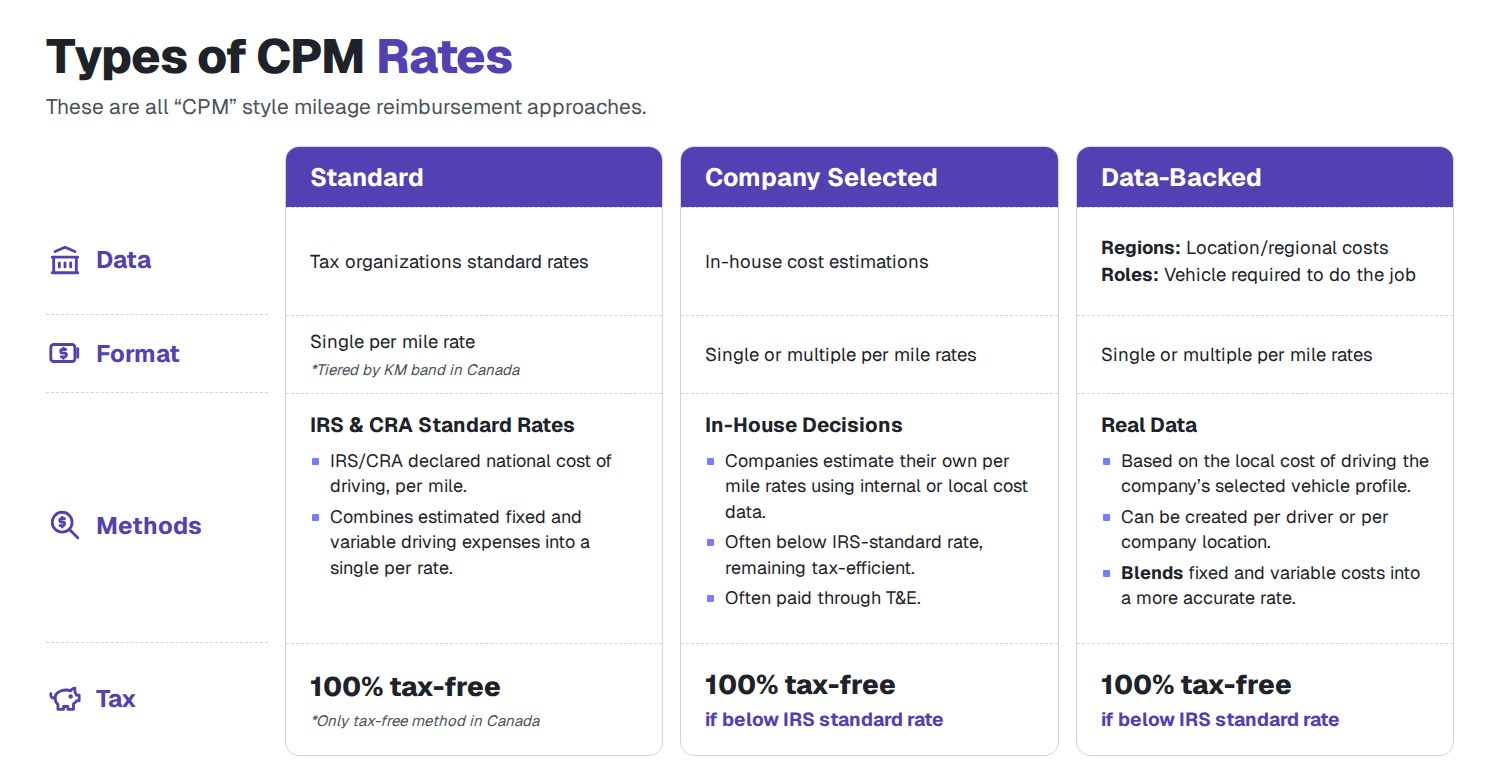
Employers generally have three approaches to setting CPM reimbursement rates: standard, company-selected, and data-backed.
All three calculate reimbursements based on eligible business miles driven. The difference is how the rate is determined and how closely it reflects employees' actual driving costs.
1. Standard CPM: Using the IRS mileage rate
The standard CPM approach uses the IRS-published business mileage rate. For the second half of 2026, that's 76 cents per business mile.
The IRS develops its business mileage rate using estimated fixed and variable vehicle expenses.
Fixed costs include depreciation and insurance, while variable costs include fuel, maintenance, and repairs.
These expenses are combined into one national per-mile rate.
For employers, this makes reimbursement straightforward. Employees track their eligible business miles, and the company multiplies those miles by the applicable IRS rate.
Standard CPM is often a practical choice for businesses with occasional drivers or organizations that prefer a consistent reimbursement rate across their workforce.
However, actual driving costs vary by location, vehicle requirements, and mileage volume.
A national rate may provide a different level of reimbursement relative to costs for employees in different circumstances.
2. Company-selected CPM: Setting an internal rate
With a company-selected CPM program, employers determine their own mileage reimbursement rate.
These rates are typically based on internal cost estimates, historical reimbursement spending, local cost information, or a combination of factors.
For example, a company might establish a rate of 65 cents per mile based on its estimated employee driving costs.
Some employers apply one rate company-wide. Others establish different rates for certain employee groups or locations.
Company-selected rates are often lower than the IRS standard mileage rate, allowing employers to manage reimbursement spending while maintaining favorable tax treatment when the necessary requirements are met.
However, setting a lower rate simply to reduce costs, without supporting data, can create concerns about fairness and negatively affect employee satisfaction.
Drivers need to feel confident that their reimbursements reasonably reflect the costs of using their personal vehicles for work. A rate backed by reliable cost data is easier to explain, justify, and maintain employee buy-in.
These reimbursements are often managed through existing travel and expense (T&E) systems, where employees submit their business mileage for approval and payment.
This approach offers flexibility, but the rate's accuracy depends on the quality of the estimates behind it.
Over time, changes in fuel prices, insurance premiums, or employee driving patterns may create a gap between the estimated rate and actual costs.
That's why regularly reviewing company-selected rates is important, both to keep reimbursements aligned with actual driving costs and to maintain employee trust.
3. Data-backed CPM: Using real vehicle cost data
A data-backed CPM program uses market data to calculate reimbursement rates based on the cost of owning and operating a vehicle for work.
Rather than relying primarily on internal estimates, employers can use location-specific driving costs and a representative vehicle profile to determine an appropriate rate.
For example, an employer might select a vehicle that meets the requirements of a particular field role, then calculate its estimated ownership and operating costs in different regions.
They can then blend these fixed ownership costs and variable operating costs into a per-mile rate that best serves that specific job, and even customize it for a specific region.
This approach considers expenses such as local fuel prices, insurance, maintenance, depreciation, and the amount of business driving employees perform.
The fixed and variable costs are then combined into a single per-mile rate.
Data-backed rates can be developed for individual drivers, specific company locations, or broader employee groups.
This can be particularly useful for businesses with employees spread across multiple states, where driving costs may vary significantly.
For Finance teams, data-backed CPM provides a clearer basis for evaluating reimbursement spending.
For employees, it helps connect their reimbursement rate to the actual costs associated with driving for work.
The main advantage is greater accuracy and transparency in how rates are calculated.

Can employers pay a custom CPM rate tax-free?
Yes. A custom CPM reimbursement rate can generally be tax-free when it stays at or below the applicable IRS standard mileage rate and meets accountable plan requirements.
An accountable plan is an employer reimbursement arrangement that follows IRS rules for documenting and reimbursing legitimate business expenses.
According to IRS Publication 463, Travel, Gift, and Car Expenses, employers must generally ensure that:
- Reimbursements are connected to legitimate business expenses.
- Employees provide adequate documentation of their business mileage within a reasonable period.
- Excess advances or unsubstantiated amounts are returned within a reasonable period.
For mileage reimbursement, employees generally need to record the date, distance, destination, and business purpose of each eligible trip.
Accurate mileage tracking helps employers substantiate reimbursements and maintain records for tax purposes.
What happens if a custom rate exceeds the IRS rate?
Employers can reimburse employees above the IRS standard mileage rate.
However, under the standard mileage allowance rules, the amount exceeding the applicable IRS rate is generally treated as taxable wages unless another qualifying reimbursement method supports excluding it.
For example, if an employer pays 80 cents per mile when the IRS rate is 76 cents, the additional 4 cents per mile would generally be taxable.
The IRS outlines these rules in Revenue Procedure 2019-46.
Employers should also remember that paying below the IRS rate doesn't automatically establish compliance with every state reimbursement law.
When Does a Custom CPM Program Make Sense?
Cents-Per-Mile (CPM) reimbursement at the IRS standard mileage rate can be a good fit for organizations with employees who drive occasionally or have variable business mileage.
However, the standard rate isn't always the most cost-effective option, particularly when it reimburses drivers more than their actual business-related vehicle costs.
A custom CPM program allows employers to set a per-mile rate that better reflects the real cost of using a personal vehicle for work.
This can help organizations avoid overpayment while maintaining fair, tax-free reimbursements when applicable requirements are met.
Custom CPM is particularly useful when drivers would be overpaid at the IRS standard mileage rate but aren't a good fit for a Fixed and Variable Rate (FAVR) program.
For example, part-time employees, contract workers, and gig workers may drive significant business mileage but not meet FAVR eligibility requirements.
In these cases, a custom CPM rate can offer a more appropriate reimbursement approach, even for drivers who regularly cover long distances.
Other examples include consultants visiting clients, healthcare workers traveling between patient locations, construction supervisors visiting project sites, and education or public-sector employees traveling between facilities.
While employees driving fewer than 5,000 business miles annually are often good candidates for CPM, mileage volume alone shouldn't determine the right program.
Employment status, FAVR eligibility, actual vehicle costs, and driving requirements also matter.
A custom CPM program gives employers the flexibility to account for these factors while keeping reimbursement costs tied directly to business driving activity.
Why CPM can be the right long-term choice
CPM is sometimes treated as a default reimbursement method, but it can also be the right long-term solution for organizations that value simplicity and consistency.
For businesses with occasional drivers, part-time employees, or project-based teams, a straightforward per-mile rate can make reimbursement easier to understand and manage.
CPM can also help employers forecast spending and maintain a standardized approach across different employee groups.
For full-time employees who drive substantial mileage consistently, employers may also want to consider Fixed and Variable Rate (FAVR) reimbursement.
FAVR reimburses employees for the real, business-required costs of owning and operating personal vehicles by separating fixed ownership expenses from variable operating costs.
Unlike CPM, which combines these expenses into one rate, FAVR calculates them separately using location-specific vehicle cost information.
Tax-Free Car Allowance (TFCA) is another option employers may consider for eligible employees with consistent driving requirements.
Some employers use a mixed reimbursement program, with CPM for occasional drivers and FAVR or TFCA for employees whose driving patterns and eligibility make those approaches a better fit.
This allows different groups to receive reimbursements suited to their driving requirements.
What Else Should Employers Consider When Setting up a CPM Program?
Choosing the right mileage rate is an important first step, but employers should also think about how they'll manage the program day to day.
Accurate mileage tracking helps ensure employees are reimbursed for eligible business travel and gives Finance teams reliable records to review.
Some organizations rely on employees to manually submit mileage through existing expense systems, while others use GPS-based mileage tracking to simplify trip capture and documentation.
For organizations with employees visiting multiple clients or job sites, the ability to assign mileage to specific projects, clients, or cost centers can also make expense reporting easier.
For example, consulting firms may need to bill mileage expenses back to clients, while construction companies may need to allocate driving costs to individual projects.
Healthcare organizations and public-sector employers may place particular importance on clear documentation, especially when expenses are connected to grants, insurance funding, or public budgets.
Payment frequency matters, too.
Employees who drive regularly for work may benefit from weekly or biweekly reimbursements, particularly when they're covering fuel and other vehicle expenses upfront.
Employers should also consider how mileage records, approvals, reporting, and reimbursements will fit into their existing processes.
For Finance teams, these decisions can improve visibility into mileage spending, support cost controls, and reduce the administrative work associated with managing reimbursements.
A well-designed CPM program should make business driving easier to manage for both employees and administrators.
Build a Mileage Reimbursement Program That Fits Your Business
The IRS standard mileage rate is a useful benchmark, but employers have options.
Whether you choose the standard rate, establish a company-selected rate, or build a data-backed CPM program, the goal is the same: reimburse employees fairly for business driving while maintaining clear, manageable costs.
At Cardata, we help businesses design and manage mileage reimbursement programs based on real driving needs, local costs, and company goals.
Talk to Cardata to explore the right reimbursement approach for your team.
Talk to Cardata