
Your mileage reimbursement program may be running smoothly. Employees are recording business miles, payments are going out, and spending appears to be within budget.
But how do you know whether the program is performing as well as it could?
As you prepare for 2027, it's worth reviewing what your reimbursement data says about costs, accuracy, compliance, and the employee experience.
You may find that your current approach is working well, or that a few adjustments could make it easier to manage.
A mileage reimbursement program evaluation helps you make those decisions using measurable results.
Here are six practical KPIs to review, how to calculate them, and what they can tell you about your program's performance.
How Do You Evaluate a Mileage Reimbursement Program?
The best way to evaluate a mileage reimbursement program is to measure six areas: cost per mile, reimbursement accuracy, driver compliance, administrative workload, employee adoption, and program suitability.
Together, these metrics help Finance, HR, and Operations assess whether the program is cost-effective, fair to employees, compliant with applicable requirements, and manageable over time.
Start by gathering 12 months of reimbursement payments, business mileage records, compliance reports, and administrative data.
Where possible, compare results across similar employee groups, locations, and driving requirements.
Reviewing monthly trends can also reveal changes that annual totals might miss.
If you're planning next year's spending, our 2027 Mileage Reimbursement Budget Guide explains how to forecast mileage, reimbursement rates, and total costs.
Once you have that financial baseline, the following KPIs can help you evaluate how well your program is working.
1. Cost Per Mile: Understand What You're Spending
Cost per mile connects your reimbursement spending to the business miles employees drive.
(highlight)
Formula:
Cost per mile = Total mileage reimbursement payments ÷ Total reimbursed business miles
(highlight)
For example, imagine your company paid $360,000 in reimbursements for 500,000 business miles over the past year.
Your average reimbursement cost would be $0.72 per mile.
This provides a useful baseline for reviewing costs over time.
For context, the IRS standard business mileage rate increased from 72.5 cents per mile during the first half of 2026 to 76 cents per mile effective July 1, 2026.
Cardata's breakdown of the midyear IRS mileage rate increase explains what this change means for employers.
The 2027 IRS standard mileage rate has not yet been announced as of October 2026.
However, the IRS rate is only one reference point. Your effective cost per mile depends on how your reimbursement program is structured.
For example, Fixed and Variable Rate (FAVR) reimbursement separates fixed vehicle ownership expenses from variable operating expenses.
Cents-Per-Mile (CPM) reimbursement uses a defined rate for each eligible business mile.
Both approaches are designed to reimburse employees for the business-required costs of owning and operating a personal vehicle for work.
When comparing cost per mile, group employees with similar mileage, roles, and reimbursement methods.
For programs with fixed payments, remember that average cost per mile can increase when business mileage decreases, even if the monthly fixed reimbursement stays the same.
You may also want to calculate your fully loaded program cost by including technology, administration, and vendor expenses.
(highlight)
What to look for: Unexplained cost increases, significant differences between comparable driver groups, or reimbursement spending that no longer aligns with business driving patterns.
The goal is to understand what drives your costs and whether your current approach remains appropriate.
(highlight)
2. Reimbursement Accuracy: Check That Payments Are Correct
Accurate reimbursements help employees receive the amounts they're entitled to while giving Finance greater confidence in program spending.
A practical way to measure accuracy is to review a sample of payments against approved business mileage, applicable reimbursement rates, and company policies.
(highlight)
Formula: Reimbursement accuracy rate = (Payments reviewed without errors ÷ Total payments reviewed) × 100
(highlight)
For example, if you review 200 payments and find that 194 were calculated correctly, your accuracy rate is 97%.
The remaining six payments should be investigated to understand what caused the differences.
Potential issues include incorrect mileage entries, outdated employee information, rate calculation errors, or incorrectly classified trips.
For consistency, define what counts as an error before reviewing payments. You should also distinguish between calculation errors and incomplete supporting records.
According to IRS Publication 463, Travel, Gift, and Car Expenses, business vehicle expenses generally require records establishing the date, mileage, and business purpose of travel.
Reliable mileage tracking helps support that documentation and provides a clearer connection between business driving and reimbursement.
(highlight)
What to look for: Repeated payment corrections, missing trip information, unusual manual adjustments, or frequent reimbursement questions from employees.
For your scorecard, set an accuracy target based on your organization's requirements and review the results consistently.
(highlight)
3. Driver Compliance: Identify Gaps Before They Become Larger Issues
Compliance is an important part of any mileage reimbursement program, particularly when employers want qualifying payments to receive tax-free treatment.
Under the IRS accountable plan rules explained in Publication 463, reimbursed expenses generally must have a business connection, be properly substantiated, and meet applicable requirements for returning excess payments.
Some reimbursement methods have additional rules.
For example, FAVR programs must follow specific IRS requirements related to mileage, eligible employees, vehicle characteristics, and reimbursement calculations.
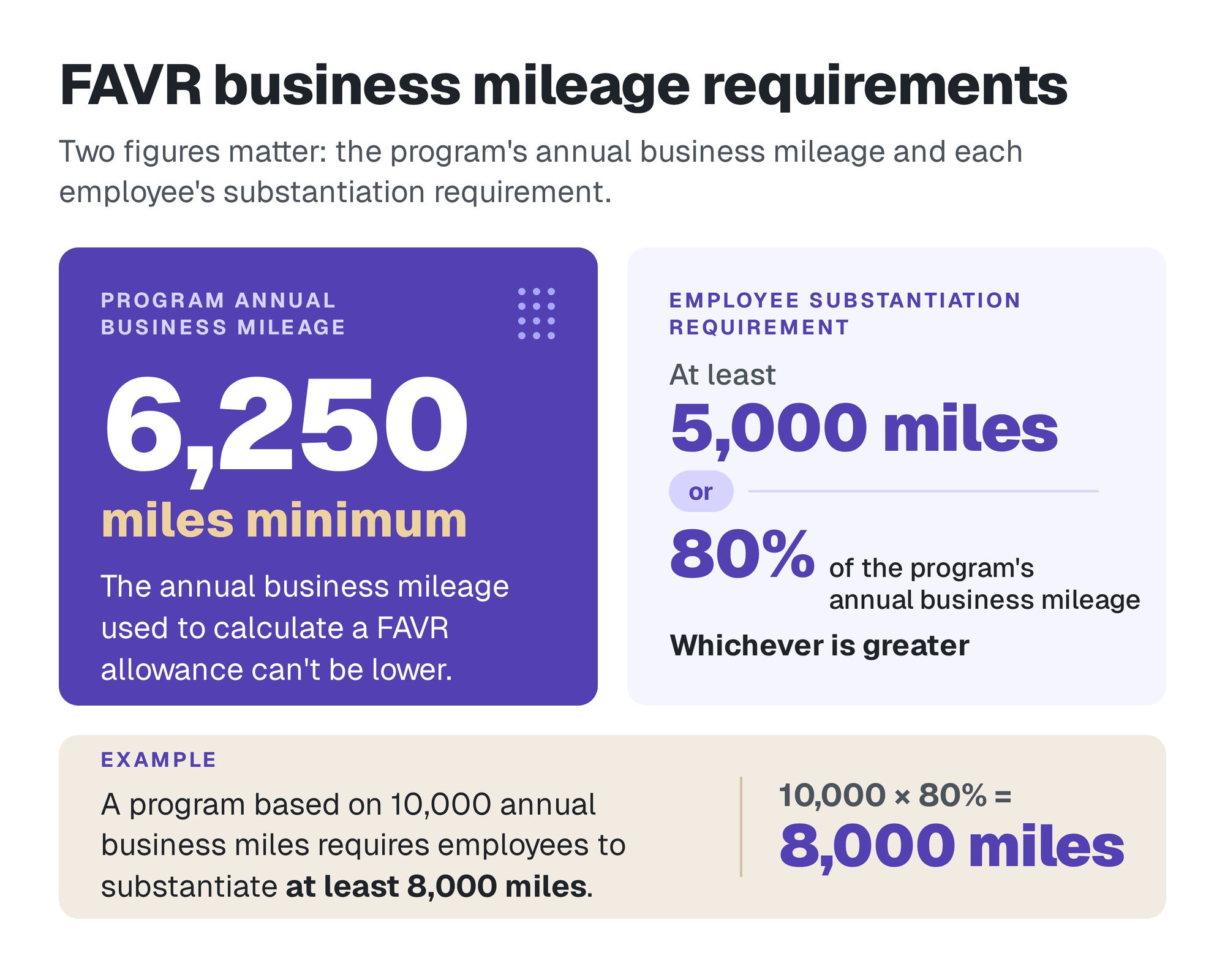
Under IRS Revenue Procedure 2019-46, the annual business mileage used to establish a FAVR allowance generally cannot be less than 6,250 miles.
Participating employees generally must substantiate at least 5,000 business miles during the calendar year or, if greater, 80% of the annual business mileage established for their allowance, subject to applicable prorating rules.
To evaluate compliance, measure the percentage of drivers meeting the requirements applicable to their reimbursement program.
(highlight)
Formula:
Driver compliance rate = (Drivers meeting all applicable requirements ÷ Drivers reviewed) × 100
(highlight)
If 185 of 200 employees meet the requirements during your review period, your compliance rate is 92.5%.
The next step is understanding which requirements account for the remaining gaps.
These might include missing mileage documentation, expired insurance records, outdated vehicle information, or FAVR-specific eligibility issues.
Be consistent about the reporting period and the definition of compliance. Some requirements apply continuously, while others are assessed over longer periods.
For a more detailed breakdown, see our FAVR compliance guide, which covers IRS mileage thresholds, vehicle requirements, and documentation.
(highlight)
What to look for: Recurring documentation issues, unresolved compliance exceptions, or drivers whose circumstances have changed without a corresponding program review.
The operational objective should be full compliance with applicable requirements, supported by a process for identifying and resolving exceptions promptly.
(highlight)
4. Administrative Workload: Measure the Time Required to Manage Reimbursements
Reimbursement payments are only one part of the total cost of running a vehicle program.
Finance may reconcile payments, HR may respond to employee questions, and managers may review mileage records or follow up on missing documentation.
These activities require time, even when they aren't tracked as a separate program expense.
A useful KPI is administrative hours per driver.
(highlight)
Formula:
Administrative hours per driver = Total monthly administration hours ÷ Number of active drivers
(highlight)
Imagine your team spends 80 hours each month managing reimbursements for 200 employees.
That's 24 minutes per driver each month.
If process improvements reduce the average to 15 minutes, the organization saves 30 administrative hours monthly.
To measure this consistently, track the time spent on mileage reviews, payment reconciliation, compliance follow-ups, reporting, and employee support.
You can also estimate the financial impact by multiplying administrative hours by the relevant loaded hourly labor cost.
For example, saving 30 hours per month at an assumed labor cost of $40 per hour represents $1,200 in monthly staff capacity.
That is an illustrative value of time saved, rather than an automatic reduction in payroll spending.
(highlight)
What to look for: Increasing administrative hours per driver, repeated manual corrections, lengthy approval cycles, or reporting that requires information from multiple systems.
Your own historical performance is often the most useful benchmark. Establish a baseline and measure whether changes are reducing workload.
(highlight)

5. Employee Adoption: Understand Whether the Process Works for Drivers
A reimbursement program depends on employees being able to record business mileage accurately and access the information they need.
If drivers frequently need to correct trips, ask about payments, or struggle with mileage tracking, the process may need attention.
One useful metric is the percentage of employees with complete mileage records by the required deadline.
(highlight)
Formula:
Mileage completion rate = (Drivers with complete required mileage records ÷ Drivers required to provide records) × 100
(highlight)
For example, if 180 of 200 employees have complete records by the deadline, your completion rate is 90%.
For programs using automated mileage capture, the measurement should reflect how the system works.
Employees may not need to manually submit their trips.
In those cases, review the percentage of drivers with complete, approved records, along with the number of unresolved trip exceptions or manual corrections.
You can also gather employee feedback through a short survey.
Ask whether drivers understand how their reimbursements are calculated, can easily access payment information, and find mileage tracking straightforward.
(highlight)
What to look for: Incomplete mileage records, frequent manual corrections, recurring support questions, or differences in adoption across departments.
These results can help identify where clearer communication, training, or simpler tools would improve the experience.
(highlight)
6. Program Suitability: Check Whether Your Reimbursement Method Still Fits
A reimbursement program that worked well when it was introduced may need adjustments as your workforce changes.
Employees may take on larger territories, move into different roles, or drive significantly more or fewer business miles than expected.
Those changes can affect which reimbursement method makes the most sense.
For example, a field sales employee driving 20,000 business miles annually has different vehicle cost considerations from an employee driving 2,000 miles.
A useful KPI is the percentage of employees whose reimbursement method has been reviewed and remains appropriate for their current driving requirements.
(highlight)
Formula:
Program suitability rate = (Drivers whose reimbursement method remains appropriate ÷ Drivers reviewed) × 100
(highlight)
This requires a consistent review process rather than a simple payment calculation.
Consider annual business mileage, geographic vehicle costs, role requirements, reimbursement structure, and applicable compliance rules.
Three common reimbursement methods include:
- Fixed and Variable Rate (FAVR): Reimburses the business-required fixed and variable costs of owning and operating a personal vehicle using a standard vehicle profile and geographically relevant cost data. Often suited to employees with substantial, consistent business mileage.
- Cents-Per-Mile (CPM): Reimburses business-required vehicle ownership and operating costs through a defined per-mile rate. Often practical for employees with occasional or lower mileage.
- Tax-Free Car Allowance (TFCA): Reimburse eligible business vehicle costs through an accountable arrangement that may include fixed and variable payments, with substantiation supporting applicable tax-free treatment.
Some organizations use a mixed reimbursement program to match different employee groups with different reimbursement methods.
For more detail on how vehicle profiles, mileage, and local costs affect program design, see our guide to building a FAVR program.
(highlight)
What to look for: Significant differences between actual and expected mileage, changing job responsibilities, or employees whose current reimbursement structure no longer reflects their business driving needs.
Review program suitability annually and whenever material changes occur.
(highlight)
Build a Mileage Reimbursement Program Evaluation Scorecard
Once you've calculated your KPIs, bring the results together into a single scorecard.
This makes it easier to identify which areas are performing well and which need attention.
Rather than relying on universal performance benchmarks, establish targets that reflect your organization's current results, policies, and risk tolerance.
For each KPI, record your baseline, current performance, target, and recommended action.
You can then categorize results as meeting expectations, needing attention, or requiring priority action.
Compliance issues affecting tax treatment or eligibility should receive appropriate attention regardless of the overall score.
Turn Your Evaluation Into a Practical Improvement Plan
A program evaluation becomes more valuable when the results guide specific decisions.
Start with the two or three areas where improvement would have the greatest impact.
If reimbursement accuracy is strong but administrative workload keeps increasing, review your approval and reporting processes.
If costs are stable but compliance exceptions are becoming more common, focus on documentation, employee communication, and follow-up procedures.
If mileage patterns have changed significantly, consider whether your reimbursement methods still fit the employees using them.
Assign an owner to each improvement, establish a measurable target, and review progress quarterly.
Make Your Mileage Reimbursement Program Work Better in 2027
A good mileage reimbursement program should be fair for employees, manageable for your team, and supported by reliable data.
Reviewing these six metrics can help you understand where your program stands and which improvements are worth prioritizing.
At Cardata, we help organizations evaluate their existing vehicle reimbursement programs by reviewing costs, mileage patterns, compliance, and administrative processes.
Our team can help identify opportunities to improve efficiency, ensure reimbursement methods fit your drivers' needs, and build a program that stays aligned with your business goals.
Talk to Cardata about reviewing your current program and finding the right fit for your employees.
Talk to Cardata