
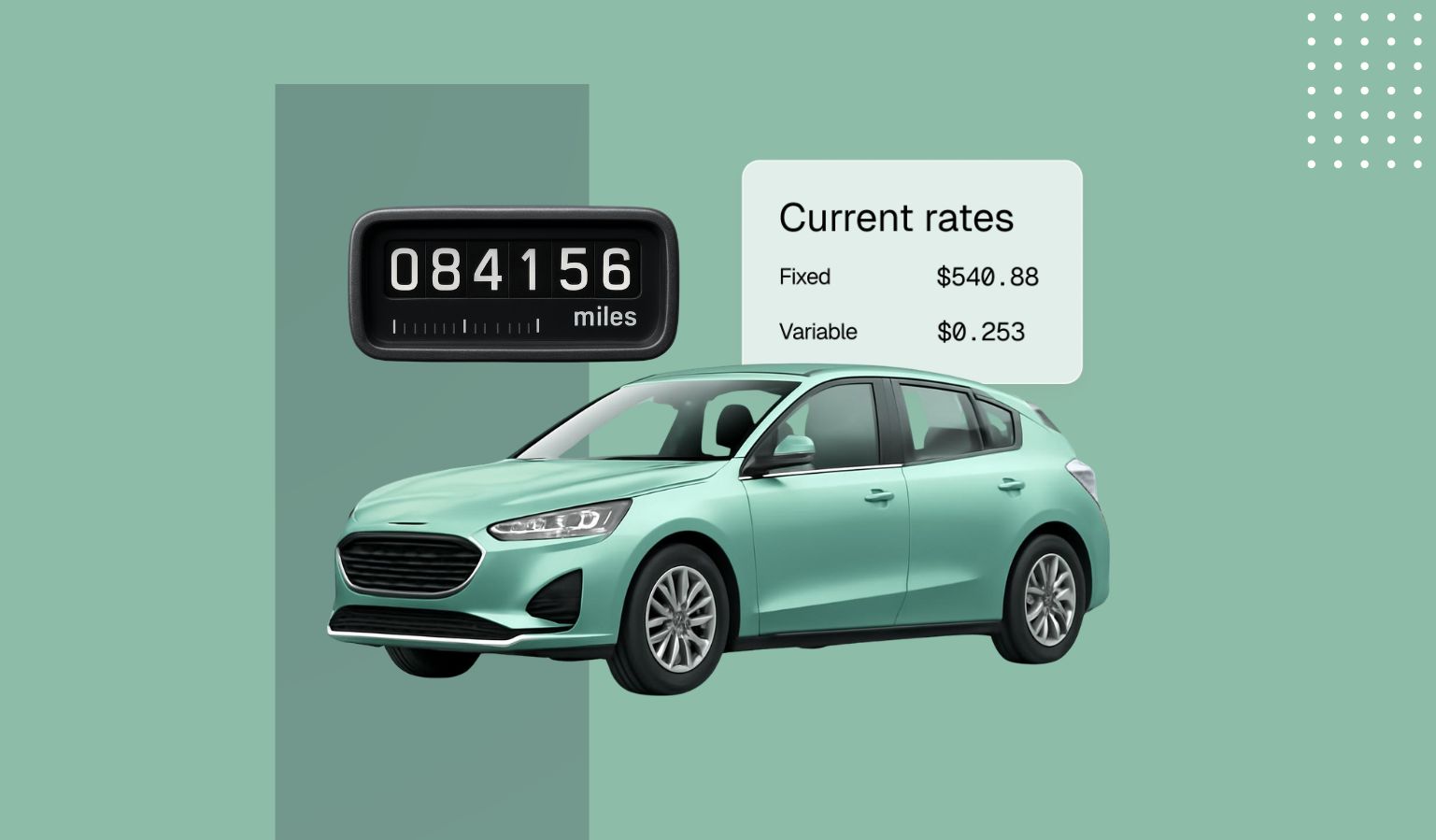
Employees who use personal vehicles for work take on a range of vehicle expenses.
Some, like insurance and registration, stay relatively consistent from month to month. Others, like fuel and routine maintenance, are more closely connected to how much an employee drives.
A Fixed and Variable Rate (FAVR) mileage reimbursement program accounts for both.
Instead of treating every vehicle expense the same way, FAVR separates eligible costs into fixed and variable categories.
The fixed portion accounts for projected vehicle ownership costs, while the variable portion accounts for projected operating costs associated with driving.
Understanding what belongs in each category makes it easier to see how FAVR mileage reimbursement works and why companies use it for employees who regularly drive personal vehicles for business.
What Costs Does FAVR Mileage Reimbursement Cover?
A Fixed and Variable Rate (FAVR) program reimburses employees for the business use of personal vehicles by accounting for both fixed and variable vehicle costs.
Under IRS FAVR rules, fixed costs include depreciation or lease payments, insurance, registration and license fees, and personal property taxes.
Variable costs include gasoline and applicable taxes, oil, tires, and routine maintenance and repairs. Here are the core fixed and variable costs identified in IRS FAVR guidance:
These categories reflect an important difference in how vehicle expenses behave.
An employee can have insurance and registration expenses even during a month with relatively little business driving.
Fuel and routine maintenance costs, on the other hand, are more closely tied to vehicle use.
What Are the Fixed Costs in a FAVR Program?
Fixed costs represent projected expenses associated with having an appropriate vehicle available for work.
Under IRS guidance, the periodic fixed payment includes depreciation or lease payments, insurance, registration and license fees, and personal property taxes.
1. Depreciation or Lease Payments
Vehicles generally lose value over time. For employees who own their vehicles, FAVR accounts for projected depreciation as part of the fixed payment.
For employees who lease eligible vehicles, lease payments can be included instead.
Depreciation is more complicated than simply looking at what an employee paid for a vehicle.
FAVR calculations use a standard automobile, standard automobile cost, retention period, residual value, and other factors defined by IRS rules.
The important point for employees and employers is simpler: the cost associated with owning or leasing the vehicle belongs on the fixed side of FAVR.
2. Insurance
Vehicle insurance is also a fixed FAVR cost.
The insurance component must be based on rates for the standard automobile in the employee's applicable base locality.
IRS rules also require participating employees to maintain insurance coverage limits at least equal to the limits used to calculate the fixed payment.
This makes insurance relevant to both reimbursement calculations and ongoing FAVR compliance.
For employers, that means insurance should be monitored throughout the program rather than treated as a one-time consideration when an employee enrolls.
3. Registration and License Fees
Registration and license fees are included in the fixed portion of a FAVR allowance.
These costs are associated with keeping a vehicle legally registered and available for use. They generally do not increase simply because an employee drives more business miles during a particular month.
4. Personal Property Taxes
Applicable personal property taxes are another fixed cost recognized under IRS FAVR guidance.
These taxes vary by location, which is one reason geography matters when calculating FAVR reimbursements.
What Are the Variable Costs in a FAVR Program?
Variable costs represent projected operating expenses that are more closely connected to driving.
Under IRS guidance, the variable portion of a FAVR allowance includes gasoline and applicable taxes, oil, tires, and routine maintenance and repairs.
The variable rate is then applied to the employee's substantiated business mileage.
1. Gasoline and Applicable Taxes
Fuel is one of the clearest examples of a variable vehicle expense.
Generally, the more an employee drives, the more fuel the vehicle consumes. FAVR accounts for projected gasoline costs, including applicable taxes, when establishing the variable rate.
This is also one area where location can make a meaningful difference.
Fuel prices can vary significantly across the country, so using one assumption for every driver may not accurately reflect the costs employees face in different territories.
2. Oil
Oil is another operating expense included in the variable portion of FAVR.
Like other routine operating expenses, oil-related costs are associated with using and maintaining a vehicle as mileage accumulates.
3. Tires
Tires are included as a variable FAVR expense.
Employees who put significant mileage on their vehicles will generally experience tire wear faster than employees who drive less.
Including tires in the variable calculation helps account for that relationship between vehicle use and cost.
4. Routine Maintenance and Repairs
Routine maintenance and repairs are also variable costs under FAVR.
As employees accumulate mileage, their vehicles require services such as scheduled maintenance and other routine repairs.
These projected costs are incorporated into the variable side of the reimbursement calculation.
How Do Fixed and Variable FAVR Payments Work Together?
The two parts of FAVR are designed to work together.
The fixed payment accounts for projected ownership-related costs. The variable payment accounts for projected operating costs and is connected to substantiated business mileage.
Consider two employees who both need personal vehicles for work. One drives 700 business miles in a month and the other drives 1,700.
Both employees still have vehicle ownership expenses such as insurance and registration.
The employee driving 1,700 miles, however, incurs more vehicle use and is likely to consume more fuel and experience more wear associated with business driving.
FAVR's fixed and variable structure allows the reimbursement methodology to recognize both types of costs.
It also distinguishes FAVR from Cents-Per-Mile (CPM), which reimburses business use by applying a set rate to each substantiated business mile rather than separately calculating each driver's fixed and variable cost components.
Does Location Affect FAVR Fixed and Variable Costs?
Yes. Geography is an important part of FAVR calculations.
IRS guidance uses the concept of a base locality, which is the geographic area where an employee generally incurs vehicle costs.
For fixed costs, the base locality is generally where the employee lives. For variable costs, it is generally where the employee drives for business.
That distinction matters because vehicle expenses can vary considerably by location.
Insurance premiums, registration costs, taxes, fuel prices, and other expenses can look different for an employee in one region compared with an employee somewhere else.
A properly designed FAVR program can account for these geographic differences instead of assuming every employee faces the same vehicle costs.
Are Tolls and Parking Included in FAVR?
Tolls and parking should be handled separately from the fixed and variable costs used to calculate a FAVR allowance.
IRS FAVR guidance specifically identifies depreciation or lease payments, insurance, registration and license fees, personal property taxes, gasoline and applicable taxes, oil, tires, and routine maintenance and repairs as costs included in the FAVR structure.
IRS guidance treats qualifying business parking fees and tolls separately.
Employers should therefore establish a separate policy for eligible parking, tolls, and other business travel expenses rather than building them into the FAVR fixed or variable rate.
Why Do Fixed and Variable Costs Matter for Mileage Reimbursement?
Separating fixed and variable costs allows reimbursement to respond to differences between employees.
Business mileage is one obvious difference. Geography is another.
Two employees can have the same job title while driving different amounts or working in regions with different vehicle costs.
A reimbursement methodology that accounts for those differences can more closely reflect the real, business-required costs associated with using personal vehicles for work.
This is particularly relevant for companies with distributed field teams.
Sales representatives, service technicians, merchandisers, healthcare employees, and other mobile workers may cover very different territories.
FAVR gives organizations a framework for reimbursing those employees while accounting for the costs associated with their driving profiles.
What Else Is Required for a Compliant FAVR Program?
Understanding the cost categories is only one part of administering FAVR.
IRS rules establish additional requirements around employee mileage, vehicles, insurance, program size, recordkeeping, and employee eligibility, including restrictions involving control and management employees.
For example, an employee generally must substantiate at least 5,000 business miles during the calendar year or, if greater, 80% of the annual business mileage used for the applicable FAVR allowance.
A FAVR program must also cover at least five employees at all times during the calendar year, with limited rules for prorating mileage requirements when an employee participates for only part of the year.
Employee vehicles must also satisfy specific ownership or leasing, cost, and age requirements, and participating drivers must maintain appropriate insurance coverage.
This is why managing FAVR involves more than calculating a fixed payment and multiplying mileage by a variable rate.
Driver eligibility, vehicle information, mileage substantiation, insurance, reimbursement calculations, and supporting records all need ongoing attention.
How Can Technology Help Manage FAVR Costs?
A FAVR program depends on accurate data.
Employers need reliable business mileage, current driver and vehicle information, appropriate insurance documentation, regional cost data, and clear reimbursement records.
Mileage reimbursement technology can bring those pieces together. Automatic mileage capture can make it easier for employees to substantiate business driving.
Centralized reporting can give Finance and Operations teams visibility into reimbursements and program performance. Insurance verification and compliance processes can help administrators keep driver information current.
Ongoing program management matters too. Fuel prices change. Employees relocate. Territories shift. Insurance policies renew. Vehicle eligibility changes.
Keeping a FAVR program current helps reimbursement continue to reflect the workforce it was designed to support.
Managing Fixed and Variable FAVR Costs With Cardata
FAVR mileage reimbursement is built around the real costs employees face when using personal vehicles for work.
Separating those expenses into fixed and variable categories helps organizations account for vehicle ownership costs, operating costs, business mileage, and geography within one reimbursement program.
Cardata helps organizations design and manage FAVR programs around their drivers and business needs.
From mileage capture and reimbursement payments to insurance verification, compliance support, reporting, and ongoing program management, Cardata brings the pieces of FAVR administration together.
See how Cardata can help you build and manage a FAVR mileage reimbursement program that works for your drivers and your business.
Talk to Cardata



.jpg)
