
An employee drives 30 miles to a customer meeting. Another drives 30 miles to the office. Both trips happen during the workweek, but they may be treated differently under IRS mileage reimbursement rules.
For employers managing field teams, understanding the difference between business miles and commuting miles is an important part of maintaining accurate, tax-efficient mileage reimbursement programs.
Ordinary commuting is generally considered personal travel, while qualifying business mileage may be reimbursed tax-free when IRS requirements are met.
But the distinction isn't always straightforward, especially for employees who work remotely, visit temporary job sites, or travel directly from home to customer locations.
Here's how employers can classify business and commuting mileage, understand common exceptions, and establish reimbursement policies that are fair, consistent, and easier to manage.
What Is the Difference Between Business Miles and Commuting Miles?
Business miles are miles driven for a qualifying business purpose, while commuting miles are generally miles driven between an employee's home and regular workplace.
Under IRS Publication 463, Travel, Gift, and Car Expenses, ordinary commuting is considered personal travel, even when an employee is required to report to work.
Business mileage, on the other hand, can qualify for tax-free reimbursement through a properly structured employer reimbursement program.
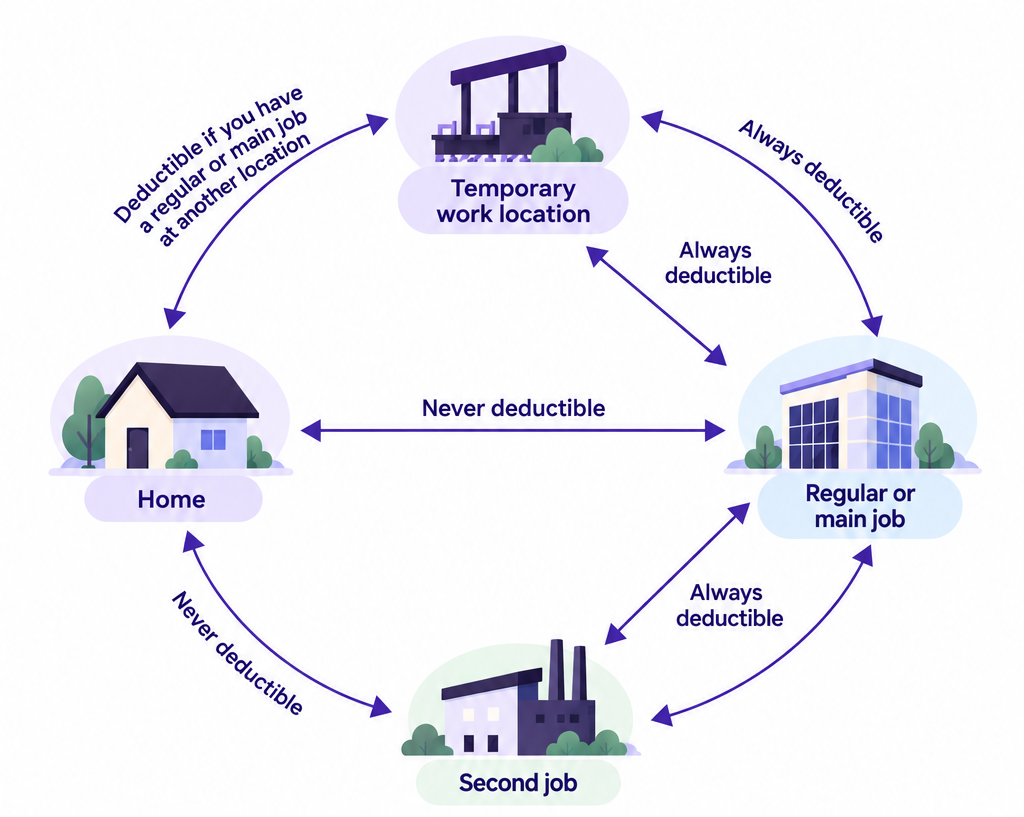
To understand the difference, it helps to know how the IRS defines a few common work locations:
- Home: The place where an employee lives. Travel between home and a regular or main workplace is generally considered personal commuting, not deductible business mileage.
- Regular or main job: An employee's principal place of business, typically their regular office or primary work location. Driving between home and this location is generally considered commuting.
- Temporary work location: A location where an assignment is realistically expected to last, and actually lasts, one year or less. Travel to a temporary work location may qualify as business mileage under certain conditions. For employees without a regular place of business, additional restrictions generally apply, including whether the temporary location is outside their metropolitan area.
- Second job or work location: When an employee travels directly between two workplaces in the same day, whether for the same employer or different employers, that travel generally qualifies as business transportation. For field employees, this commonly includes driving between customer locations or job sites.
These distinctions matter because not every trip taken during the workday qualifies as business mileage, and not every trip starting from home is automatically considered commuting.
The purpose of the trip, the employee's regular work location, and applicable IRS exceptions all help determine how the mileage should be classified.
Here's how business and commuting miles compare.
For employers, the practical takeaway is that mileage classification should happen before reimbursement is calculated.
A clear policy that defines regular workplaces, temporary assignments, and travel between job sites helps ensure the right miles are included in each driver's payment.
It also gives administrators a consistent framework for reviewing mileage claims, supporting accurate reimbursements and IRS compliance.
What Counts as Business Mileage?
Business mileage generally includes driving an employee performs as part of their job, beyond ordinary commuting.
For example, a sales representative might drive from the office to several customer meetings throughout the day.
A service technician might travel between repair appointments. A regional manager might visit multiple company locations.
These trips typically qualify as business mileage because they involve transportation between work locations or other qualifying business destinations.
Common examples include:
- Driving between customer meetings or job sites
- Traveling from an office to a supplier or vendor
- Visiting another company location for business
- Driving to a qualifying off-site meeting or training session
- Traveling between multiple work locations during the same workday
However, the purpose of the trip and the employee's regular work arrangements matter.
For example, driving directly from home to a customer location is not automatically considered business mileage.
Employers need to determine whether the customer location is temporary, whether the employee has another regular workplace, and whether any IRS exceptions apply.
Publication 463 provides the framework for making these distinctions.
What Counts as Commuting Mileage?
Commuting mileage is generally the distance an employee drives between their home and regular place of work.
Imagine an employee who lives 15 miles from the office. They drive there every morning and return home every evening.
Those 30 daily miles are ordinarily classified as commuting, even though the employee needs to make the trip to perform their job.
The IRS considers commuting a personal expense.
This classification generally remains the same if an employee takes business calls during the drive, uses a personal vehicle required by their employer, or travels outside normal business hours.
Employers can choose to help employees cover commuting expenses, but ordinary commuting reimbursements generally cannot receive the same tax-free treatment as properly substantiated business mileage.
This is an important distinction for companies offering car allowances or mileage reimbursement programs.
A payment intended to cover business driving must be supported by qualifying business expenses to receive favorable tax treatment. Simply labeling a payment as mileage reimbursement does not make it tax-free.
When Does Commuting Become Business Mileage?
Not every trip between home and work counts as commuting.
The IRS recognizes certain exceptions, particularly for employees traveling to temporary work locations, working from qualifying home offices, or visiting multiple work sites.
Whether an employee is field-based or in-office also plays an important role in determining which miles qualify as business travel.
- Field-Based Employees: Employees who travel directly from home to customers, job sites, or other business locations without an assigned regular office. Depending on their work arrangements and the nature of each trip, some home-to-work travel may qualify as business mileage.
- In-Office Employees: Employees assigned to a regular office, branch, or reporting center. A reporting center is the office or work location assigned to an employee for commute purposes. Travel between home and this location is generally considered personal commuting, while travel to other business locations may qualify under certain IRS rules.
Understanding these distinctions helps employers apply the following exceptions consistently.
1. Travel to a Temporary Work Location
Travel from home to a temporary work location may qualify as business mileage, particularly when an employee has another regular workplace.
For example, a project manager who normally reports to an office but is assigned to a temporary construction site may be able to count the drive from home as business mileage.
Under IRS rules, an assignment is generally considered temporary if it's expected to last, and actually lasts, 1 year or less.
Additional conditions apply to field-based employees without a regular workplace, including restrictions based on whether the temporary location is outside their metropolitan area.
2. Travel From a Qualifying Home Office
If an employee's home qualifies as their principal place of business under IRS rules, travel from home to another work location in the same business may qualify as business mileage.
This can be particularly relevant for field-based employees who begin their workday at home before traveling to customer locations or job sites.
However, being field-based or working remotely doesn't automatically make home-to-work travel deductible. The home office must meet specific IRS requirements to qualify as a principal place of business.
3. Travel Between Multiple Work Locations
Travel between offices, customer sites, or other work locations during the same day generally qualifies as business mileage.
For example, a field-based sales representative driving between several customer meetings can typically count those miles as business travel.
Similarly, an in-office employee who drives from their assigned reporting center to a customer meeting can generally count that trip as business mileage.
However, an in-office employee's regular commute between home and their assigned office remains personal mileage, as do any personal detours.
For employers, clearly identifying whether drivers are field-based or assigned to a regular reporting center is an important starting point for mileage classification.
A consistent policy should define these work arrangements, account for applicable IRS exceptions, and establish documentation requirements for qualifying business trips.
How Do Business and Commuting Miles Affect Mileage Reimbursement?
The difference between business and commuting miles directly affects how much an employer can reimburse tax-free.
The IRS publishes an optional standard mileage rate that employers can use to calculate reimbursements for qualifying business driving.
For July 1 through December 31, 2026, the IRS business standard mileage rate is 76 cents per mile. The rate was 72.5 cents per mile for January 1 through June 30, 2026.
Consider an employee who records the following mileage in October 2026:
In this example, an employer using the applicable IRS standard mileage rate would calculate a $608 reimbursement for the employee's 800 qualifying business miles.
The 400 commuting miles would remain outside the tax-free business mileage calculation.
If the employer mistakenly included all 1,200 miles, the calculated payment would increase to $912.
That creates $304 in additional payment that is not supported by qualifying business mileage.
Unless another applicable exclusion applies, that excess amount would generally need to be treated as taxable compensation.
Across a larger field team, consistent mileage classification helps employers manage reimbursement spending and maintain accurate records.

Can Employers Reimburse Commuting Miles?
Yes. Employers can choose to compensate employees for commuting expenses.
However, ordinary commuting payments generally need to be treated as taxable wages rather than tax-free business expense reimbursements.
Under IRS accountable plan rules, tax-free reimbursements generally must satisfy three requirements:
- Business connection: The expense must have a qualifying business purpose.
- Adequate substantiation: Employees must provide appropriate documentation of the expense within a reasonable period.
- Return of excess payments: Employees must return amounts exceeding substantiated expenses within a reasonable period.
Amounts that don’t satisfy accountable plan requirements might need to be treated as taxable wages.
Employers should also distinguish federal tax treatment from state employment laws. Some states impose additional requirements concerning reimbursement of necessary employee business expenses.
The fact that a trip is considered commuting for federal tax purposes does not automatically resolve every employer obligation under applicable state law.
How Should Employers Track Business Miles and Commuting Miles?
A reliable mileage reimbursement program starts with accurate trip records and a clear mileage reimbursement policy for classifying travel.
According to IRS Publication 463, mileage records generally need to establish when business travel occurred, where the employee traveled, the business purpose, and the distance driven.
Depending on the reimbursement method, employees may also need to document total annual vehicle mileage and maintain supporting records.
For companies with employees driving every day, the challenge is making that process manageable.
A field sales representative might visit five customers in a day. A service technician could complete several appointments across a large territory.
Expecting every driver to manually reconstruct their mileage at the end of the month can create unnecessary administrative work and increase the likelihood of incomplete records.
Mileage tracking software can help by capturing trips and supporting business-versus-personal classification.
Still, employers need a consistent policy behind the technology. Tracking a trip does not, by itself, establish that the mileage qualifies for tax-free reimbursement.
Can Commuting Mileage Deductions Be Automated?
Yes. Mileage tracking software can automate commute deductions, helping employers consistently exclude commuting miles from reimbursable business mileage without requiring employees to calculate those deductions manually.
Cardata offers several configurable ways to automatically deduct commute mileage from an employee's reported business mileage.
The right configuration depends on how employees travel, where they typically work, and how the company defines reimbursable mileage.
When establishing automated commute rules, employers should consider three key questions.
1. Where Do Your Employees Typically Work?
An employee's work arrangement is the starting point for determining how commute deductions should be configured.
- Field-Based Employees: Employees who primarily travel directly from home to customers, job sites, or other business locations without an assigned regular office.
- In-Office Employees: Employees assigned to a regular main office, branch, or reporting center that they're expected to visit regularly.
These distinctions help employers determine which commute rules are appropriate for different groups of drivers.
For example, an in-office employee may have a defined commuting distance to their assigned reporting center, while a field-based employee's daily travel patterns may vary depending on customer locations.

2. How Should Commute Mileage Be Calculated?
Commute deductions can be calculated using different automated methods, depending on the company's reimbursement policy.
- Distance-Based Deductions: Automatically subtract a preset number of miles, such as the distance between an employee's home and assigned office or reporting center.
- Trip-Based Deductions: Calculate commute mileage using the employee's actual first and last tracked trips of the day, based on established commute rules.
Distance-based deductions provide a more predictable approach, while trip-based deductions reflect the actual distances employees travel at the beginning and end of their workday.
Employers can also configure rules around assigned reporting centers, including whether an employee starts or ends their day at home or visits their designated office location.
3. When Should Commute Deductions Apply?
Employers can also determine when automated deductions are triggered. Depending on the company's reimbursement policy, deductions may apply:
- When an employee starts or ends their day at home: Apply commute deductions based on where the employee begins or finishes their workday.
- When an employee visits their assigned office: Apply deductions when travel involves a designated reporting center.
- Every day an employee reports business mileage: Apply a consistent daily deduction according to the company's established commute policy.
These configurations allow employers to balance consistency with the realities of how their employees travel.
The right approach depends on the organization's policies, workforce structure, and the types of trips employees regularly make.
Automated commute deductions can reduce the time spent manually reviewing and adjusting mileage records. However, automation doesn't replace employee responsibility for identifying personal travel.
For example, if an employee drives from home to get coffee, drops their children off at school, and then travels to a customer meeting, an automated rule may account for the applicable commute deduction but not necessarily the additional personal stops.
Employees still need to review their mileage records and correctly classify personal trips.
With the right configurations and review processes in place, automated commute deductions can help employers apply reimbursement policies consistently, reduce administrative work, and maintain accurate mileage records.
3 Practices That Help Employers Manage Mileage Correctly
1. Define Commuting Rules in Your Vehicle Policy
Explain how your organization classifies travel between home, regular workplaces, temporary assignments, and customer locations.
Include examples that reflect how employees actually work, including remote employees and drivers who travel directly to customer locations.
Clear guidance helps reduce inconsistent decisions and gives employees a better understanding of which trips qualify.
2. Make Mileage Classification Easy for Drivers
Give employees a straightforward way to identify business and personal trips, correct mistakes, and review their mileage records.
Automated tracking can reduce manual work, but employees should still have a way to confirm the business purpose and classification of their trips.
This is especially important for organizations using a Fixed and Variable Rate (FAVR) reimbursement program, where accurate business mileage supports reimbursement calculations and IRS compliance.
3. Review Mileage Data Before Approving Payments
Managers should have visibility into reported business mileage, unusual claims, and adjustments.
Regular reviews help employers maintain reliable records, identify potential errors, and manage reimbursement spending.
They also provide an opportunity to assess whether employee driving patterns still align with the company's reimbursement policies and program structure.
Together, these practices support accurate reimbursement administration and the business-purpose documentation requirements outlined in Publication 463.
Make Business Mileage Reimbursement Easier to Manage
Understanding the difference between business miles and commuting miles is an important part of building a fair, compliant, and cost-efficient vehicle reimbursement program.
For employers, accurate classification is only one piece of the process.
Reliable mileage records, clear reimbursement policies, and regular program oversight help ensure employees are reimbursed appropriately while giving Finance and HR teams greater confidence in their decisions.
Cardata helps businesses manage these responsibilities through fully managed vehicle reimbursement programs that combine mileage tracking, automated commute deductions, compliance support, and reimbursement administration.
With flexible commute rules tailored to company policies and employee work arrangements, Cardata helps reduce manual work, improve mileage accuracy, and simplify program management.
Talk to Cardata to learn how a fully managed reimbursement program can support your team.
Talk to Cardata