

Every year, the IRS sets the standard mileage rate used to calculate tax-free reimbursement and tax deductions for millions of miles driven for work.
Whether you're reimbursing employees or tracking deductible business mileage, understanding the current rate helps ensure reimbursements stay fair, compliant, and up to date.
Read on to learn the current rate, how it's set, and the full history of rate changes going back three decades, including every mid-year adjustment and what drove it.
The Current IRS Standard Mileage Rate (2026)
The 2026 IRS standard mileage rate started the year at 72.5 cents per business mile. On July 1, 2026, the IRS increased it to 76 cents per mile to keep pace with the rising cost of driving.
Mid-year changes like this aren’t common. But in 2026, the cost of driving has risen faster than expected. There’s been fuel price volatility, along with continued increases in insurance, maintenance, and depreciation.
These are the factors that likely prompted the IRS to update the rate six months into the year instead of waiting until January.
Here is a breakdown of the IRS standard mileage rate in 2026:
One thing to note is that the charitable rate is set by statute rather than IRS discretion, which is why it rarely changes. These rates apply across gasoline, diesel, hybrid, and fully electric vehicles.
How Does the IRS Calculate the Standard Mileage Rate?
Each year, The IRS bases the standard mileage rate on annual studies of vehicle ownership and operating costs. It looks at both fixed costs like depreciation, insurance, and licensing, and variable costs like fuel, maintenance, and tires.
That annual cost study has historically been conducted by an independent firm on the IRS's behalf, looking at real-world driving costs across the country.
The medical and moving rate is narrower, reflecting mainly variable costs like fuel.
A portion of the business rate is specifically attributed to depreciation each year, since that's typically the single largest fixed cost of vehicle ownership. The remaining portion covers the variable, day-to-day costs of driving.
Because these underlying costs shift with the broader economy, the rate typically moves a few cents in either direction each year.
How Often Does the IRS Change the Mileage Rate Mid-Year?
Not often. The IRS typically updates the standard mileage rate once a year, with new rates taking effect on January 1.
Mid-year changes are the exception rather than the rule. Since the late 1990s, however, it has made only five mid-year adjustments: 2005, 2008, 2011, 2022, and 2026.
These rare updates occurred when the cost of owning and operating a vehicle rose much faster than expected after the annual rate had already been announced.
Rather than waiting until the following January, the IRS adjusted the rate mid-year to better reflect the real cost of driving.
(highlight)
Want the full story behind these rate changes? Read our guide to the history of the IRS standard mileage rate, where we break down every major rate change since 1994.
(highlight)
Who Can Use the IRS Standard Mileage Rate?
The IRS standard mileage rate applies in a few different situations, but not everyone uses it in the same way.
Employers often use the business mileage rate to reimburse employees who drive their personal vehicles for work. When reimbursements are made through an IRS-compliant accountable plan and employees maintain proper mileage records, those payments can generally be made tax-free.
Self-employed individuals can also use the business mileage rate to calculate the deductible cost of driving for business use instead of tracking every vehicle expense individually, provided they meet the IRS requirements.
The IRS also publishes separate rates for medical or qualifying moving travel and charitable driving.
The medical and moving rate applies only in limited circumstances, such as qualifying moves by active-duty members of the U.S. Armed Forces. The charitable rate applies to eligible volunteer driving for qualified charitable organizations.
While the standard mileage rate serves all of these purposes, the business rate is the one most employers use when reimbursing employees for work-related driving.
How the Rate Applies to Reimbursement Programs
The IRS standard mileage rate doesn't work the same way for every reimbursement program. Sometimes it's the reimbursement rate itself. Other times, it's simply a tax or compliance benchmark.
Here's how it applies to the most common programs:
- Cents-Per-Mile (CPM) programs use the IRS standard mileage rate directly as the per-mile reimbursement amount.
- Tax-Free Car Allowance (TFCA) programs use the IRS rate as a ceiling. As long as total reimbursement doesn't exceed what the employee would receive at the IRS rate, it can remain tax-free. Any amount above that may become taxable if it isn't properly substantiated.
- Fixed and Variable Rate (FAVR) programs don't use the IRS standard mileage rate to calculate reimbursements. Instead, FAVR uses its own IRS-approved methodology to reimburse employees for the real, business-required cost of owning and operating a personal vehicle for work. The IRS rate still matters, though, because the IRS also sets a maximum standard automobile cost each year. That limit caps the vehicle value employers can use when calculating FAVR reimbursements.

A Brief History of the IRS Standard Mileage Rate
Curious about how the IRS standard mileage rate has changed over the years?
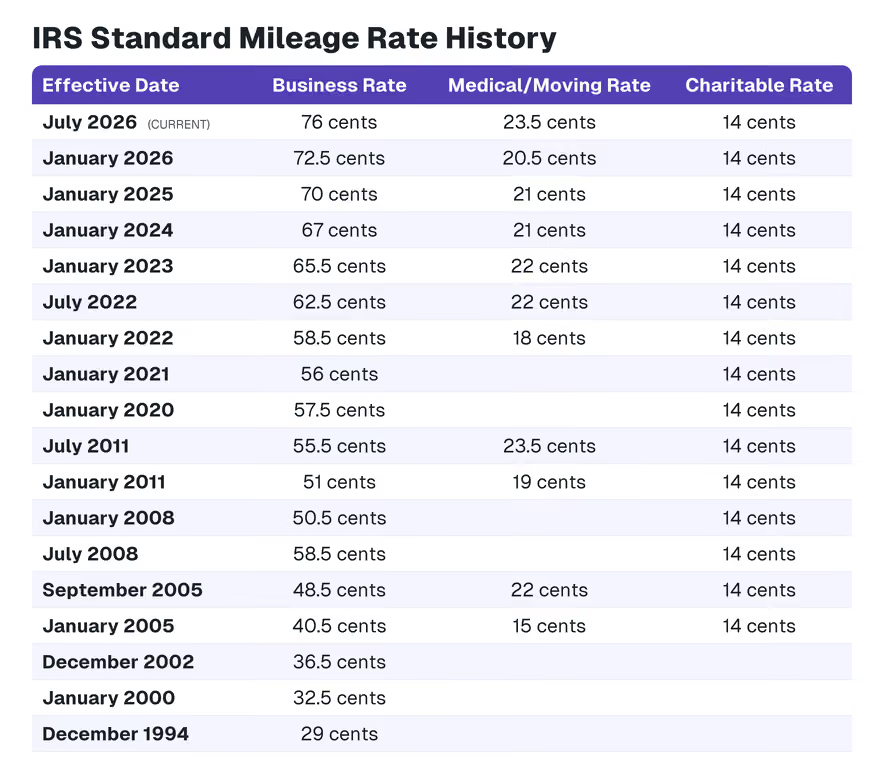
The table below shows every business standard mileage rate since the IRS first introduced it, including the years when the rate changed mid-year.
Between the years shown here, the rate generally changed by just a few cents at a time, reflecting gradual shifts in fuel, insurance, maintenance, and other driving costs.
Aside from the 2011 mid-year adjustment, you can see that the 2010s were a relatively stable period.
How Should Employers Use the IRS Mileage Rate?
The IRS standard mileage rate is more than just an annual number.
It's the benchmark many organizations use to reimburse employees for driving their personal vehicles for work, and it plays an important role in keeping those reimbursements fair and tax compliant.
For organizations using a Cents-Per-Mile (CPM) program or a Tax-Free Car Allowance (TFCA), changes to the IRS rate matter right away.
A mid-year update like the one in July 2026 may mean reimbursement rates need to be adjusted. Otherwise, payments can quickly fall below the current cost of driving or, in some cases, create tax issues if they exceed IRS limits without proper substantiation.
This is one reason many organizations choose Fixed and Variable Rate (FAVR) reimbursement or a mixed reimbursement model.
Rather than relying on a single national mileage rate, FAVR reimburses employees for the real, business-required cost of owning and operating a personal vehicle for work, using local cost data.
As a result, it's less affected when the IRS updates the standard mileage rate. Many organizations use FAVR for high-mileage employees and CPM for employees who drive only occasionally, balancing accuracy with simplicity.
Following the unusual mid-year increase in July 2026, the next milestone will be the 2027 IRS standard mileage rate.
We expect the 2027 rate to be announced around the start of the new year, consistent with the IRS's annual rate-setting process.
When it is released, organizations using the standard mileage rate should review what the new rate means for their 2027 reimbursement programs.
Staying current on IRS guidance helps organizations keep their reimbursement policies aligned with current requirements and gives employees greater clarity about how their business driving is reimbursed.
If you're reviewing your vehicle reimbursement program ahead of 2027, Cardata can help.
We work with organizations to design and manage tax-free reimbursement programs, including CPM, TFCA, FAVR, and mixed reimbursement models, so you can choose an approach that fits your employees, driving patterns, and business needs.
Book a Demo With Cardata


.avif)
.jpg)
