
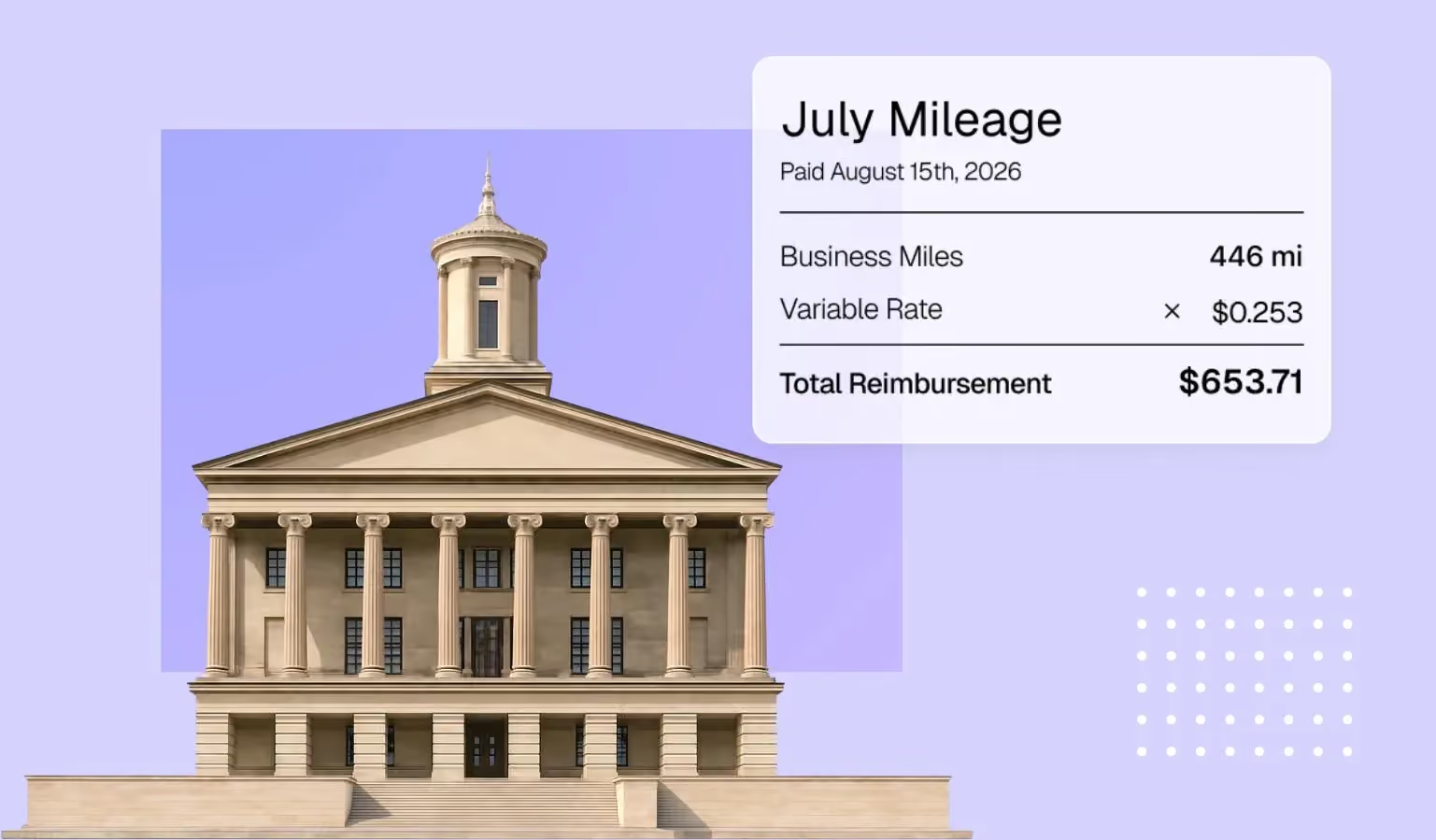
Fixed and Variable Rate (FAVR) reimbursement can provide tax-free vehicle reimbursement when the program and participating employees meet applicable IRS requirements.
FAVR reimburses employees for the real, business-required cost of owning and operating a personal vehicle for work.
It combines fixed payments for ownership costs with variable payments for operating costs.
When applicable FAVR and accountable plan requirements are satisfied, qualifying reimbursements can be excluded from an employee’s taxable wages.
Tax treatment can change when an employee or allowance fails a FAVR requirement.
Other IRS mileage allowance rules may then determine how much of the reimbursement can still be treated as substantiated.
Here’s how FAVR tax treatment works in 2026 and what employers need to know about keeping a program compliant.
Is FAVR Reimbursement Tax-Free?
FAVR reimbursement can be tax-free when the allowance meets IRS FAVR requirements and the employee satisfies the applicable substantiation requirements.
Under IRS Revenue Procedure 2019-46, vehicle expenses reimbursed using a qualifying FAVR allowance can be treated as substantiated for tax purposes.
FAVR includes two types of payments: Fixed and variable.
Fixed payments account for projected ownership costs such as depreciation or lease payments, insurance, registration and license fees, and applicable personal property taxes.
Variable payments account for projected operating costs such as fuel, oil, tires, maintenance, and repairs.
The reimbursement calculation uses a standard automobile, projected business mileage, geographic cost data, and other program assumptions.
This gives employers a consistent way to reimburse employees for business-required vehicle costs across a workforce.
Which FAVR Requirements Can Affect Tax Treatment?
FAVR has compliance requirements at both the program and employee level. Employers need to consider more than a single mileage threshold or vehicle rule.
Important requirements include:
FAVR also has rules governing annual business mileage assumptions, business-use percentage, standard automobile cost, documentation, and rate calculations.
What Is the FAVR Mileage Requirement?
The commonly referenced 5,000-mile rule is only part of the FAVR mileage requirement.
At the employee level, a driver must substantiate at least 5,000 business miles during the calendar year or, if greater, 80% of the annual business mileage used by the FAVR allowance.
Imagine a FAVR allowance based on 10,000 annual business miles. Eighty percent is 8,000 miles, so the employee would need to substantiate at least 8,000 business miles.
The IRS permits this requirement to be prorated monthly when an employee is covered by the allowance for only part of the calendar year.
There is also a separate program-level requirement. The annual business mileage used to calculate a FAVR allowance cannot be less than 6,250 miles per year.
That creates an important distinction:
- Program calculation: At least 6,250 projected annual business miles.
- Employee requirement: At least 5,000 substantiated business miles or 80% of the allowance’s annual business mileage, whichever is greater.
The IRS also limits the business-use percentage used in a FAVR calculation to 75%.
How Does FAVR Vehicle Cost Compliance Work?
FAVR reimbursement is based partly on what the IRS calls a standard automobile.
Cardata may use vehicle profiles when designing a program for different employee groups, but the standard automobile is the IRS concept underlying each specific FAVR allowance.
An employee does not need to drive the exact standard automobile. Their vehicle does need to satisfy the applicable IRS requirements.
For an employee vehicle to qualify, its cost when new must have been at least 90% of the standard automobile cost used to calculate the employee’s FAVR allowance during the first calendar year the vehicle is covered.
The IRS looks at the vehicle's cost as a new vehicle, including when the employee purchased the vehicle used.
The IRS also sets a maximum standard automobile cost each year. For 2026, IRS Notice 2026-10 sets that maximum at $61,700 for automobiles, including trucks and vans.
This means vehicle selection matters both to the reimbursement calculation and to employee compliance.

How Does Vehicle Age Affect FAVR Compliance?
Every FAVR allowance has a retention period. This represents the number of calendar years the employer expects an employee to drive the standard automobile before replacing it.
The IRS requires a retention period of at least two calendar years.
An employee vehicle’s model year also cannot differ from the current calendar year by more than the number of years in the applicable retention period.
For example, an employer may select a retention period based on the vehicle needs of a particular employee group.
Employees whose vehicles fall outside the permitted model-year range may no longer satisfy that FAVR vehicle requirement.
The retention period also influences the reimbursement calculation because projected ownership costs depend partly on how long the standard automobile is expected to remain in service.
What Vehicle Information Do Employees Need to Provide?
FAVR requires documentation as well as rate calculations.
Within 30 days after a FAVR allowance first covers an employee’s vehicle, or covers it again after a lapse, the employee must provide a written declaration with required information.
That includes the vehicle’s make, model and year, proof of insurance coverage limits, odometer reading, and applicable vehicle cost information.
The IRS also requires information related to certain depreciation methods for owned vehicles or actual-expense treatment for leased vehicles.
Employees have annual documentation responsibilities too.
These requirements give employers or their program administrators the information needed to determine whether a vehicle continues to meet applicable FAVR rules.
Accurate mileage records are equally important.
IRS Publication 463, Travel, Gift, and Car Expenses explains the recordkeeping principles for business transportation expenses and accountable plans.
Timely records can help substantiate mileage, dates, destinations, and business purpose.
Is FAVR Vehicle Compliance the Same as a Company Vehicle Policy?
FAVR vehicle requirements and an employer’s internal vehicle policy serve different purposes.
FAVR requirements help determine whether an employee can be treated as covered by a FAVR allowance under IRS rules.
An employer can also establish its own policies based on business and risk requirements. These might address vehicle condition, insurance, suitability for a role, or maximum vehicle age.
A company policy can therefore set requirements beyond the FAVR rules.
Keeping the two concepts clear makes it easier for employees to understand which requirements affect FAVR treatment and which come from their employer’s internal policy.
What Happens When a Driver Falls Out of FAVR Compliance?
When a FAVR requirement is not satisfied, the tax treatment depends on the circumstances.
Revenue Procedure 2019-46 says that when a mileage allowance fails one or more FAVR requirements, the employee receiving the allowance is not treated as covered by FAVR during the period of failure.
Other IRS mileage allowance rules can still determine how much of the employee’s vehicle expenses are treated as substantiated.
This is an important distinction. A driver can fail a FAVR requirement while still having legitimate and adequately documented business mileage.
Under IRS accountable plan rules, employees generally need a business connection for reimbursed expenses, must adequately account for those expenses within a reasonable period, and must return applicable excess reimbursements within a reasonable period.
Amounts that fail the accountable plan requirements can be treated as wages. IRS Publication 463 provides more detail on these rules.
How Does the IRS Mileage Rate Affect FAVR Tax Treatment?
FAVR uses its own fixed and variable methodology. Employers do not calculate a FAVR reimbursement simply by multiplying business mileage by the IRS standard mileage rate.
The IRS standard mileage rate can still become relevant under the IRS mileage allowance rules when a payment does not satisfy FAVR requirements.
There are two business standard mileage rates in 2026:
The IRS increased the rate to 76 cents effective July 1, 2026 after increases in fuel prices.
The timing matters. IRS Announcement 2026-11 applies the revised rate to qualifying transportation expenses paid or incurred on or after July 1 and to mileage allowances that meet its July 1 effective-date conditions.
Employers reviewing 2026 reimbursements therefore need to use the rate that applies to the relevant expense and reimbursement period.
How Can Employers Keep FAVR Tax Treatment Clear?
Good FAVR administration starts with program design and continues throughout the year.
Employers need to consider employee roles, business mileage, geography, reasonable vehicle requirements, retention periods, insurance, and the data used to calculate reimbursement rates.
Employee circumstances can change. Drivers replace vehicles, mileage patterns shift, and insurance information needs updating. Regular monitoring helps employers identify those changes and maintain accurate records.
Technology can support that work through mileage capture, insurance verification, compliance monitoring, and centralized reporting.
The goal is straightforward: reimburse employees fairly for the business-required costs of using their personal vehicles while maintaining the records and program controls needed to support the intended tax treatment.
Build a FAVR Program Around How Your Team Drives
FAVR can give employers a structured, tax-efficient way to reimburse employees for the real, business-required costs of owning and operating personal vehicles for work.
Getting the intended tax treatment depends on the details. Mileage, vehicle requirements, insurance, documentation, employee eligibility, and thoughtful program design all play a role.
Cardata helps companies design and manage FAVR programs around employee roles, mileage, geography, and business requirements.
If you’re evaluating FAVR or reviewing an existing vehicle reimbursement program, connect with Cardata to build a program that is clear, compliant, and practical for your team.
Talk to Cardata

.jpg)
.jpg)
.jpg)
