
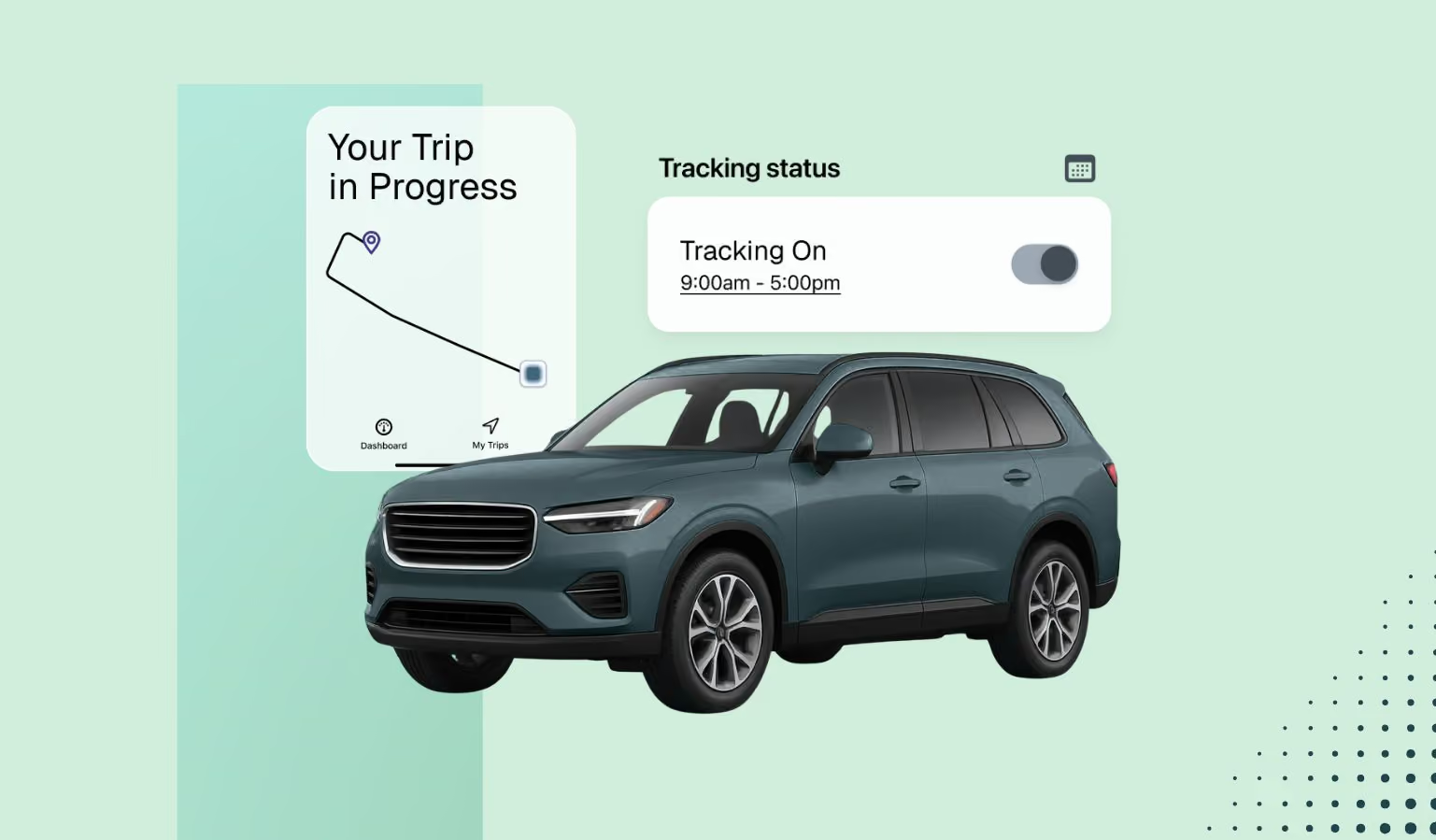
On the surface, mileage reimbursement seems simple. Employees track their business miles, submit them for approval, and get reimbursed.
In practice, there's a lot more involved. Organizations need accurate mileage records, fair reimbursements, reliable reporting, and confidence that every payment meets IRS requirements. Managing all of that manually can quickly become time-consuming.
That's where artificial intelligence (AI) is starting to make a difference.
Combined with GPS mileage capture and modern reimbursement software, AI helps automate routine tasks, analyze reimbursement data, identify unusual activity, and surface reporting insights involved in managing a vehicle reimbursement program.
Instead of replacing reimbursement programs, AI helps organizations run them more efficiently by reducing administrative work and making reimbursement data easier to understand.
Why Mileage Reporting Matters
Mileage reimbursement might seem like a small administrative task, but it touches finance, HR, payroll, compliance, and every employee who drives for work.
Every business mile needs to be documented accurately. Under an IRS accountable plan, reimbursements generally require records showing the time, place, business purpose, and mileage of each trip.
Missing information can create additional work for administrators and, in some situations, may affect the tax treatment of reimbursements.
Accurate mileage records also matter because they directly influence reimbursement costs. Small errors repeated across dozens or hundreds of drivers can add up surprisingly quickly.
That makes mileage tracking more than a reporting exercise. It's an important part of controlling costs while making sure employees are reimbursed fairly.
The Hidden Costs of Manual Mileage Reporting
Manual mileage reporting creates work for everyone involved.
Employees have to log every business trip, reconstruct routes, and submit mileage reports each month.
Managers then review those submissions, finance reconciles reimbursements, and payroll processes the payments.
It's a process that's easy to underestimate until you calculate the time involved.
Based on Cardata's internal data from customers using GPS-powered mileage capture, employees can save up to 42 hours each year compared to manual mileage logging.
That's nearly an entire workweek returned to selling, servicing customers, or supporting operations instead of filling out mileage reports.
And the financial impact goes beyond productivity. Manual reporting also increases the likelihood of:
- Missed or forgotten trips
- Duplicate mileage entries
- Typing errors
- Mileage estimates instead of actual routes
- Additional time spent reviewing and correcting reports
Across a large driver population, even small inaccuracies can result in unnecessary reimbursement costs or lengthy approval cycles.
Where AI Makes the Biggest Difference in Mileage Reimbursement
GPS technology solved the problem of automatically recording mileage. AI helps organizations manage everything that comes next.
Rather than asking administrators to review every mileage submission manually, AI can quickly analyze trip data, identify potential issues, and surface the records that deserve a closer look.
Instead of spending time searching for problems, administrators can focus on reviewing the exceptions that actually require attention.
For example, imagine an employee who typically drives 500 business miles each month suddenly logs 1,200 miles.
Rather than relying on someone to spot the discrepancy manually, AI can flag the unusual activity for review before reimbursement is approved. It surfaces potential issues, rather than making reimbursement decisions on its own.
The same technology can identify missing trip details, policy exceptions, or incomplete documentation that might otherwise go unnoticed.
For organizations managing hundreds or thousands of drivers, this significantly reduces administrative effort while helping reimbursement teams work more efficiently.
How AI Improves Mileage Reporting and Analytics
Beyond day-to-day administration, AI also gives organizations a clearer picture of how their reimbursement program is performing.
Instead of manually exporting spreadsheets and building reports, AI-powered analytics can organize reimbursement data into dashboards, summarize trends, and answer questions in seconds.
Finance, HR, and operations teams can spend less time gathering data and more time using it to make informed decisions.
For example, organizations can quickly understand:
- Which departments have the highest reimbursement costs?
- Are reimbursement expenses increasing in certain regions?
- How are reimbursement costs changing over time?
- Which reimbursement programs are being used most frequently?
- Are there opportunities to improve efficiency or adjust reimbursement policies?
By turning thousands of individual trips into meaningful business insights, AI helps organizations monitor program performance, identify trends earlier, and make data-driven decisions with greater confidence.
AI Doesn't Replace Compliance
Artificial intelligence can automate many parts of a reimbursement program, but it doesn't replace the IRS rules that determine whether reimbursements remain tax-free.
IRS-compliant programs still require accurate mileage records, documentation that supports the time, place, and business purpose of each trip, and reimbursement policies that are administered correctly.
AI can help capture, organize, and analyze that information, but it can't determine whether a reimbursement program is designed or managed in accordance with IRS requirements.
That's why many organizations pair AI-powered software with a managed reimbursement partner.
The technology automates mileage capture, surfaces reporting insights, and helps identify potential issues, while reimbursement experts oversee program design, monitor compliance requirements, and help ensure reimbursements remain accurate and tax-free.
Technology makes the process faster and more efficient. Expertise helps ensure it's done correctly.
Building an Optimized Vehicle Reimbursement Program
For organizations still relying on spreadsheets or manual mileage logs, AI represents an opportunity to simplify one of the most time-consuming parts of vehicle reimbursement.
Combined with an IRS-compliant reimbursement program, GPS mileage capture, and expert program management, AI helps reduce manual work, improve reporting accuracy, and give organizations greater confidence in every reimbursement they make.
The result is a reimbursement program that's easier to manage for administrators, easier to use for employees, and better equipped to support accurate, compliant reimbursements over the long term.
Ready to See What's Possible?
The first step is understanding how your organization manages mileage today. How much time do employees spend tracking trips? How many manual corrections does payroll make each month? How easy is it to answer questions about reimbursement costs, reporting, or compliance?
Those answers can help identify where automation will have the biggest impact.
At its core, AI isn't changing why organizations reimburse employees. It's changing how reimbursement programs are managed.
By reducing manual work, improving visibility, and turning reimbursement data into actionable insights, AI gives finance, HR, and operations teams more time to focus on running an effective program instead of administering one.
For organizations looking to modernize their approach, the right technology is only part of the equation.
A well-designed, IRS-compliant reimbursement program ensures employees are reimbursed fairly while giving administrators the tools and support they need to manage the program with confidence.
That's where Cardata can help. We combine AI-powered reporting, GPS mileage capture, and fully managed, IRS-compliant reimbursement programs to help organizations reduce administrative work, improve visibility, and simplify driving for work.
Talk to Cardata

.avif)
.jpg)
