For last-mile delivery companies, reviewing mileage can involve more than checking what a driver submitted. You may also need to confirm that reported business mileage makes sense based on the delivery route that employee was expected to complete.
Doing that manually means comparing mileage submissions with route information to find the differences yourself.
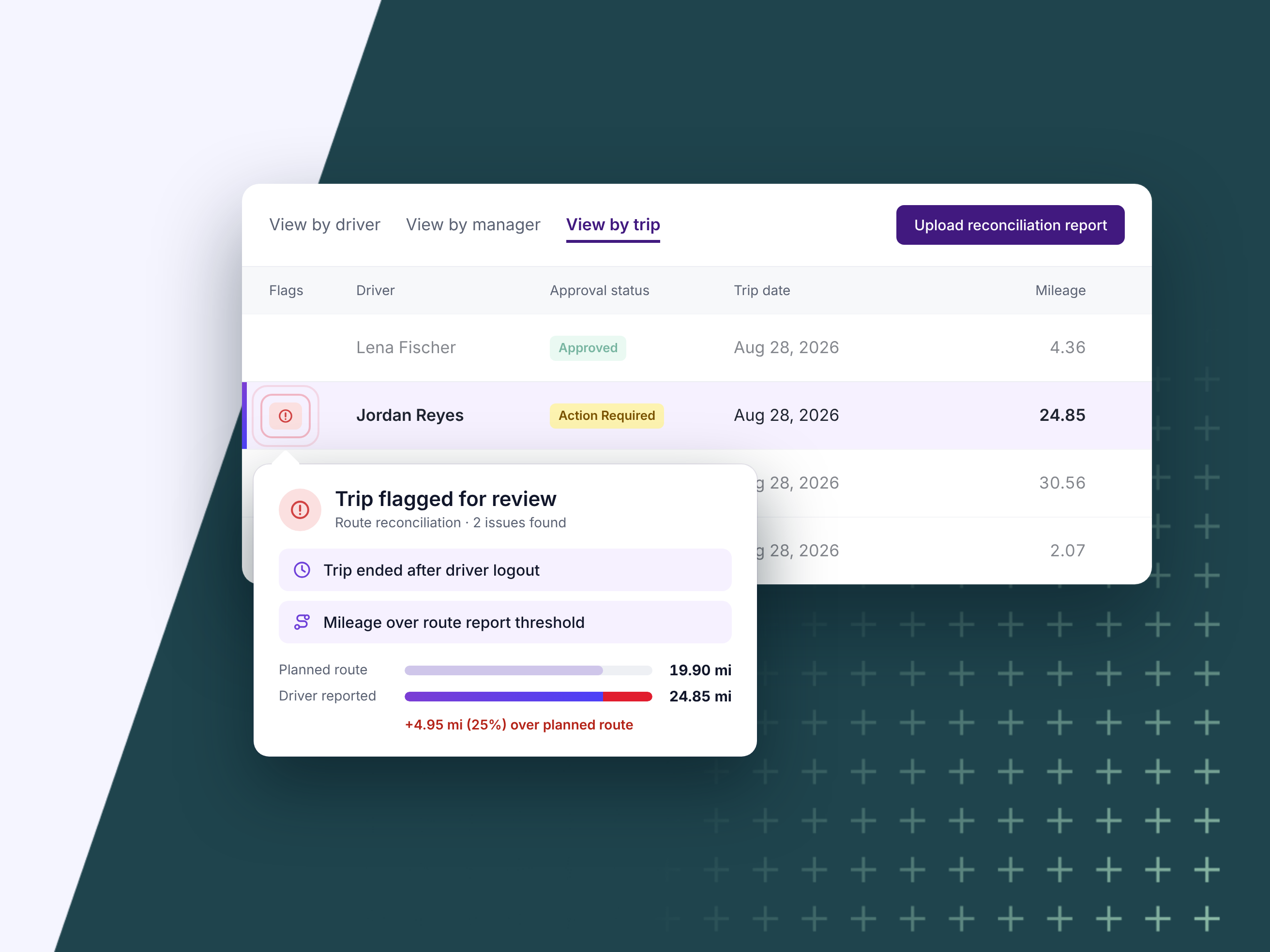
That’s why we’ve introduced Route Reconciliation. It automatically compares reported business mileage and trip timing against expected route information, then flags discrepancies in Mileage Approval for your team to review.
What Changed?
Route Reconciliation gives last-mile delivery companies a simpler way to compare reported business mileage against expected delivery activity.
After a route report is uploaded, Cardata compares expected route information with the business mileage submitted by your drivers and identifies discrepancies.
Cardata can then flag:
- Distance differences: A driver’s total reported business mileage for the day is meaningfully higher or lower than the planned route distance.
- Early starts: A trip starts before the driver’s login time in the route report.
- Late ends: A trip ends after the driver’s logout time in the route report.
When a discrepancy is identified, it appears as a flag in Mileage Approval with the reason the trip was flagged.
A flag is informational and does not prevent approval. It simply shows your team where reported mileage or trip timing differs from what was expected so you can decide whether it needs additional review.
Why Does It Matter?
Reported mileage will not always match an expected delivery route exactly. The challenge is identifying the differences that deserve attention.
A driver may report more or fewer miles than planned. An employee may start a trip before logging in for their route or continue driving after logging out. There may be a reasonable explanation for any of these differences.
When reported mileage and expected route information are reviewed separately, admins have to compare the records themselves to find potential discrepancies. For last-mile delivery companies managing mileage across many drivers and routes, that can add unnecessary work to the approval process.
Route Reconciliation brings those discrepancies to the surface automatically.
Instead of searching through separate records to find where something does not line up, admins can quickly see which mileage may need a closer look before reimbursement is approved.
Importantly, a flag does not mean the reported mileage is incorrect. It tells your team that the mileage or trip timing differs from the expected route, giving admins more context before making a reimbursement decision.
How Does This Help You Do Your Job?
For last-mile delivery companies managing mileage across many drivers and routes, manually comparing every submission against expected delivery activity can add unnecessary work to the approval process.
Route Reconciliation helps you focus that effort where it matters.
You can quickly identify potential over- or under-reported mileage, spot trips that fall outside expected delivery activity, and see why a trip was flagged directly within Mileage Approval.
Because flags are informational, your team remains in control of the final decision. If you review a discrepancy and are satisfied with the reported mileage, you can approve the trip without additional steps.
The result is a more focused mileage review process that helps you spend less time comparing reports and gives you clearer context when making reimbursement decisions.
Focus Your Review Where It Matters
Mileage review should not require manually comparing every route just to find the few differences that need attention.
With Route Reconciliation, last-mile delivery companies can automatically surface discrepancies between reported business mileage and expected routes, review the relevant context, and make more informed reimbursement decisions.
Less manual comparison. Clearer mileage reviews. More time focused on the exceptions that actually need your attention.
