
.jpg)
Payroll and income taxes can affect the cost of business driving when employers provide vehicle benefits or payments to employees.
The tax treatment depends largely on how the vehicle program is structured.
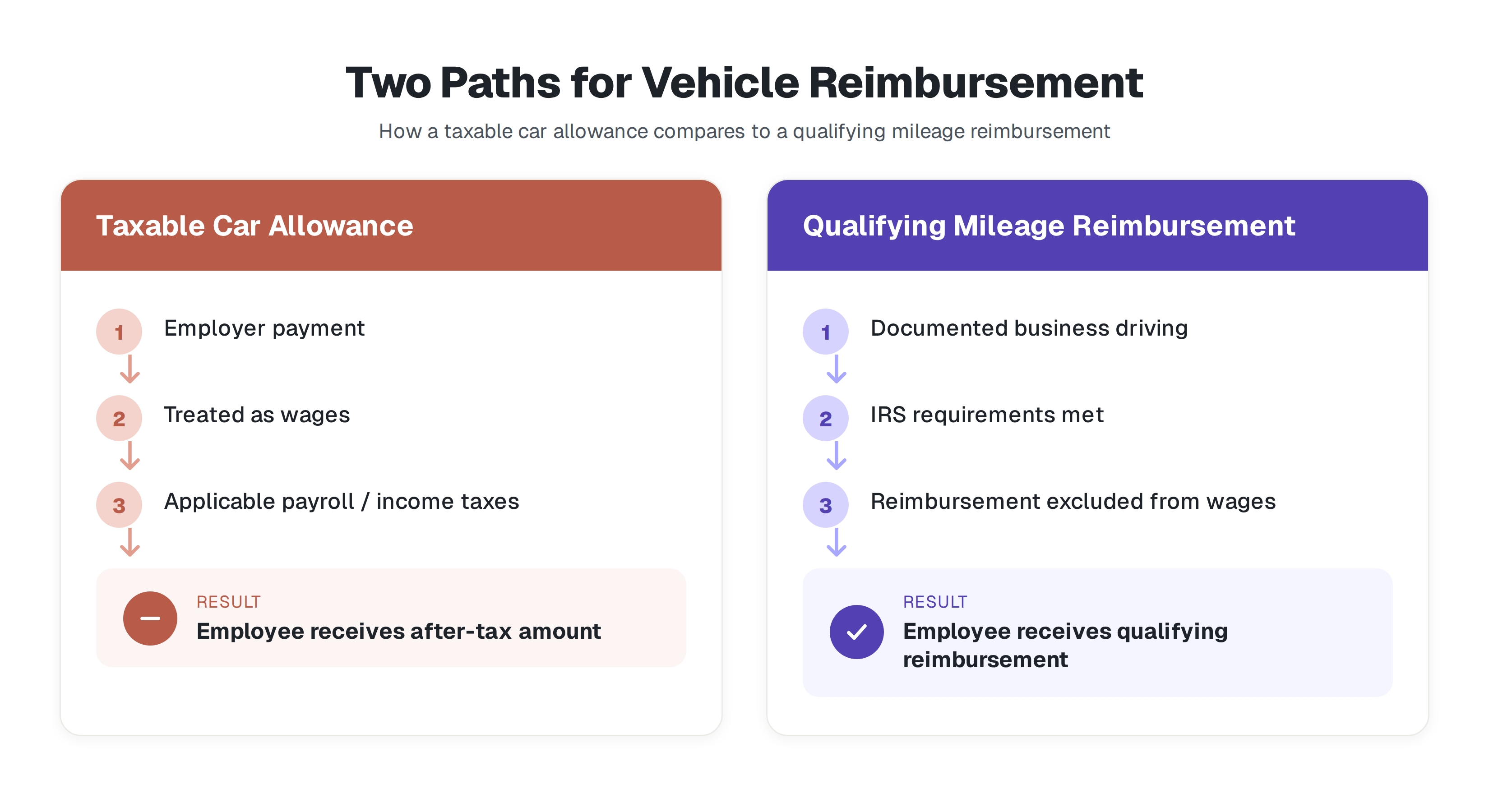
A taxable car allowance, for example, is generally treated as wages and subject to applicable income and employment taxes.
Qualifying vehicle reimbursements can generally be excluded from an employee’s taxable wages when they meet IRS requirements.
For employers with employees who drive for work, understanding that difference can help Finance, HR, and Operations teams choose a vehicle program that is clear, practical, and tax-efficient.
How Do Payroll Taxes Affect Business Driving?
Payroll taxes come into play when a vehicle payment or benefit is treated as employee wages.
One of the main employment taxes employers need to consider is the Federal Insurance Contributions Act (FICA) tax. FICA consists of Social Security and Medicare taxes.
The Social Security tax rate is 6.2% for the employee and 6.2% for the employer, up to the applicable Social Security wage base.
The Medicare tax rate is 1.45% for the employee and 1.45% for the employer. Additional Medicare Tax rules can also apply to certain employees.
For wages subject to both taxes, employers generally contribute 7.65% through Social Security and Medicare taxes, while employees generally have the same combined rate withheld.
Social Security is subject to an annual wage base, and additional Medicare tax rules can apply to certain employees.
This becomes important when comparing a taxable vehicle allowance with a qualifying vehicle reimbursement.
If a monthly car allowance is treated as wages, applicable payroll taxes increase the employer’s cost and reduce the amount the employee ultimately takes home.
Are Car Allowances Taxable?
A traditional flat car allowance is generally taxable when it does not meet IRS accountable plan requirements.
For example, an employer might give a field employee $600 every month to help cover the cost of using a personal vehicle for work.
If the employee receives that amount without adequately accounting for their business expenses under an accountable plan, the payment is generally treated as wages.
That means the allowance can be subject to federal income tax withholding, Social Security and Medicare taxes, and potentially applicable state and local taxes.
Flat car allowances remain attractive to some employers because they are relatively simple to administer.
As a workforce grows, however, the tax treatment and lack of connection to actual business driving can make it worth reviewing whether another structure is a better fit.
Are Mileage Reimbursements Tax-Free?
The IRS allows employers to reimburse qualifying employee business expenses without treating the mileage reimbursement as wages when the arrangement meets accountable plan requirements.
Under IRS rules, an accountable plan generally requires three things:
- The expense must have a business connection.
- The employee must adequately account for the expense within a reasonable period.
- The employee must return any excess reimbursement within a reasonable period.
When these requirements are met, qualifying reimbursements generally do not have to be included in the employee’s wages.
For employees who use personal vehicles for work, mileage records are an important part of that process.
Employers need a reliable way to establish that the mileage being reimbursed was connected to legitimate business driving.
This is one reason mileage tracking matters beyond simply calculating how much an employee should receive. Good records also help support the tax treatment of the reimbursement.
What Vehicle Programs Can Employers Use?
Employers generally have several ways to support employees who need a vehicle for work. Three common approaches are company vehicles, taxable car allowances, and vehicle reimbursement programs.
Company Vehicles
A company car can make sense when employees need specialized equipment, branded vehicles, or vehicles that meet specific operational requirements.
The tax treatment depends in part on how the vehicle is used. Business use of an employer-provided vehicle can generally qualify as a working condition fringe benefit.
Personal use is generally treated as a taxable fringe benefit unless a specific exclusion applies.
Commuting in an employer-provided vehicle can also create a taxable benefit. Employers therefore need processes for tracking business and personal use and applying the appropriate IRS valuation and payroll rules.
For some organizations, that level of control is necessary for the job. For others, having employees use personal vehicles and reimbursing their business driving may be a more practical fit.
Taxable Car Allowances
A taxable car allowance gives employees a set payment to help cover vehicle expenses.
The simplicity is appealing. Employers can add a fixed amount to payroll without calculating a different reimbursement for every employee.
The tradeoff is that an unsubstantiated allowance is generally treated as taxable wages. The payment also may not reflect how much an employee actually drives or differences in vehicle costs from one location to another.
For an employer with a distributed field team, those differences can become more noticeable as the program grows.
Mileage Reimbursement Programs
A mileage reimbursement program reimburses employees for the real, business-required costs of owning and operating a personal vehicle for work.
Common structures include Fixed and Variable Rate (FAVR), Cents-Per-Mile (CPM), and Tax-Free Car Allowance (TFCA).
These programs approach reimbursement differently, but each can support tax-free reimbursement when structured and administered according to the applicable IRS requirements.
After choosing a reimbursement method, employers also need processes for mileage capture, documentation, payments, and ongoing compliance.
How Do FAVR, CPM, and TFCA Affect Taxes?
The right reimbursement structure depends on how employees drive, where they work, and what the organization needs from its vehicle program.
FAVR reimburses drivers through a combination of fixed and variable payments designed around the real, business-required costs of owning and operating a personal vehicle for work.
Fixed costs can include expenses such as insurance, depreciation, and registration, while variable costs can account for expenses such as fuel, maintenance, and tires.
FAVR has specific IRS requirements that employers and participating drivers must follow.
CPM reimburses employees at a set amount for each qualifying business mile driven. Employers commonly use the IRS standard mileage rate as a benchmark.
For 2026, the IRS business mileage rate was 72.5 cents per mile from January 1 through June 30 and increased to 76 cents per mile effective July 1, 2026.
TFCA provides another way to reimburse employees for the real, business-required costs of using a personal vehicle for work.
It is structured around accountable plan requirements and uses substantiated business mileage to determine the amount that can be reimbursed without being treated as taxable wages.
Each method has different administrative and compliance considerations. Employers should choose based on their driver population rather than assuming one reimbursement structure fits every employee.
How Are Company Cars Taxed Through Payroll?
Company vehicles introduce a different tax question because the employer owns or provides the vehicle.
When an employee uses a company vehicle for both business and personal purposes, employers generally need to determine how much of that use is business-related and how much represents a taxable personal benefit.
The IRS provides several methods for valuing personal use of employer-provided vehicles, subject to specific requirements.
Depending on the circumstances, these can include the annual lease value rule, cents-per-mile rule, and commuting rule.
Employers also need adequate records. For example, business mileage, time and place of travel, and business purpose can help establish the portion of vehicle use that qualifies as business use.
This creates an ongoing administrative responsibility for employers with fleet vehicles that employees can also use personally.
What Records Do Employers Need for Tax-Free Mileage Reimbursement?
Documentation is central to a well-managed reimbursement program.
Employers generally need records that establish details such as the date, business miles driven, destination, and business purpose.
Records should be created and submitted in a way that meets the applicable substantiation and accountable plan requirements.
For a field employee who completes several trips every day, manually reconstructing mileage weeks later can be difficult.
GPS-based mileage capture and digital trip records can make that process easier for both drivers and administrators.
Better documentation gives employers a clearer record of what they are reimbursing and helps support the intended tax treatment of the program.
How Can Employers Reduce the Tax Impact of Business Driving?
The first step is understanding how the current vehicle program is treated.
If employees receive a taxable allowance, employers can evaluate whether an accountable mileage reimbursement program would better match their business driving.
Organizations operating fleets can review which employees genuinely need company-provided vehicles and whether personal vehicle reimbursement makes sense for other roles.
For many businesses, the answer may involve different approaches for different groups of drivers.
What matters is having a structured program that reflects actual business use, provides appropriate documentation, and follows the applicable IRS rules.
Build a Clearer Vehicle Reimbursement Program
How an employer pays for business driving can affect both program costs and what employees ultimately receive.
Taxable allowances, company vehicles, and tax-free reimbursement programs each come with different tax, documentation, and administrative requirements.
For employees using personal vehicles for work, a well-structured reimbursement program can connect payments more closely to legitimate business driving while supporting the records needed for the intended tax treatment.
The right approach depends on factors such as employee mileage, location, driving patterns, and program goals.
Cardata helps employers design and manage FAVR, CPM, and TFCA programs, with support for mileage capture, compliance, and reimbursement.
Ready to optimize your employee mobility strategy? Talk to Cardata about building a mileage reimbursement program that fits your business.
Talk to Cardata


.avif)
.jpg)
