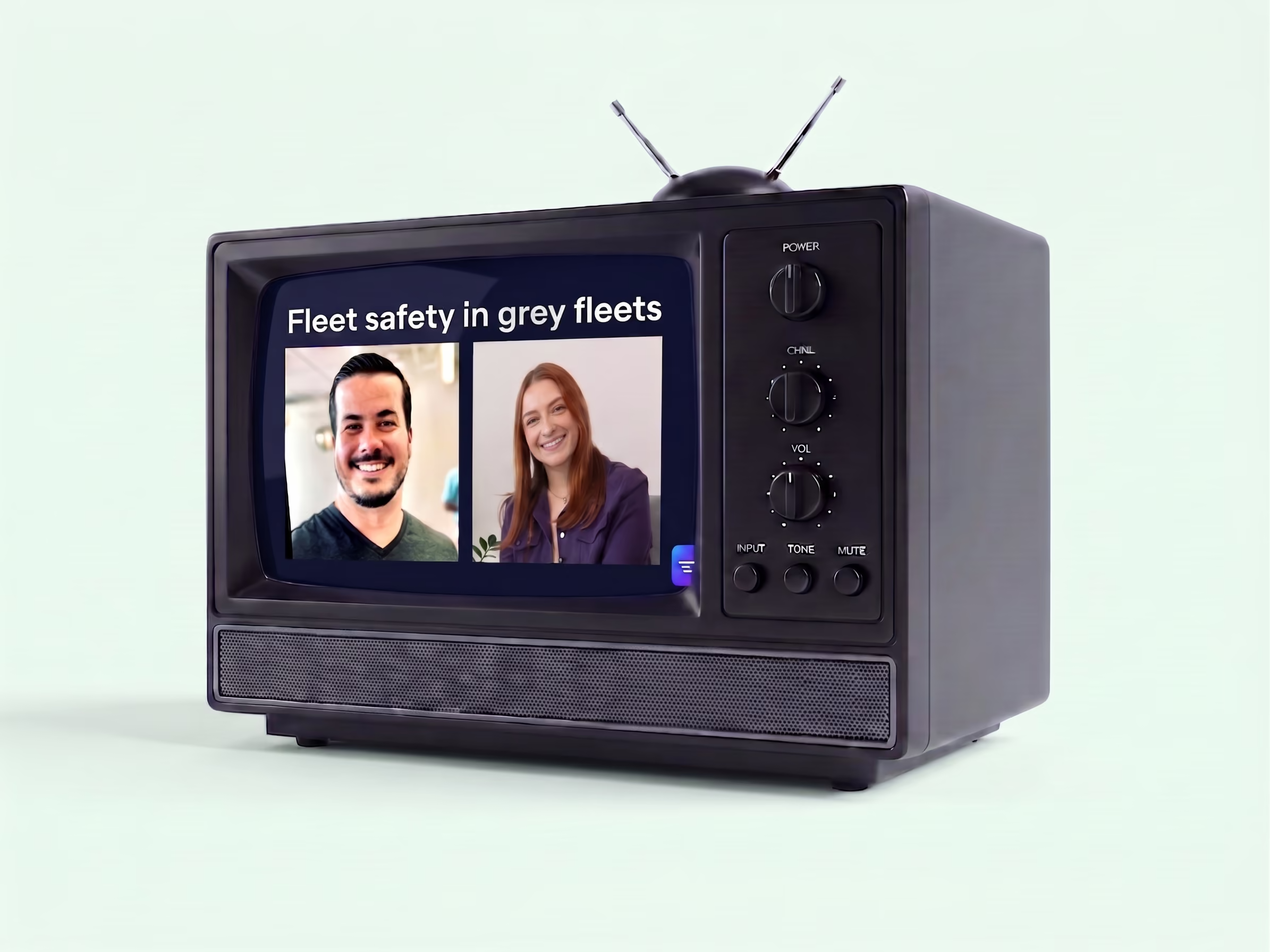
Companies that reimburse employees for driving personal vehicles — often called a "grey fleet" — face the same safety and liability risks as traditional company-owned fleets, but with far less oversight. On this episode of The Keys, Cardata's Lee Adam sat down with Jeff Condrin, Senior Sales Solutions Engineer at Samba Safety, to unpack why grey fleet risk gets overlooked, how continuous Motor Vehicle Record (MVR) monitoring closes the visibility gap, and how pairing monitoring with driver safety training cut violations by 77% in 12 months for organizations that implemented both.
What Is a "Grey Fleet" and Why Does It Matter for Reimbursement Programs?
As more companies shift from owning vehicles to reimbursing employees who drive their own cars — through FAVR (Fixed and Variable Rate), CPM (cents-per-mile), or other vehicle reimbursement models — a new category of risk emerges. Condrin calls this the "grey fleet": employees who drive personal vehicles for work but fall outside the stringent oversight applied to owned or regulated fleets.
Unlike CDL drivers or company-owned vehicles, grey fleet drivers typically:
- Carry personal auto insurance selected for price, not work-related coverage
- Aren't subject to the same hiring or ongoing compliance checks as regulated fleets
- Are often overlooked entirely in a company's risk assessment, simply because driving isn't their primary job function
The Numbers: Why Grey Fleet Risk Is Bigger Than Most Companies Realize
Sales reps, field service technicians, and other high-mileage employees who drive 10,000 to 45,000+ miles per year in personal vehicles represent significant exposure. According to Samba Safety's data:
- 10–15% of drivers in any given fleet will experience one or more infractions in a given year
- Roughly 80% of "invalid license" flags stem from administrative issues (missed court dates, unpaid tickets) rather than dangerous driving — meaning most red flags are resolvable, not terminal
- Organizations that combined continuous monitoring with driver safety training saw a 77% reduction in violations over 12 months
Common Mistakes Companies Make with Fleet Safety
Condrin outlined the most frequent gaps he sees across organizations transitioning to employee-owned vehicle programs:
- No driver safety policy — or one that isn't enforced. A signed policy on file means little if it isn't revisited over time.
- Data without action. Many companies can pull driver risk data but never build a process to act on it.
- Treating grey fleet drivers as lower priority simply because driving isn't their core job function — despite representing a large share of total miles driven on the company's behalf.
MVR Pulls vs. Continuous MVR Monitoring: What's the Difference?
A common misconception is that pulling Motor Vehicle Records annually or quarterly is equivalent to "monitoring." It isn't.
- Annual/biannual MVR pulls provide a snapshot in time — but a lot can happen to a driver's record in between pulls.
- Continuous MVR monitoring connects to all 50 states and automatically flags new violations, suspensions, or license status changes as they happen — closing the visibility gap in real time.
Monitoring is also more cost-effective at scale: rather than paying to pull records for an entire driver population every year, organizations are alerted only when a driver's record actually changes.
How MVR Scoring Works
Because all 50 states use different violation codes and point systems, Samba Safety normalizes this data into a standardized scoring model — creating an apples-to-apples comparison regardless of where a driver is located. Records are typically categorized as:
- Green — low to no risk
- Yellow — within policy, but showing emerging behaviors worth monitoring
- Red — high-risk, requiring immediate review (e.g., invalid license status or major violations like a DUI)
Importantly, a "red" flag doesn't automatically mean termination. Many red flags are administrative and resolvable — giving organizations the data needed to have a productive conversation with the employee rather than a punitive one.
The Role of Driver Safety Training
Monitoring identifies risk; training addresses it. Samba Safety's approach includes three types of training:
- Onboarding training — setting expectations from day one
- Ongoing training — combating the "forgetting curve" through regular refreshers
- Remedial training — targeted, reactive training triggered by a specific violation
Because grey fleet drivers rarely receive any formal "driving for work" training — unlike CDL holders — this layer is especially critical for sales reps, field technicians, and other high-mileage employees driving personal vehicles.
Building a Complete Risk Profile
The biggest gains come from combining data sources rather than viewing them in isolation. When MVR monitoring, safety training, and insurance verification are managed together, organizations get a full picture of fleet risk — from individual drivers up to the organization-wide level — and can act on trends before they become costly claims.
This is where Cardata's partnership with Samba Safety adds value for vehicle reimbursement program administrators: driver data, monitoring, and training all connect through a single onboarding motion, reducing administrative burden while closing safety gaps.
FAQ: Grey Fleet Safety and MVR Monitoring
Do I need to monitor drivers who use personal vehicles occasionally, not full-time?Yes. Risk isn't limited to professional or CDL drivers — any employee who gets behind the wheel for work-related purposes represents exposure that should be monitored.
Is annual MVR pulling enough?Annual pulling is better than nothing, but it leaves a significant visibility gap between checks. Continuous monitoring closes that gap by flagging changes as they occur.
What does a "red" MVR status mean?It typically indicates a major violation (like a DUI) or an invalid license status. However, most invalid-license flags are administrative (unpaid fines, missed court dates) rather than indicators of dangerous driving.
How does this connect to a vehicle reimbursement program?Companies moving from company-owned fleets to reimbursement models (FAVR, CPM) shift liability exposure onto personal vehicles. Pairing a reimbursement program with MVR monitoring, safety training, and insurance verification ensures that cost savings don't come at the expense of safety or compliance.
What results can organizations expect?Companies combining continuous monitoring with driver safety training saw a 77% reduction in violations over 12 months, according to Samba Safety's data.
Interested in how Cardata pairs vehicle reimbursement programs with driver safety solutions powered by Samba Safety? Reach out to learn how to close your organization's gray fleet visibility gap.
Book a Demo