
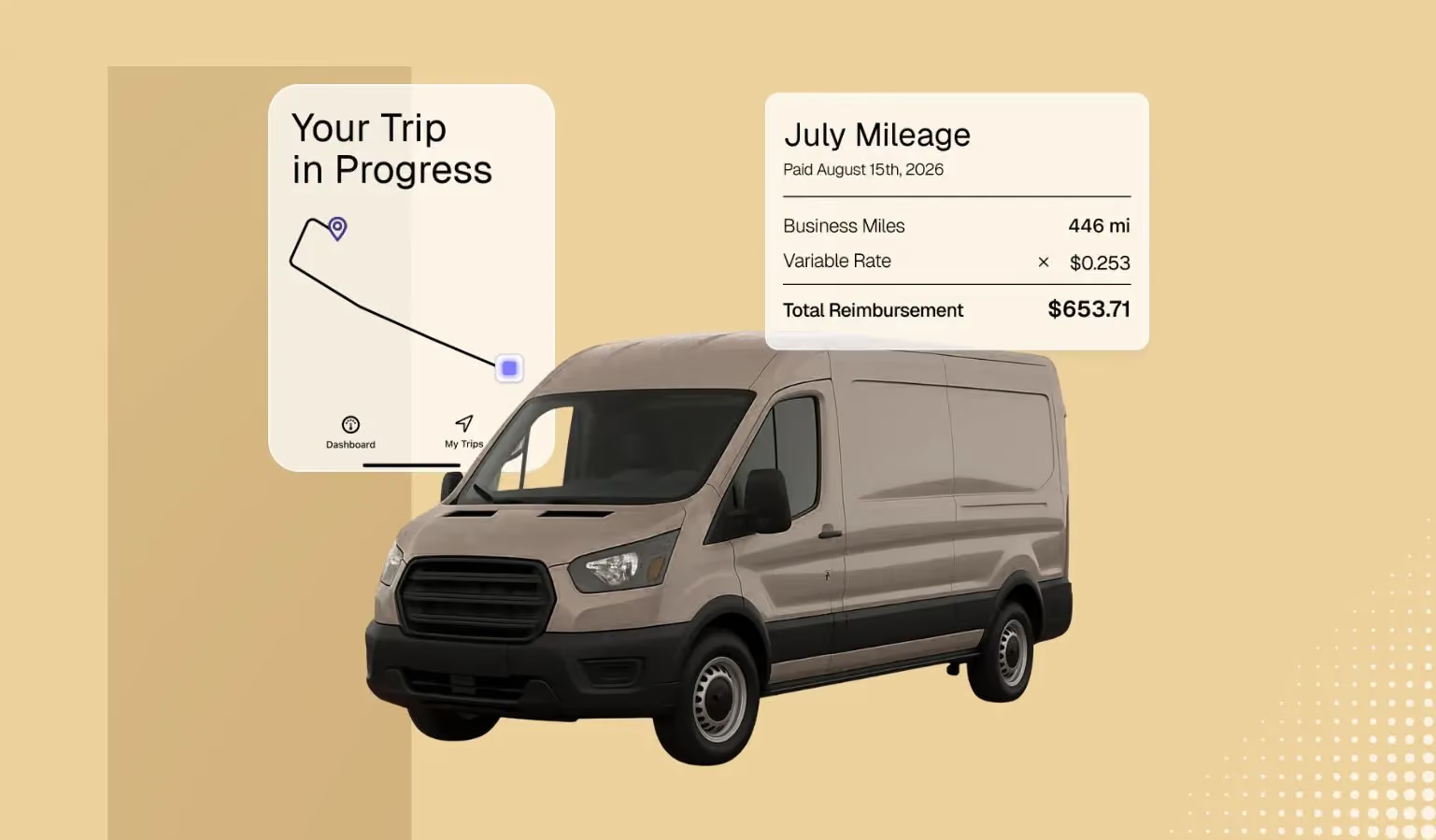
For companies with employees who drive for work, one of the biggest decisions is how to structure the vehicle program.
Do you provide company vehicles? Reimburse employees for using their own cars? Or use a mix of both?
There’s no one-size-fits-all answer. The best approach depends on the type of driving your employees do, the vehicles they need, and what matters most to your finance, HR, and operations teams.
This guide breaks down how fleet programs and vehicle reimbursement programs work in practice, where each one works well, where challenges tend to show up, and how organizations are approaching vehicle strategy today.
How Each Model Works
1. Company Fleet Programs
In a fleet program, the company purchases or leases vehicles and assigns them to employees for work use.
The company is responsible for insurance, maintenance, registration, and eventually replacing or disposing of the vehicles. Many organizations work with fleet management companies (FMCs) to handle procurement, service scheduling, and compliance.
Fleet programs make the most sense when employees need vehicles that aren’t practical to own personally.
Upfitted service vans, heavy equipment vehicles, refrigerated trucks, and vehicles with power take-off systems are good examples. In those situations, company ownership isn’t just a preference, it’s usually a necessity.
Fleet vehicles can also support branding. If having a consistent, professional presence on the road matters, company vehicles can reinforce that in a way personal vehicles can’t.
2. Vehicle Reimbursement Programs
In a vehicle reimbursement program, employees drive their own vehicles for work and receive reimbursement for the business portion of their driving costs. The company doesn’t own or maintain the vehicle. Employees handle insurance, maintenance, and vehicle selection themselves.
There are three main reimbursement structures, each with different levels of accuracy and compliance requirements.
Under an IRS accountable plan, reimbursements may be treated as non-taxable when administered through a compliant accountable plan and supported by documented business mileage.
That’s one of the biggest advantages of a structured reimbursement program compared to a flat taxable car allowance.
What Each Model Actually Costs
Comparing fleet and reimbursement costs is more complicated than it looks at first. A big reason is that fleet costs are spread across multiple categories that often don’t appear together in one report.
1. Fleet: Where Costs Add Up
The most obvious fleet expense is the lease payment or purchase price. But that’s only part of the picture. You also have depreciation, insurance, fuel, maintenance, administrative overhead, vehicle reconditioning, and disposal costs.
Depreciation is especially important. A vehicle starts losing value the moment it leaves the lot, and that decline continues throughout its life. For owned vehicles, that cost sits directly on the balance sheet. For leased vehicles, it’s built into the lease payment.
Commercial auto insurance is often more expensive than personal coverage because fleets typically operate more miles and carry greater liability exposure.
Fleet vehicles tend to drive more miles and operate under tougher conditions, so insurers price policies accordingly.
If employees use fleet vehicles for commuting or personal errands, those miles are covered by the company’s policy too, increasing exposure.
Personal use is another area where costs can creep in. When employees use company vehicles outside of work, that use should either be charged back to the employee or reported as a taxable fringe benefit under IRS rules.
In reality, reported personal use often ends up lower than actual personal use, which can create tax and compliance issues.
2. Reimbursement: Where Costs Are Easier to See
Reimbursement programs are usually easier to manage because costs are tied directly to documented business mileage. The company pays for work-related driving and nothing else.
There’s no depreciation on the balance sheet, no commercial auto insurance premiums, no reconditioning expenses, and no disposal costs.
Administrative work is generally lighter too, focusing on mileage review and compliance rather than vehicle management.
The tax treatment is different as well. A flat car allowance paid through payroll is treated as income and subject to payroll taxes for both the employer and employee.
Under an IRS accountable plan, FAVR and CPM reimbursements are tax-free, which means the same dollars go further for everyone involved.
When Does Fleet Make Sense?
Fleet ownership is the right choice in certain situations. The simplest test is whether the job requires a vehicle an employee couldn’t reasonably own, maintain, or insure themselves.
Construction, emergency services, field service, utility work, and other roles that depend on specialized or upfitted vehicles often fall into this category.
The same goes for organizations where branded vehicles are a genuine operational requirement or where standardized vehicles and centralized maintenance create meaningful efficiencies.
When Reimbursement Makes More Sense
For employees driving standard passenger vehicles for everyday business travel, reimbursement programs often provide a better balance of cost, simplicity, and employee experience.
Standard Business Travel Roles
Sales representatives, regional managers, field consultants, and territory supervisors generally need reliable transportation.
They don’t need specialized vehicles. They simply need to be reimbursed fairly for business driving.
For these roles, reimbursement removes the burden of managing company-owned assets while still providing a fair and transparent payment structure.
Under FAVR, reimbursements reflect an employee’s location and driving profile, so someone in a high-cost market receives a different rate than someone in a lower-cost area. That level of accuracy is difficult to achieve with a traditional fleet arrangement.
Scalability Without Asset Procurement
One of the biggest practical advantages of reimbursement programs is how easily they scale. When you hire more drivers, you add them to the program. There’s no need to purchase or lease additional vehicles.
The same is true when headcount decreases. Removing someone from a reimbursement program is straightforward. Disposing of a company vehicle usually isn’t.
Employee Preference and Satisfaction
Many employees prefer driving their own vehicle because they choose the vehicle, know its history, and are already familiar with its operation.
When reimbursements are structured fairly, employees also tend to view the program as more transparent.
They can see how payments are calculated, which often builds more trust than receiving a company vehicle with a long list of rules attached.
Reimbursement programs can also improve consistency by tying payments to documented business use rather than providing the same benefit regardless of how much an employee drives.
For organizations with employees who have different territories, mileage patterns, or travel requirements, that can create a stronger sense of fairness across the workforce.
The Mixed Model: Matching the Program to the Role
Most organizations don’t need to choose between fleet and reimbursement as a company-wide policy. In many cases, the better approach is matching the program to the role.
A field service company might keep company vans for technicians while putting sales representatives on FAVR. An HVAC company might own upfitted service vehicles while reimbursing account managers through CPM.
This kind of segmented approach allows organizations to use fleet ownership where it truly adds value instead of applying it across every driving role.
If you’re evaluating a mixed model, a few questions can help determine which program fits each role:
- Does the role require a vehicle the employee couldn’t reasonably own or maintain themselves?
- Is there a specialized upfit, equipment configuration, or commercial requirement that makes company ownership necessary?
- Is branded vehicle presence genuinely required for the role, or is it simply preferred?
- How many miles does the employee drive each year, and how consistent is that mileage?
- What does it cost to manage the vehicle as a company asset compared with reimbursing business use?
When the answers point to operational necessity, fleet ownership is usually the right choice. When they point to standard business travel in a standard vehicle, reimbursement is often the better fit.
A Note on Tax Treatment
Tax treatment is one of the most important differences between fleet programs and reimbursement programs.
In a fleet program, employees who use company vehicles for personal purposes must either pay a personal-use chargeback or have that value reported as taxable income on their W-2. Tracking and reporting this accurately requires ongoing recordkeeping and adds administrative work.
Flat car allowances, even when they’re described as reimbursements, are generally treated as taxable wages by the IRS. That means payroll taxes apply to both the employer and employee, increasing costs and reducing what employees take home.
Under an IRS accountable plan, properly structured reimbursement programs—including FAVR, CPM, and TFCA—can be fully tax-free as long as payments are tied to documented business mileage and the plan meets IRS substantiation requirements.
For many organizations, that’s one of the strongest financial reasons to move away from a taxable allowance or an unmanaged fleet.
How Organizations Are Approaching This Today
Vehicle program strategy has changed quite a bit over the last several years. Rising insurance costs, higher vehicle prices, and fuel volatility have made the true cost of fleet ownership harder to ignore.
At the same time, improvements in mileage tracking technology have made reimbursement programs much easier to manage accurately.
Many organizations are taking a fresh look at whether their fleet still reflects actual operational needs. For some, the answer is yes. Their employees need specialized vehicles that can’t be replaced with a reimbursement model.
For others, the fleet has expanded over time and now includes roles that could be handled just as effectively through reimbursement.
The organizations getting the best results tend to approach the decision role by role rather than treating it as a company-wide policy.
Fleet where it’s necessary. Reimbursement where it’s enough.
Talk to Cardata


.avif)
.jpg)
