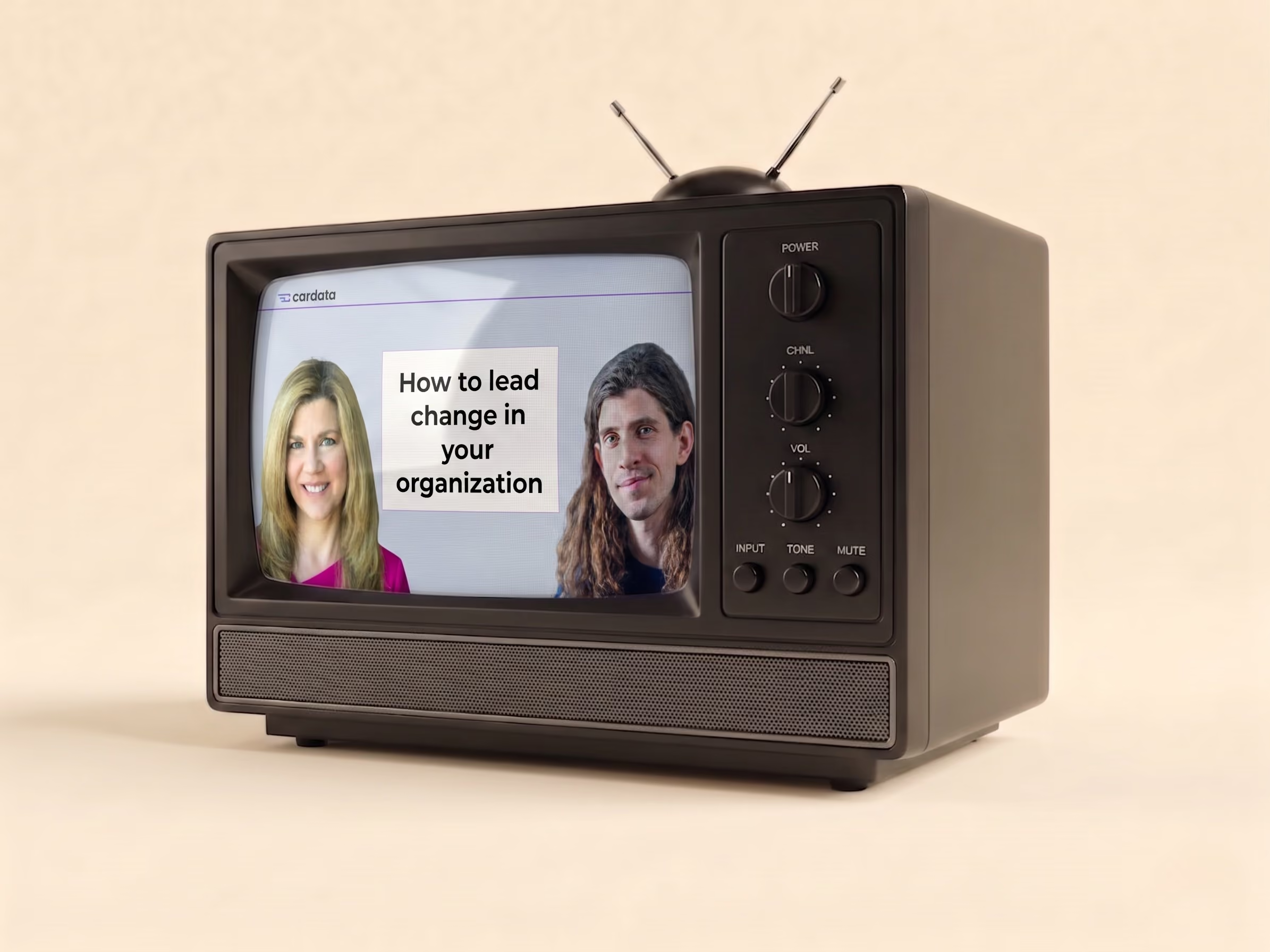
Change is accelerating across every workplace — driven by AI, shifting employee expectations, and a post-pandemic redefinition of flexibility. On this episode of The Keys, Cardata's Torbin spoke with HR keynote speaker and change leadership expert Jennifer McClure about why people resist change, how to build trust before you ask employees to adapt, and why change leadership is now a core career skill rather than a soft nice-to-have.
Is Change Really Accelerating, or Does It Just Feel That Way?
McClure's answer is nuanced: the pace of technological change has always been constant, but what's genuinely different now is the sheer volume and availability of options. Leaders today are bombarded with new platforms, tools, and AI-driven solutions — often before they've even identified the problem those tools are meant to solve.
Her recommendation for leaders feeling overwhelmed by the noise: get clear on what you're actually trying to accomplish before searching for a technology solution, rather than the other way around.
The Pandemic Didn't Just Change Where We Work — It Changed What Employees Expect
McClure points out that the pandemic conversation has largely shifted from "remote vs. in-office" to something bigger: flexibility as a baseline expectation, even for frontline and hourly workers who need to pick up a sick kid or attend a doctor's appointment.
She traces this shift across generations — from her parents' era of pensions and "golden handcuffs" that kept people in one job for decades, through the erosion of traditional retirement benefits, to a workforce that increasingly asks: what's the mutual value in this relationship? Employees no longer default to gratitude for simply having a job; they expect a two-way partnership.
Why People Resist Change (and Why That's Normal)
Resistance to change isn't irrational — McClure frames it as a natural protective instinct. People resist because:
- Change threatens what they've earned — status, comfort, expertise built over years
- Change is genuinely hard, and things often break during the transition
- The full ripple effects are rarely mapped out in advance — a change designed to solve one problem can create unintended consequences for customers, other departments, or the broader workforce
Her practical antidote: premortem thinking — deliberately mapping out what could go wrong before launching a change, rather than only planning for the best-case scenario.
A Cautionary Tale: When "New Technology" Meets Deep Resistance
McClure shares a story from early in her career: convincing a 28-year veteran recruiting director to post a single job on an early job board instead of the newspaper. The director technically complied — but printed and stapled every single online résumé, because that was the only workflow she trusted. "I'm never posting a job online again," she said, missing the point entirely.
The lesson generalizes well beyond recruiting: new technology adopted with old habits and workflows delivers none of its value. Leaders introducing new tools — whether an ATS, a CRM, or a mileage and expense platform — need to walk people through why the new process works differently, not just swap the interface and expect old habits to translate.
AI Adoption: Curiosity Over Fear
McClure pushes back on all-or-nothing AI narratives. Her framing: most leaders already use AI daily without realizing it, embedded in tools they've used for years. The healthier posture is curiosity, not fear — she describes herself as a "late early adopter," someone who lets others test new tools first, then adopts once real-world use cases emerge.
Her guidance for leaders approaching AI:
- Experiment personally before mandating anything organization-wide
- Reframe AI as time-freeing, not job-replacing — job boards didn't eliminate recruiters; they changed what recruiters spent their time on
- Don't over-automate the human element. Keep a path to a real person available, even as routine questions get handled by self-service tools
The Skills Every Leader Needs Now
Drawing on industry research (including DDI's annual leadership survey), McClure highlights the skills rising fastest in importance for leaders navigating constant change:
- Empathy — identified as the number one trait leaders need to develop, and one that can be built like a muscle even if it doesn't come naturally
- Change management and change leadership — the ability to cast a vision, communicate a plan, and prepare for what might go wrong
- Communication across distributed teams — leading people you may rarely or never meet in person
- Digital fluency — comfort adopting new tools and workflows without needing to fully replicate old habits inside them
What Happens When a Change Initiative Fails
Failure, in McClure's view, isn't the real risk — dishonesty about failure is. The change leadership failures she's seen most often come from leaders who:
- Blame employees for a failed rollout instead of evaluating what actually went wrong
- Withhold information because they assume people "can't handle it"
- Push forward with a failing plan rather than transparently pivoting
Her framework for handling failure well: be transparent about what happened, take responsibility, communicate what will change as a result, and — where possible — make people whole. Trust, once broken by a leader who's been caught concealing or misrepresenting information, is very difficult to rebuild.
A Real-World Case Study: Employee Engagement During the Pandemic
McClure cites Gallup's employee engagement tracking data as a striking real-world experiment in change leadership. Engagement had hovered in the high-20s to low-30s (percent) for roughly 20 years — until April 2020, when it spiked as leaders shifted to daily communication, transparency about what they did and didn't know, and visible personal check-ins.
By September 2020, engagement had dropped again — not because the pandemic had improved, but because that same intensity of communication had quietly stopped. The takeaway: engagement rises and falls with visible, consistent leadership communication, not with the severity of circumstances alone.
Why HR Should Be in Every Change Conversation
McClure argues that HR leaders should insist on a seat in any organizational change initiative — not to list what can't be done, but to help shape how a change gets implemented responsibly. Her reframe: instead of walking into a room and saying "you can't do that," effective HR leaders say "here's my concern, and here's how we can meet your objective while addressing it."
Her broader point: every organizational change is ultimately a change for the people doing the work. If HR isn't in the room, the human impact of that change is being overlooked.
FAQ: Change Leadership and Managing Workplace Change
Why do employees resist change, even when it's meant to help them?Resistance is a natural protective response — people are guarding what they've earned (status, comfort, expertise) and reacting to the very real risk that new processes will break something or create consequences that weren't fully planned for.
What is "premortem thinking" in change management?It's the practice of proactively identifying what could go wrong with a planned change before implementing it, rather than only planning for success. This allows leaders to prepare mitigations in advance.
Is change leadership a distinct skill from change management?Yes. Change management is largely about communication strategy — identifying stakeholders, messaging, and logistics. Change leadership is about casting the broader vision and getting people to willingly come along with it.
How should leaders introduce new technology to resistant employees?Beyond simply rolling out the tool, leaders need to explain why the new process is different, demonstrate the benefit in terms the employee cares about, and avoid letting people revert to old manual workflows layered on top of new tools.
Should HR be involved in non-HR organizational changes?Yes. Any change that affects people — which is nearly every organizational change — benefits from HR's involvement in shaping communication, retraining, and impact planning, rather than being looped in only after decisions are finalized.
Change is constant for field teams too — from new mileage capture technology to evolving vehicle reimbursement programs. Reach out to Cardata to learn how thoughtful rollout and change management can improve adoption of tools your team actually uses.
Book a Demo